Archive for the “Science” Category
By Alan Siddons
Insulated by an outer crust, the surface of the earth acquires nearly all of its heat from the sun. The only exit for this heat to take is through a door marked “Radiation.” And therein lies a tale…
Recently, I chanced upon an Atmospheric Science Educator Guide [PDF] published by NASA. Aimed at students in grades 5 through 8, it helps teachers explain how so-called “greenhouse gases” warm our planet Earth.
These guides are interesting on a number of levels, so I recommend that you look them over. But what caught my eye was this:
- Question: Do all of the gases in our atmosphere absorb heat?
- Answer: (Allow students to discuss their ideas. Don’t provide the answer at this time.)
Indeed, that’s a good one to think over yourself. Almost all of what we’re breathing is nitrogen and oxygen — do these gases absorb heat? Lakes and rocks absorb heat, after all, and thereby reach a higher temperature. So can nitrogen and oxygen molecules do the same?
Well, I won’t keep you hanging. After allowing students to discuss it, the instructor is instructed to give them the final verdict.
- Answer: No. Only some gases have the unique property of being able to absorb heat.
These are the infrared-absorbing “greenhouse gases,” of course, substances like carbon dioxide water vapor, and not nitrogen and oxygen.
Now, is something wrong here? Most definitely, for NASA has a finger on the scale. Let’s review a few basics that NASA should have outlined.
Read the rest of this article at the American Thinker.
55 Comments »
A paper published in Geophysical Research Letters finds no statistically significant increase in the airborne proportion of anthropogenic carbon dioxide over the past 150 years. Being that climate scientists like those from the Climactic Research Unit at Hadley and alarmist members of the UN’s Intergovernmental Panel on Climate Change (IPCC) claims that increased CO2 is to blame for warming patterns over the past several decades and that the warming will soon accelerate out of control, due to an inability of the ecosystem to cope with increased CO2 emissions, this research poses a problem. How can carbon dioxide be causing warming if the level of CO2 in the atmosphere has not actually been on the rise?
We know that mankind does produce and emit a relatively small (compared to naturally occurring CO2) amount of CO2 and industrialization has increased our overall CO2 emissions, but now it seems that it hasn’t mattered. The earth’s natural mechanisms have effectively dealt with the increase. Vegetation, like forests and ocean algae, of course thrive on CO2 and convert it into Oxygen.
A December 31st article in Science Daily noted, “Most of the carbon dioxide emitted by human activity does not remain in the atmosphere, but is instead absorbed by the oceans and terrestrial ecosystems.”
Despite the new evidence that CO2 cannot have been responsible for the recent reported warming (that ended around 1999), the warmists are undeterred. The article goes on to say, “However, some studies have suggested that the ability of oceans and plants to absorb carbon dioxide recently may have begun to decline and that the airborne fraction of anthropogenic carbon dioxide emissions is therefore beginning to increase.
“Many climate models also assume that the airborne fraction will increase. Because understanding of the airborne fraction of carbon dioxide is important for predicting future climate change, it is essential to have accurate knowledge of whether that fraction is changing or will change as emissions increase.”
So, the new line may well be: Even though it hasn’t happened at all yet, future increases in atmospheric carbon dioxide will cause global warming, because we’re on the verge of maxing out the earth’s ability to absorb CO2.
It seems the climate models may now rely on predicting a heretofore unobserved increase in anthropogenic carbon dioxide in the atmosphere in order to predict future CO2-driven global warming, even though (despite earlier claims) neither has actually been observed.
Every claim of the warmists has been disproven. Not a single catastrophic prediction has come to pass. They insist the science is settled and the debate is over but science is based on observation and duplicable results. Observation shows no CO2-induced warming and the CRU’s climate models haven’t produced one accurate result, let a lone a duplicate. The warmists it seems, will unabashedly stretch to any length to try to maintain their dreams of carbon-based economic control, but the thing about stretching something is that it also grows thin.
Abstract: Is the airborne fraction of anthropogenic CO2 emissions increasing?
Science Daily: No Rise of Airborne Fraction of Carbon Dioxide in Past 150 Years, New Research Finds
27 Comments »
His Excellency Ban Ki Moon
Secretary-General, United Nations
New York, NY
United States of America
8 December 2009
Dear Secretary-General,
Climate change science is in a period of ‘negative discovery’ - the more we learn about this exceptionally complex and rapidly evolving field the more we realize how little we know. Truly, the science is NOT settled.
Therefore, there is no sound reason to impose expensive and restrictive public policy decisions on the peoples of the Earth without first providing convincing evidence that human activities are causing dangerous climate change beyond that resulting from natural causes. Before any precipitate action is taken, we must have solid observational data demonstrating that recent changes in climate differ substantially from changes observed in the past and are well in excess of normal variations caused by solar cycles, ocean currents, changes in the Earth’s orbital parameters and other natural phenomena.
We the undersigned, being qualified in climate-related scientific disciplines, challenge the UNFCCC and supporters of the United Nations Climate Change Conference to produce convincing OBSERVATIONAL EVIDENCE for their claims of dangerous human-caused global warming and other changes in climate. Projections of possible future scenarios from unproven computer models of climate are not acceptable substitutes for real world data obtained through unbiased and rigorous scientific investigation.
Specifically, we challenge supporters of the hypothesis of dangerous human-caused climate change to demonstrate that:
1.Variations in global climate in the last hundred years are significantly outside the natural range experienced in previous centuries;
2.Humanity’s emissions of carbon dioxide and other ‘greenhouse gases’ (GHG) are having a dangerous impact on global climate;
3.Computer-based models can meaningfully replicate the impact of all of the natural factors that may significantly influence climate;
4.Sea levels are rising dangerously at a rate that has accelerated with increasing human GHG emissions, thereby threatening small islands and coastal communities;
5.The incidence of malaria is increasing due to recent climate changes;
6.Human society and natural ecosystems cannot adapt to foreseeable climate change as they have done in the past;
7.Worldwide glacier retreat, and sea ice melting in Polar Regions , is unusual and related to increases in human GHG emissions;
8.Polar bears and other Arctic and Antarctic wildlife are unable to adapt to anticipated local climate change effects, independent of the causes of those changes;
9.Hurricanes, other tropical cyclones and associated extreme weather events are increasing in severity and frequency;
10.Data recorded by ground-based stations are a reliable indicator of surface temperature trends.
It is not the responsibility of ‘climate realist’ scientists to prove that dangerous human-caused climate change is not happening. Rather, it is those who propose that it is, and promote the allocation of massive investments to solve the supposed ‘problem’, who have the obligation to convincingly demonstrate that recent climate change is not of mostly natural origin and, if we do nothing, catastrophic change will ensue. To date, this they have utterly failed to do so.
Signed by:
1.Habibullo I. Abdussamatov, Dr. Sci., mathematician and astrophysicist, Head of the Russian-Ukrainian Astrometria project on the board of the Russian segment of the ISS, Head of Space Research Laboratory at the Pulkovo Observatory of the Russian Academy of Sciences, St. Petersburg, Russia
2.Göran Ahlgren, docent organisk kemi, general secretary of the Stockholm Initiative, Professor of Organic Chemistry, Stockholm, Sweden
3.Syun-Ichi Akasofu, PhD, Professor of Physics, Emeritus and Founding Director, International Arctic Research Center of the University of Alaska, Fairbanks, Alaska, U.S.A.
4.J.R. Alexander, Professor Emeritus, Dept. of Civil Engineering, University of Pretoria, South Africa; Member, UN Scientific and Technical Committee on Natural Disasters, 1994-2000, Pretoria, South Africa.
5.Jock Allison, PhD, ONZM, formerly Ministry of Agriculture Regional Research Director, Dunedin, New Zealand
Read the rest of this entry »
10 Comments »
By Investors Business Daily Editorial Board
For two years, our space agency has refused Freedom of Information requests on why it has repeatedly corrected its climate figures. A leading researcher threatens to sue to find more inconvenient truths.
What’s become known as “Climate-Gate” may be about to explode on this side of the pond as well. Chris Horner, a senior fellow at the Competitive Enterprise Institute, has threatened a lawsuit against NASA if by year-end the agency doesn’t honor his FOI requests for information on how and why its climate numbers have been consistently adjusted for errors.
“I assume that what is there is highly damaging,” says Horner, who suspects, based on the public record, the same type of data fudging, manipulation and suppression that has occurred at Britain’s East Anglia Climate Research Unit. “These guys (NASA) are quite clearly determined not to reveal their internal discussions about this.”
They may have good reason. NASA was caught with its thermometers down when James Hansen, head of NASA’s Goddard Institute for Space Studies, announced that 1998 was the country’s hottest year on record, with 2006 the third hottest.
NASA and Goddard were forced to correct the record in 2007 to show that 1934, decades before the advent of the SUV, was in fact the warmest. In fact, the new numbers showed that four of the country’s 10 warmest years were in the 1930s.
Hansen, who began the climate scare some two decades ago, was caught fudging the numbers again in declaring October 2008 the warmest on record. This despite the fact that the National Oceanic and Atmospheric Administration had registered 63 local snowfall records and 115 lowest-ever temperatures for the month, and ranked it as only the 70th-warmest October in 114 years.
Scores of temperature records from Russia and elsewhere were not based on that October’s readings at all. Figures from the previous month had simply been carried over and repeated two months running. Was Hansen, like his CRU counterpart Michael Mann, trying to “hide the decline” in temperatures?
Read the rest of this piece at Investors Business Daily.
19 Comments »
The world cannot trust scientists who abuse their power
By Gordon Crovitz
For anyone who doubts the power of the Internet to shine light on darkness, the news of the month is how digital technology helped uncover a secretive group of scientists who suppressed data, froze others out of the debate, and flouted freedom-of-information laws. Their behavior was brought to light when more than 1,000 emails,and some 3,500 additional files were published online, many of which boasted about how they suppressed hard questions about their data.
The emails, released by an apparent whistle-blower who used the name “FOI,” were written by scientists at the Climate Research Unit of the University of East Anglia in England. Its scientists are high-profile campaigners for the theory of global warming.
The findings from East Anglia have been at the core of policy reports by the U.N.’s Intergovernmental Panel on Climate Change. The IPCC does not do its own research but compiles information relating to climate change. It has declared the evidence that the globe is warming to be “unequivocal,” a claim routinely cited by lawmakers in the U.S. and elsewhere as authoritative.
The IPCC stresses honest science. According to its Web site, its goal is to “assess on a comprehensive, objective, open and transparent basis the scientific, technical and socio-economic information relevant to understanding the scientific basis of risk of human-induced climate change, its potential impacts and options for adaptation and mitigation.”
The panel, which shared the 2007 Nobel Peace Prize with Al Gore, now faces the inconvenient truth that it relied on scientists who violated scientific process. In one email, the Climate Research Unit’s director, Phil Jones, wrote Michael Mann of Pennsylvania State University, promising to spike studies that cast doubt on the relationship between human activity and global warming. “I can’t see either of these papers being in the next IPCC report,” he said. He pledged to “keep them out somehow—even if we have to redefine what the peer-review literature is!”
In another email exhange, Mr. Mann wrote to Mr. Jones: “This was the danger of always criticizing the skeptics for not publishing in the ‘peer-reviewed literature.’ Obviously, they found a solution to that—take over a journal! So what do we do about this? I think we have to stop considering ‘Climate Research’ as a legitimate peer-reviewed journal. Perhaps we should encourage our colleagues in the climate research community to no longer submit to, or cite papers in, this journal.”
Other emails include one in which Keith Briffa of the Climate Research Unit told Mr. Mann that “I tried hard to balance the needs of the science and the IPCC, which were not always the same,” and in which Mr. Jones said he had employed Mr. Mann’s “trick” to “hide the decline” in temperatures. A May 2008 email from Mr. Jones with the subject line “IPCC & FOI” asked recipients to “delete any emails you may have had” about data submitted for an IPCC report. The British Freedom of Information Act makes it a crime to delete material subject to an FOI request; such a request had been made earlier that month.
Over the weekend, East Anglia officials disclosed they had disposed years ago of the historic weather data underlying their analysis. This may be one reason they’ve fought information requests. They say they’ll release the data they still have some time next year.
Read the rest of this piece at Wall Street Journal.
15 Comments »
By Hannah Devlin
Alarming predictions that climate change will lead to the extinction of hundreds of species may be exaggerated, according to Oxford scientists.
They say that many biodiversity forecasts have not taken into account the complexities of the landscape and frequently underestimate the ability of plants and animals to adapt to changes in their environment.
“The evidence of climate change-driven extinctions have really been overplayed,” said Professor Kathy Willis, a long-term ecologist at the University of Oxford and lead author of the article.
Professor Willis warned that alarmist reports were leading to ill-founded biodiversity policies in government and some major conservation groups. She said that climate change has become a “buzz word” that is taking priority while, in practice, changes in human use of land have a greater impact on the survival of species. “I’m certainly not a climate change denier, far from it, but we have to have sound policies for managing our ecosystems,” she said.
The International Union for the Conservation of Nature backed the article, saying that climate change is “far from the number-one threat” to the survival of most species. “There are so many other immediate threats that, by the time climate change really kicks in, many species will not exist any more,” said Jean Christophe Vie, deputy head of the IUCN species program, which is responsible for compiling the international Redlist of endangered species.
He listed hunting, overfishing, and destruction of habitat by humans as more critical for the majority of species.
However, the Royal Society for the Protection of Birds disagreed, saying that climate change was the single biggest threat to biodiversity on the planet. “There’s an absolutely undeniable affect that’s happening now,” said John Clare, an RSPB spokesman. “There have been huge declines in British sea birds.”
The article, published today in the journal Science, reviews recent research on climate change and biodiversity, arguing that many simulations are not sufficiently detailed to give accurate predictions.
In particular, the landscape is often described at very low resolution, not taking into account finer variations in vegetation and altitude that are vital predictors for biodiversity.
Read the rest of this article at Times Online.
30 Comments »
By Robert Ferguson
The Senate testimony of Sec. Chu is predicated upon false assumptions, points out Christopher Monckton in a succinct letter to Senators posted by the Science and Public Policy Institute [SPPI], a Washington DC –based NGO.
The letter points out that Chu’s testimony cites the now-outdated 2007 Climate Assessment Report of the IPCC and a subsequent but also now-outdated MIT study, saying global warming by 2100 would be 7-11 Fº. “These excessive estimates are founded solely on computerized guesswork,” says Christopher Monckton, former adviser to UK Prime Minister Thatcher and current SPPI policy adviser.
Monckton reviews a number of recent papers having appeared in the peer-reviewed literature that put the man-made warming scare to rest, and render regulation of CO2 emissions needless and blindingly fatuous.
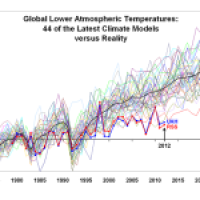
Particular attention is given to the recent paper of Lindzen and Choi (2009). Using direct measurements of outgoing radiation, the two researchers found that the IPCC models get both the science and their “predictions” wrong. Monckton presents a series of IPPC model graphs and compares them to the one produced from real measurements. “The IPPC model predictions,” reports Monckton, “actually trend in a direction opposite to that of the graph from observed reality.”
Concludes Monckton, “By patient, painstaking measurement, the two researchers have trumped the computer models’ unanimously erroneous guesswork, and have definitively ended the debate over the question how much warming CO2 causes. Therefore, Secretary Chu’s declaration that the ‘threat’ from ‘climate change’ is ‘grave’ and that current levels of CO2 emission are ‘unsustainable’ has no scientific justification.”
Read the rest of this article at Wooeb News.
Read Lord Monckton’s letter here.
37 Comments »
A newly released scientific study published by MIT climate scientist Richard Lindzen has the potential of destroying one of the fundamental underpinnings of global warming theorists. The study collected 15-years of long wave radiation measurements from a satellite orbiting the earth. The study correlates the change in the earth’s surface temperature with the change in outgoing long wave radiation. Lindzen’s study shows that as the earth warms, the amount of radiation being bounced-back into outer space actually increases. This is exactly the opposite result that is assumed to occur in the UN climate models. The UN models predict that more radiation is trapped in the earth’s atmosphere as the temperature rises. Lindzen’s findings blow a hole a mile-wide in the arguments used by global warming evangelists.
Read more about Lindzin’s study here.
47 Comments »
|