Al Gore’s defense of global-warming hysteria in Sunday’s New York Times has many flaws, but I’ll focus on just one whopper — where the “Inconvenient Truth” man states the opposite of scientific fact.Gore wrote, “The heavy snowfalls this month have been used as fodder for ridicule by those who argue that global warming is a myth, yet scientists have long pointed out that warmer global temperatures have been increasing the rate of evaporation from the oceans, putting significantly more moisture into the atmosphere — thus causing heavier downfalls of both rain and snow in particular regions, including the Northeastern United States.”
It’s an interesting theory, but where are the facts?
According to “State of the Climate” from the National Oceanic and Atmospheric Administration, “Global precipitation in 2009 was near the 1961-1990 average.” And there was certainly no pattern of increasing rain and snow on America’s East Coast during the post-1976 years, when NOAA says the globe began to heat up.
Insulated by an outer crust, the surface of the earth acquires nearly all of its heat from the sun. The only exit for this heat to take is through a door marked “Radiation.” And therein lies a tale…
Recently, I chanced upon an Atmospheric Science Educator Guide [PDF] published by NASA. Aimed at students in grades 5 through 8, it helps teachers explain how so-called “greenhouse gases” warm our planet Earth.
These guides are interesting on a number of levels, so I recommend that you look them over. But what caught my eye was this:
Question: Do all of the gases in our atmosphere absorb heat?
Answer: (Allow students to discuss their ideas. Don’t provide the answer at this time.)
Indeed, that’s a good one to think over yourself. Almost all of what we’re breathing is nitrogen and oxygen — do these gases absorb heat? Lakes and rocks absorb heat, after all, and thereby reach a higher temperature. So can nitrogen and oxygen molecules do the same?
Well, I won’t keep you hanging. After allowing students to discuss it, the instructor is instructed to give them the final verdict.
Answer: No. Only some gases have the unique property of being able to absorb heat.
These are the infrared-absorbing “greenhouse gases,” of course, substances like carbon dioxide water vapor, and not nitrogen and oxygen.
Now, is something wrong here? Most definitely, for NASA has a finger on the scale. Let’s review a few basics that NASA should have outlined.
The Minority Staff of the Senate Committee on Environment and Public Works released a report today titled, “‘Consensus’ Exposed: The CRU Controversy.” The report covers the controversy surrounding emails and documents released from the University of East Anglia’s Climatic Research Unit (CRU). It examines the extent to which those emails and documents affect the scientific work of the UN’s IPCC, and how revelations of the IPCC’s flawed science impacts the EPA’s endangerment finding for greenhouse gases.
The report finds that some of the scientists involved in the CRU controversy violated ethical principles governing taxpayer-funded research and possibly federal laws. In addition, the Minority Staff believes the emails and accompanying documents seriously compromise the IPCC-based “consensus” and its central conclusion that anthropogenic emissions are inexorably leading to environmental catastrophes.
In its examination of the controversy, the Minority Staff found that the scientists:
Obstructed release of damaging data and information;
Manipulated data to reach preconceived conclusions;
Colluded to pressure journal editors who published work questioning the climate science “consensus”; and
Assumed activist roles to influence the political process.
Considered the climate Bible by governments around the world, the UN’s Intergovernmental Panel on Climate Change (IPCC) report is meant to be a scientific analysis of the most authoritative research.
Instead, it references literature generated by Greenpeace - an organization known more for headline-grabbing publicity stunts than sober-minded analysis. (Eight IPCC-cited Greenpeace publications are listed at the bottom of this post.)
In one section of this Nobel-winning report, climate change is linked to coral reef degradation. The sole source for this claim? A Greenpeace report titled “Pacific in Peril“ (see Hoegh-Guldberg below). Here the report relies on a Greenpeace document to establish the lower-end of an estimate involving solar power plants (Aringhoff).
When discussing solar energy elsewhere, the report references two Greenpeace documents in one sentence. Here it uses a Greenpeace paper as its sole means of documenting where the “main wind-energy investments” are located globally (Wind).
On this page, the report notes that while some research suggests wind power will generate between three and five percent of global electricity by 2030, a more optimistic forecast places this number at 29%. The six times more favorable estimate comes from GWEC, 2006 - a 60-page, photo-rich report co-authored by Greenpeace and the Global Wind Energy Council. (The latter describes itself as “the global wind industry trade association.”) In fairness to the IPCC, even it rejectedGreenpeace’s numbers, choosing instead to use 7% in its analysis.
Confidence Melting Away: Doubts Grow in Climate Change Debate
By Gerald Traufetter
The Siachen Glacier is home to the world’s highest crisis region. Here, at 6,000 meters (19,680 feet) above sea level, Indian and Pakistani soldiers face off, ensconced in heavily armed positions.
The ongoing border dispute between the two nuclear powers has already claimed the lives of 4,000 men — most of them having died of exposure to the cold.
Now the Himalayan glacier is also at the center of a scientific dispute. In its current report, the Intergovernmental Panel on Climate Change (IPCC) predicts that the glacier, which is 71 kilometers (44 miles) long, could disappear by 2035. It also predicts that the other 45,000 glaciers in the world’s highest mountain range will be virtually gone by then, with drastic consequences for billions of people in Asia, whose life depends on water that originates in the Himalayas. The IPCC report led environmental activists to sound the alarm about a drama that could be unfolding at the “world’s third pole.”
“This prognosis is, of course, complete nonsense,” says John Shroder, a geologist and expert on glaciers at the University of Nebraska in Omaha. The results of his research tell a completely different story.
For the past three decades, the US glaciologist has been traversing the majestic mountains of the Himalayan region, particularly the Karakorum Range, with his measuring instruments. The discoveries he has made along the way are not consistent with the assessment long held by the IPCC. “While many glaciers are shrinking, others are stable and some are even growing,” says Shroder.
Untenable Claim
The gaffe over the Himalayan glaciers has triggered an outcry in the world of climatology. Some are already using the word “Glaciergate” in reference to the scandal over a scientifically untenable claim in the fourth IPCC assessment report, which the UN climate body publishes every five years. The fourth assessment report was originally published in 2007. Last week, the IPCC withdrew the erroneous claim and apologized for the error.
German Environment Minister Norbert Röttgen, a member of the center-right Christian Democratic Union (CDU), is also upset about the incident. “The error in the IPCC report is serious and should not have happened,” Röttgen told SPIEGEL. “Scientific accuracy is a vital condition to support the credibility of the political conclusions we draw as a result.” Although the minister still has confidence in the overall validity of the IPCC report, he wants to see “a thorough investigation into how the error originated and was communicated.”
But why wasn’t this clearly nonsensical claim noticed long ago by at least one of the 3,000 scientists who contributed to the IPCC report? “What’s really amazing is that such a blunder remained uncorrected for so long,” says Shroder.
As Global Warming Movement Collapses, Activists Already ‘Test-Marketing’ the Next Eco-Fear! ‘Laughing Gas’ Crisis? Oxygen Crisis? Plastics?
Global Warming Being Thrown Under the Bus as New Replacement Environmental Scare is Sought
By Marc Morano
As the man-made global warming fear movement collapses and the climate establishment lay in a Climategate ridden tatters, many are asking what next? (For latest on climate movement’s demise go to www.ClimateDepot.com)
As man-made global warming fears enter the ashbin of history, what will environmentalists, UN activists and politicians do to fill the void of a failed eco-scare?
Well, wonder no more….
Some forward thinking green activists and even the UN climate Chief have already taken up the task of test-marketing the next eco-scares to replace man-made global warming.
As man-made climate fears subside and the scientific, economic, cultural and political case evaporates for climate change “action,” expect more and more green activists to take up the mantle for “laughing gas” as a possible replacement eco-scare.
See also: Laughing Gas Knocks Out CO2 - By Doug Hoffman - Oct. 30, 2009 - Excerpt: “In the face of ever mounting evidence that CO2 is incapable of causing the level of global devastation prophesied by climate change catastrophists a new villain is being sought. The leading candidate is nitrous oxide (N2O), better known as laughing gas. A report in Science claims that N2O emissions are currently the single most important cause of ozone depletion and are expected to remain so throughout the 21st century. The IPCC rates N2O as 310 times as potent a greenhouse gas as CO2 on a 100 year time scale. Is this a greenhouse gas bait and switch, or are the global warming alarmists trying to up the ante.”
Still can’t picture former Vice President Al Gore touting the “laughing gas” crisis as the “moral” challenge of our time in a Oscar-winning documentary? Not to worry, there are many more eco-scares currently being test-marketed.
Plastics
Gore’s own producer of “An Inconvenient Truth” — Hollywood eco-activist Laurie David — is already test-marketing another eco-scare with potential promise.
“The rapid rise in global plastic production is leading to a rise in plastic pollution and its devastating effects on our oceans and our lives.,” Laurie David wrote on July 31, 2009. Selected Excerpts From David’s blog post: “This insidious invasion of the biosphere by our plastic waste is in some ways more alarming for us humans than global warming. Our bodies have evolved to handle carbon dioxide, the nemesis of global warming, indeed, we exhale it with every breath. Plastic, though present in the biosphere from the nano scale on up, is too stable a molecule for any organism to fully assimilate or biodegrade. So we have a situation in which a vector for a suite of devastating chemicals, chemicals implicated in many modern diseases, is now invading the ocean, our bodies and indeed, the entire biosphere. The prognosis for improvement in this situation is grim.”
Still not convinced of either “laughing gas” or “plastics” as the next dominant eco-scare? Don’t worry, we are just getting started.
Just how widespread is the test marketing of a new eco-scare to replace the flailing global warming movement?
The bitter winter afflicting much of the Northern Hemisphere is only the start of a global trend towards cooler weather that is likely to last for 20 or 30 years, say some of the world’s most eminent climate scientists.
Their predictions – based on an analysis of natural cycles in water temperatures in the Pacific and Atlantic oceans – challenge some of the global warming orthodoxy’s most deeply cherished beliefs, such as the claim that the North Pole will be free of ice in summer by 2013.
According to the US National Snow and Ice Data Centre in Colorado, Arctic summer sea ice has increased by 409,000 square miles, or 26 per cent, since 2007 – and even the most committed global warming activists do not dispute this.
The scientists’ predictions also undermine the standard climate computer models, which assert that the warming of the Earth since 1900 has been driven solely by man-made greenhouse gas emissions and will continue as long as carbon dioxide levels rise.
They say that their research shows that much of the warming was caused by oceanic cycles when they were in a ‘warm mode’ as opposed to the present ‘cold mode’.
This challenge to the widespread view that the planet is on the brink of an irreversible catastrophe is all the greater because the scientists could never be described as global warming ‘deniers’ or sceptics.
However, both main British political parties continue to insist that the world is facing imminent disaster without drastic cuts in CO2. Last week, as Britain froze, Climate Change Secretary Ed Miliband maintained in a parliamentary answer that the science of global warming was ‘settled.’
Sea water under an East Antarctic ice shelf showed no sign of higher temperatures despite fears of a thaw linked to global warming that could bring higher world ocean levels, first tests showed on Monday.
Sensors lowered through three holes drilled in the Fimbul Ice Shelf showed the sea water is still around freezing and not at higher temperatures widely blamed for the break-up of 10 shelves on the Antarctic Peninsula, the most northerly part of the frozen continent.
“The water under the ice shelf is very close to the freezing point,” Ole Anders Noest of the Norwegian Polar Institute wrote in a statement after drilling through the Fimbul, which is between 250 meters and 400 meters (820-1,310 ft) thick.
“This situation seems to be stable, suggesting that the melting under the ice shelf does not increase,” he wrote of the first drilling cores.
Modern men have lived through 20 sudden global warmings
By Pete DuPont
Al Gore said the other week that climate change is “a principle in physics. It’s like gravity. It exists.” Sarah Palin agreed that “climate change is like gravity,” but added a better conclusion: Each is “a naturally occurring phenomenon that existed long before, and will exist long after, any governmental attempts to affect it.”
Over time climates do change. As author Howard Bloom wrote in The Wall Street Journal last month, in the past two million years there have been 60 ice ages, and in the 120,000 years since the development of modern man, “we’ve lived through 20 sudden global warmings,” and of course this was before–long before–”smokestacks and tail pipes.”
In our earth’s history there has been both global warming and global cooling. In Roman times, from 200 B.C. to A.D. 600, it was warm; from 600 to 900 came the cold Dark Ages; more warming from 900 to 1300; and another ice age from 1300 to 1850. Within the past century, the earth has warmed by 0.6 degree Celsius, but within this period we can see marked shifts: cooling (1900-10), warming (1910-40), cooling again (1940 to nearly 1980), and since then a little warming. The Hadley Climatic Research Unit global temperature record shows that from 1980 to 2009, the world warmed by 0.16 degree Celsius per decade.
As for the impact of reducing global warming, Bjorn Lomborg, director of the Copenhagen Consensus Center, outlined in The Wall Street Journal that Oxfam concluded that if wealthy nations diverted $50 billion to climate change that “at least 4.5 million children would die and 8.6 million fewer people could have access to HIV/AIDS treatment.” And if we spent it on reducing carbon emissions? It would “reduce temperatures by all of one-thousandth of one degree Fahrenheit over the next hundred years.”
A paper published in Geophysical Research Letters finds no statistically significant increase in the airborne proportion of anthropogenic carbon dioxide over the past 150 years. Being that climate scientists like those from the Climactic Research Unit at Hadley and alarmist members of the UN’s Intergovernmental Panel on Climate Change (IPCC) claims that increased CO2 is to blame for warming patterns over the past several decades and that the warming will soon accelerate out of control, due to an inability of the ecosystem to cope with increased CO2 emissions, this research poses a problem. How can carbon dioxide be causing warming if the level of CO2 in the atmosphere has not actually been on the rise?
We know that mankind does produce and emit a relatively small (compared to naturally occurring CO2) amount of CO2 and industrialization has increased our overall CO2 emissions, but now it seems that it hasn’t mattered. The earth’s natural mechanisms have effectively dealt with the increase. Vegetation, like forests and ocean algae, of course thrive on CO2 and convert it into Oxygen.
A December 31st article in Science Daily noted, “Most of the carbon dioxide emitted by human activity does not remain in the atmosphere, but is instead absorbed by the oceans and terrestrial ecosystems.”
Despite the new evidence that CO2 cannot have been responsible for the recent reported warming (that ended around 1999), the warmists are undeterred. The article goes on to say, “However, some studies have suggested that the ability of oceans and plants to absorb carbon dioxide recently may have begun to decline and that the airborne fraction of anthropogenic carbon dioxide emissions is therefore beginning to increase.
“Many climate models also assume that the airborne fraction will increase. Because understanding of the airborne fraction of carbon dioxide is important for predicting future climate change, it is essential to have accurate knowledge of whether that fraction is changing or will change as emissions increase.”
So, the new line may well be: Even though it hasn’t happened at all yet, future increases in atmospheric carbon dioxide will cause global warming, because we’re on the verge of maxing out the earth’s ability to absorb CO2.
It seems the climate models may now rely on predicting a heretofore unobserved increase in anthropogenic carbon dioxide in the atmosphere in order to predict future CO2-driven global warming, even though (despite earlier claims) neither has actually been observed.
Every claim of the warmists has been disproven. Not a single catastrophic prediction has come to pass. They insist the science is settled and the debate is over but science is based on observation and duplicable results. Observation shows no CO2-induced warming and the CRU’s climate models haven’t produced one accurate result, let a lone a duplicate. The warmists it seems, will unabashedly stretch to any length to try to maintain their dreams of carbon-based economic control, but the thing about stretching something is that it also grows thin.
This 53-minute documentary offers an alternative explanation for climate change that is based upon a relationship between cosmic rays, the sun and the earth’s clouds.
Because the findings contridicted the so-called “scientific consensus” that CO2 was responsible for climate change, the author of this study was unable to get his work published in a scientific journal. This is the same corrupt peer review process exposed in ClimateGate that is leading to censorship of studies that contradict the C02 theory.
GCS Editor: We’re not entirely convinced of the CFC angle - it’s never been proven that the ozone hole (which we now know comes and goes) was affected by CFCs, but the cosmic ray theory makes sense.
By John Morris, Waterloo University
Cosmic rays and chlorofluorocarbons (CFCs), both already implicated in depleting the Earth’s ozone layer, are also responsible for changes in the global climate, a University of Waterloo scientist reports in a new peer-reviewed paper.
In his paper, Qing-Bin Lu, a professor of physics and astronomy, shows how CFCs - compounds once widely used as refrigerants - and cosmic rays - energy particles originating in outer space - are mostly to blame for climate change, rather than carbon dioxide (CO2) emissions. His paper, derived from observations of satellite, ground-based and balloon measurements as well as an innovative use of an established mechanism, was published online in the prestigious journal Physics Reports.
“My findings do not agree with the climate models that conventionally thought that greenhouse gases, mainly CO2, are the major culprits for the global warming seen in the late 20th century,” Lu said. “Instead, the observed data show that CFCs conspiring with cosmic rays most likely caused both the Antarctic ozone hole and global warming. These findings are totally unexpected and striking, as I was focused on studying the mechanism for the formation of the ozone hole, rather than global warming.”
His conclusions are based on observations that from 1950 up to now, the climate in the Arctic and Antarctic atmospheres has been completely controlled by CFCs and cosmic rays, with no CO2 impact.
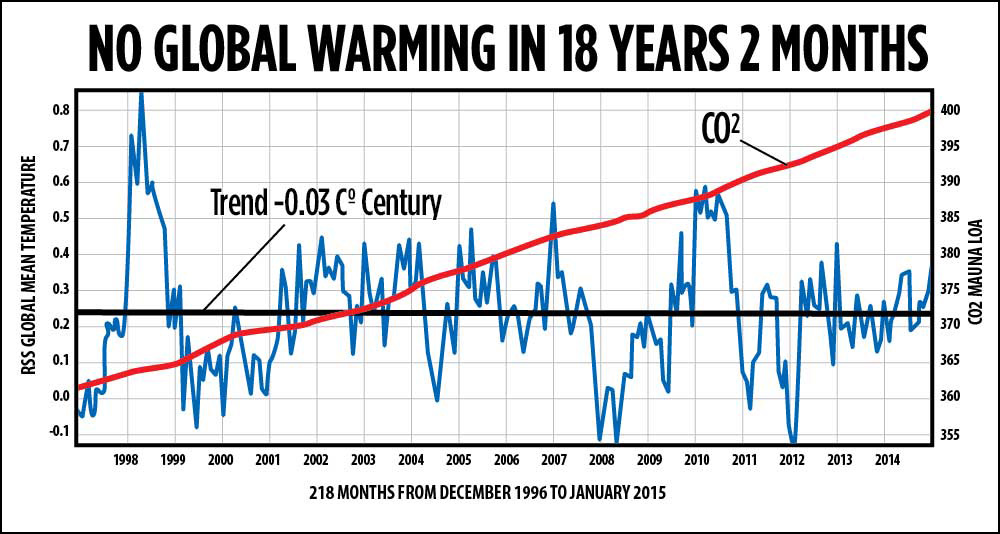
“Most remarkably, the total amount of CFCs, ozone-depleting molecules that are well-known greenhouse gases, has decreased around 2000,” Lu said. “Correspondingly, the global surface temperature has also dropped. In striking contrast, the CO2 level has kept rising since 1850 and now is at its largest growth rate.”
In his research, Lu discovers that while there was global warming from 1950 to 2000, there has been global cooling since 2002. The cooling trend will continue for the next 50 years, according to his new research observations.
As well, there is no solid evidence that the global warming from 1950 to 2000 was due to CO2.
In the Grand Ceremonial Hall of the University of Copenhagen, a splendid Nordic classical space overlooking the Church of our Lady in the heart of the old city, rows of repellent, blue plastic chairs surrounded the podium from which no less a personage than Dr. Rajendra Pachauri, chairman of the IPCC, was to speak.
I had arrived in good time to take my seat among the dignitaries in the front row. Rapidly, the room filled with enthusiastic Greenies and enviro-zombs waiting to hear the latest from ye Holy Bookes of Ipecac, yea verily.
The official party shambled in and perched on the blue plastic chairs next to me. Pachauri was just a couple of seats away, so I gave him a letter from me and Senator Fielding of Australia, pointing out that the headline graph in the IPCC’s 2007 report, purporting to show that the rate of warming over the past 150 years had itself accelerated, was fraudulent.
Would he use the bogus graph in his lecture? I had seen him do so when he received an honorary doctorate from the University of New South Wales. I watched and waited.
Sure enough, he used the bogus graph. I decided to wait until he had finished, and ask a question then.
Pachauri then produced the now wearisome list of lies, fibs, fabrications and exaggerations that comprise the entire case for alarm about “global warming”. He delivered it in a tired, unenthusiastic voice, knowing that a growing majority of the world’s peoples – particularly in those countries where comment is free – no longer believe a word the IPCC says.
They are right not to believe. Science is not a belief system. But here is what Pachauri invited the audience in Copenhagen to believe.
1. Pachauri asked us to believe that the IPCC’s documents were “peer-reviewed”. Then he revealed the truth by saying that it was the authors of the IPCC’s climate assessments who decided whether the reviewers’ comments were acceptable. That – whatever else it is – is not peer review.
2. Pachauri said that greenhouse gases had increased by 70% between 1970 and 2004. This figure was simply nonsense. I have seen this technique used time and again by climate liars. They insert an outrageous statement early in their presentations, see whether anyone reacts and, if no one reacts, they know they will get away with the rest of the lies. I did my best not to react. I wanted to hear, and write down, the rest of the lies.
3. Next came the bogus graph, which is featured three times, large and in full color, in the IPCC’s 2007 climate assessment report. The graph is bogus not only because it relies on the made-up data from the Climate Research Unit at the University of East Anglia but also because it is overlain by four separate trend-lines, each with a start-date carefully selected to give the entirely false impression that the rate of warming over the past 150 years has itself been accelerating, especially between 1975 and 1998. The truth, however – neatly obscured by an ingenious rescaling of the graph and the superimposition of the four bogus trend lines on it – is that from 1860-1880 and again from 1910-1940 the warming rate was exactly the same as the warming rate from 1975-1998
4. Pachauri said that there had been an “acceleration” in sea-level rise from 1993. He did not say, however, that in 1993 the method of measuring sea-level rise had switched from tide-gages to satellite altimetry against a reference geoid. The apparent increase in the rate of sea-level rise is purely an artefact of this change in the method of measurement.
5. Pachauri said that Arctic temperatures would rise twice as fast as global temperatures over the next 100 years. However, he failed to point out that the Arctic was actually 1-2 Celsius degrees warmer than the present in the 1930s and early 1940s. It has become substantially cooler than it was then.
6. Pachauri said the frequency of heavy rainfall had increased. The evidence for this proposition is largely anecdotal. Since there has been no statistically-significant “global warming” for 15 years, there is no reason to suppose that any increased rainfall in recent years is attributable to “global warming”.
7. Pachauri said that the proportion of tropical cyclones that are high-intensity storms has increased in the past three decades. However, he was very careful not to point out that the total number of intense tropical cyclones has actually fallen sharply throughout the period.
8. Pachauri said that the activity of intense Atlantic hurricanes had increased since 1970. This is simply not true, but it appears to be true if – as one very bad scientific paper in 2006 did – one takes the data back only as far as that year. Take the data over the whole century, as one should, and no trend whatsoever is evident. Here, Pachauri is again using the same statistical dodge he used with the UN’s bogus “warming-is-getting-worse” graph: he is choosing a short run of data and picking his start-date with care so as falsely to show a trend that, over a longer period, is not significant.
9. Pachauri said small islands like the Maldives were vulnerable to sea-level rise. Not if they’re made of coral, which is more than capable of outgrowing any sea-level rise. Besides, as Professor Morner has established, sea level in the Maldives is no higher now than it was 1250 years ago, and has not risen for half a century.
10. Pachauri said that if the ice-sheets of Greenland or West Antarctica were to melt there would be “meters of sea-level rise”. Yes, but his own climate panel has said that that could not happen for thousands of years, and only then if global mean surface temperatures stayed at least 2 C (3.5 F) warmer than today’s.