Archive for the “CO2” Category


epa-200x200By Siobhan Hughes (Dow Jones)

Governors of 18 U.S. states on Wednesday urged Congress to stop “harmful” Environmental Protection Agency regulation of greenhouse-gas emissions, saying the agency isn’t equipped to deal with “the very real potential for economic harm.”

The governors, led by Mississippi Gov. Haley Barbour, made their request in a letter to Senate Majority Leader Harry Reid (D., Nev.), House Speaker Nancy Pelosi (D., Calif.) and their Republican counterparts. The letter was also signed by Minnesota Gov. Tim Pawlenty, a Republican who has been cited as a possible contender in the 2012 presidential election.

“We feel compelled to guard against a regulatory approach that would increase the cost of electricity and gasoline prices, manufactured products, and ultimately harm the competitiveness of the U.S. economy,” the governors wrote. “We strongly urge Congress to stop harmful EPA regulation of greenhouse-gas emissions that could damage those vital interests.”

The Obama administration’s EPA fired back that it “rejects the premise that addressing greenhouse gases threatens the economy,” saying that other EPA actions “have led to innovations and the creation of new markets that can spur economic growth.” The EPA “will continue to follow the law and the science, which overwhelmingly indicates climate change is a real and growing threat to the American people,” spokesman Brendan Gilfillan said in a statement.

The governors’ letter, signed mostly by Republicans, intensifies a battle with the Obama administration’s EPA as it prepares to regulate greenhouse-gas emissions from vehicles and stationary sources such as power plants. The rules are due to be finalized by the EPA later this month. EPA Administrator Lisa Jackson has said the regulations for power plants, factories and oil refineries will be effective on a delayed basis, beginning in 2011, allowing companies extra time to plan ahead.

Coal, oil and manufacturing states have warned of the costs of complying, which could involve equipment purchases and other spending. In Congress, multiple measures are pending to hinder the EPA. One measure, from coal-state lawmakers including Sen. Jay Rockefeller (D., W.Va.) would suspend EPA regulations for two years. Another measure, led by oil-state Sen. Lisa Murkowski (R., Alaska) would overturn the EPA regulations.

“A simple delay of EPA action will do nothing to provide relief to Americans looking for jobs or businesses looking to make new investments in our states,” the governors wrote in urging Congress to stop the EPA outright and to pass comprehensive energy legislation. “Furthermore, such delay of EPA action only creates more uncertainty in a difficult fiscal environment.”

The letter emboldened Republicans already at odds with the EPA. Sen. Jim Inhofe (R, Okla.) said in a statement that the EPA should “stop this tax and the regulatory nightmare it will create, and work with Congress to pass an all-of-the-above energy plan that means more jobs, more energy, and more security for America.”

Read the rest at the Wall Street Journal.

Comments No Comments »

225px-jay_rockefeller_official_photoBy Juliet Eilperin

Sen. John D. Rockefeller (D-WVa.) will introduce legislation Thursday to impose a two-year moratorium on the Environmental Protection Agency’s ability to regulate greenhouse gases from power plants and other stationary emitters, a move that could undermine the Obama administration’s plan to pursue a cap on carbon emissions in the face of congressional opposition.

Rockefeller’s bill, one of several recent congressional efforts to curb the EPA’s authority to address climate change under the Clean Air Act, highlights the resistance the administration will face if it attempts to limit carbon dioxide through regulation. Obama and his top deputies have repeatedly said they would prefer for Congress to set mandatory, nationwide limits on greenhouse gas emissions, but the EPA is moving ahead with plans to do so if legislation fails to pass this year.

“Today, we took important action to safeguard jobs, the coal industry, and the entire economy as we move toward clean coal technology,” Rockefeller said. “This legislation will issue a two-year suspension on EPA regulation of greenhouse gases from stationary sources–giving Congress the time it needs to address an issue as complicated and expansive as our energy future. Congress, not the EPA, must be the ideal decision-maker on such a challenging issue.”

Republicans, too, have repeatedly tried to rein in the EPA’s climate authority–Sen. Lisa Murkowski (R-Alaska) has introduced a resolution of disapproval that would overturn the agency’s scientific finding that greenhouse gases endanger public health and welfare, and House Republicans introduced their own version of the resolution this week. But Rockefeller’s effort is especially significant because it points to growing unease among Democrats over the prospect of the administration tackling climate change without explicit congressional approval.

Three Senate Democrats–Blanche Lincoln (Ark.), Mary Landrieu (La.) and Ben Nelson (Neb.)–are co-sponsoring Murkowksi’s resolution. House Agriculture Committee Chairman Collin C. Peterson (D-Minn.) and Armed Services Chairman Ike Skelton (D-Mo.) have introduced a similar measure, and House Natural Resources Committee Chairman Nick J. Rahall (D-WVa), along with Democratic Reps. Alan Mollohan (WVa) and Rick Boucher (D-Va.), will introduce a companion bill to Rockefeller’s. In addition, Rep. Earl Pomeroy (D-N.D.) has introduced a measure that would strip the EPA of its authority to regulate pollution linked to global warming.

Read the rest at Washington Post.

Comments No Comments »

nasa_logo1By Alan Siddons

Insulated by an outer crust, the surface of the earth acquires nearly all of its heat from the sun. The only exit for this heat to take is through a door marked “Radiation.” And therein lies a tale… 

Recently, I chanced upon an Atmospheric Science Educator Guide [PDF] published by NASA. Aimed at students in grades 5 through 8, it helps teachers explain how so-called “greenhouse gases” warm our planet Earth.

These guides are interesting on a number of levels, so I recommend that you look them over. But what caught my eye was this:

  • Question: Do all of the gases in our atmosphere absorb heat?
  • Answer: (Allow students to discuss their ideas. Don’t provide the answer at this time.)

Indeed, that’s a good one to think over yourself. Almost all of what we’re breathing is nitrogen and oxygen — do these gases absorb heat? Lakes and rocks absorb heat, after all, and thereby reach a higher temperature. So can nitrogen and oxygen molecules do the same?

Well, I won’t keep you hanging. After allowing students to discuss it, the instructor is instructed to give them the final verdict. 

  • Answer: No. Only some gases have the unique property of being able to absorb heat.

These are the infrared-absorbing “greenhouse gases,” of course, substances like carbon dioxide water vapor, and not nitrogen and oxygen. 

Now, is something wrong here? Most definitely, for NASA has a finger on the scale. Let’s review a few basics that NASA should have outlined.

Read the rest of this article at the American Thinker.

Comments 56 Comments »

dontmess-texasTexas suit one of several to challenge EPA

By Ed Stoddard

Texas and several national industry groups on Tuesday filed separate petitions in federal court challenging the government’s authority to regulate U.S. greenhouse gas emissions.

Texas, which leads U.S. states in carbon dioxide emissions due to its heavy concentration of oil refining and other industries, will see a major impact if U.S. mandatory emissions reductions take effect.

In December, the Environmental Protection Agency ruled that greenhouse gases like carbon dioxide endanger human health, opening the door for the agency to issue mandatory regulations to reduce them.

Texas said it had filed a petition for review challenging the EPA’s “endangerment finding” with the U.S. Court of Appeals for the D.C. Circuit. Texas has also asked the EPA to reconsider its ruling.

“The EPA’s misguided plan paints a big target on the backs of Texas agriculture and energy producers and the hundreds of thousands of Texans they employ,” Texas Gov. Rick Perry said.

The National Association of Manufacturers, the American Petroleum Institute, and the National Petrochemical and Refiners Association also said on Tuesday they filed a petition challenging the EPA in federal appeals court.

The U.S. Chamber of Commerce and U.S. iron and steel makers have also signaled they would file lawsuits.

Read the rest or this story at Reuters.

Comments 31 Comments »

bpBy Stephen Power And Ben Casselman

Three big companies quit an influential lobbying group that had focused on shaping climate-change legislation, in the latest sign that support for an ambitious bill is melting away.

Oil giants BP PLC and ConocoPhillips and heavy-equipment maker Caterpillar Inc. said Tuesday they won’t renew their membership in the three-year-old U.S. Climate Action Partnership, a broad business-environmental coalition that had been instrumental in building support in Washington for capping emissions of greenhouse gases.

The move comes as debate over climate change intensifies and concerns mount about the cost of capping greenhouse-gas emissions.

On a range of issues, from climate change to health care, skepticism is growing in Washington that Congress will pass any major legislation in a contentious election year in which Republicans are expected to gain seats. For companies, the shifting winds have reduced pressure to find common ground, leading them to pursue their own, sometimes conflicting interests.

Last week, the head of the Pharmaceutical Research and Manufacturers of America, Billy Tauzin, said he would step down as president of the industry’s main lobby in Washington, amid criticism from some in the industry over the alliance he made last year with the White House to support health-care legislation.

The administration had worked hard to persuade industry groups to climb aboard its major legislative initiatives—a tack many business interests saw as sensible following the Democrats’ big gains in the 2008 elections. But “unlikely bedfellows make for breakups,” said Kevin Book, managing director of Clearview Energy Partners, a consulting firm.

Spokesmen for ConocoPhillips and BP said the companies still support legislation to reduce greenhouse-gas emissions, but believe they can accomplish more working outside USCAP’s umbrella. Caterpillar said it plans to focus on commercializing green technologies.

ConocoPhillips’s senior vice president for government affairs, Red Cavaney, said the USCAP was focused on getting a climate-change bill passed, whereas Conoco is increasingly concerned with what the details of such a bill would be.

“USCAP was starting to do more and more on trying to get a bill out without trying to work as much on the substance of it,” Mr. Cavaney said.

A spokesman for USCAP said it intends to continue its work. More than 20 other large companies, including oil company Royal Dutch Shell PLC and industrial heavyweights General Electric Co. and Honeywell International Inc., remain in the coalition with environmental groups such as the Environmental Defense Fund and Natural Resources Defense Council. The USCAP said it expects to add new members in coming months.

“We think there’s momentum to get [a climate bill] done,” USCAP spokesman Tad Segal said. “President [Barack] Obama’s State of the Union address made it clear the administration is behind us.”

Read the rest of this article at Wall Street Journal.

Comments 8 Comments »

Lighthearted humor, chilling prophecy, pushing an agenda, or something else?

Comments 23 Comments »

jerry-lewisConfidence Melting Away: Doubts Grow in Climate Change Debate

By Gerald Traufetter

The Siachen Glacier is home to the world’s highest crisis region. Here, at 6,000 meters (19,680 feet) above sea level, Indian and Pakistani soldiers face off, ensconced in heavily armed positions.

The ongoing border dispute between the two nuclear powers has already claimed the lives of 4,000 men — most of them having died of exposure to the cold.

Now the Himalayan glacier is also at the center of a scientific dispute. In its current report, the Intergovernmental Panel on Climate Change (IPCC) predicts that the glacier, which is 71 kilometers (44 miles) long, could disappear by 2035. It also predicts that the other 45,000 glaciers in the world’s highest mountain range will be virtually gone by then, with drastic consequences for billions of people in Asia, whose life depends on water that originates in the Himalayas. The IPCC report led environmental activists to sound the alarm about a drama that could be unfolding at the “world’s third pole.”

“This prognosis is, of course, complete nonsense,” says John Shroder, a geologist and expert on glaciers at the University of Nebraska in Omaha. The results of his research tell a completely different story.
For the past three decades, the US glaciologist has been traversing the majestic mountains of the Himalayan region, particularly the Karakorum Range, with his measuring instruments. The discoveries he has made along the way are not consistent with the assessment long held by the IPCC. “While many glaciers are shrinking, others are stable and some are even growing,” says Shroder.

Untenable Claim

The gaffe over the Himalayan glaciers has triggered an outcry in the world of climatology. Some are already using the word “Glaciergate” in reference to the scandal over a scientifically untenable claim in the fourth IPCC assessment report, which the UN climate body publishes every five years. The fourth assessment report was originally published in 2007. Last week, the IPCC withdrew the erroneous claim and apologized for the error.

German Environment Minister Norbert Röttgen, a member of the center-right Christian Democratic Union (CDU), is also upset about the incident. “The error in the IPCC report is serious and should not have happened,” Röttgen told SPIEGEL. “Scientific accuracy is a vital condition to support the credibility of the political conclusions we draw as a result.” Although the minister still has confidence in the overall validity of the IPCC report, he wants to see “a thorough investigation into how the error originated and was communicated.”

But why wasn’t this clearly nonsensical claim noticed long ago by at least one of the 3,000 scientists who contributed to the IPCC report? “What’s really amazing is that such a blunder remained uncorrected for so long,” says Shroder.

Read the rest of this story at ABC News (Yes. Really. ABC News).

Comments 24 Comments »

matsoyAs Global Warming Movement Collapses, Activists Already ‘Test-Marketing’ the Next Eco-Fear! ‘Laughing Gas’ Crisis? Oxygen Crisis? Plastics?

Global Warming Being Thrown Under the Bus as New Replacement Environmental Scare is Sought

By Marc Morano

As the man-made global warming fear movement collapses and the climate establishment lay in a Climategate ridden tatters, many are asking what next? (For latest on climate movement’s demise go to www.ClimateDepot.com)

As man-made global warming fears enter the ashbin of history, what will environmentalists, UN activists and politicians do to fill the void of a failed eco-scare?

Well, wonder no more….

Some forward thinking green activists and even the UN climate Chief have already taken up the task of test-marketing the next eco-scares to replace man-made global warming.

One of the most prominent eco-scares now being quietly promoted behind man-made climate fears is the allegedly “growing” nitrous oxide (a.k.a. “laughing gas”) threat to the planet. See: Time for next eco-scare already?! ‘Earth’s growing nitrogen threat’: ‘It helps feed a hungry world, but it’s worse than CO2′ The Christian Science Monitor - January 12, 2010 - Excerpt: Nitrous oxide is nearly 300 times as potent as carbon dioxide – considered the leading cause of climate change – and the third most threatening greenhouse gas overall.

As man-made climate fears subside and the scientific, economic, cultural and political case evaporates for climate change “action,” expect more and more green activists to take up the mantle for “laughing gas” as a possible replacement eco-scare.

See also: Laughing Gas Knocks Out CO2 - By Doug Hoffman - Oct. 30, 2009 - Excerpt: “In the face of ever mounting evidence that CO2 is incapable of causing the level of global devastation prophesied by climate change catastrophists a new villain is being sought. The leading candidate is nitrous oxide (N2O), better known as laughing gas. A report in Science claims that N2O emissions are currently the single most important cause of ozone depletion and are expected to remain so throughout the 21st century. The IPCC rates N2O as 310 times as potent a greenhouse gas as CO2 on a 100 year time scale. Is this a greenhouse gas bait and switch, or are the global warming alarmists trying to up the ante.”

Still can’t picture former Vice President Al Gore touting the “laughing gas” crisis as the “moral” challenge of our time in a Oscar-winning documentary? Not to worry, there are many more eco-scares currently being test-marketed.

Plastics

Gore’s own producer of “An Inconvenient Truth” — Hollywood eco-activist Laurie David — is already test-marketing another eco-scare with potential promise.

One Word: Plastics.” Yes, just 43 years after the 1967 film “The Graduate”, “plastics” just may be the future!
See: AGW RIP? Is It Time for Next Eco-Scare Already? Gore’s producer Laure David touts plastic crisis: ‘Plastic waste is in some ways more alarming for us humans than global warming’ - July 31, 2009

“The rapid rise in global plastic production is leading to a rise in plastic pollution and its devastating effects on our oceans and our lives.,” Laurie David wrote on July 31, 2009. Selected Excerpts From David’s blog post: “This insidious invasion of the biosphere by our plastic waste is in some ways more alarming for us humans than global warming. Our bodies have evolved to handle carbon dioxide, the nemesis of global warming, indeed, we exhale it with every breath. Plastic, though present in the biosphere from the nano scale on up, is too stable a molecule for any organism to fully assimilate or biodegrade. So we have a situation in which a vector for a suite of devastating chemicals, chemicals implicated in many modern diseases, is now invading the ocean, our bodies and indeed, the entire biosphere. The prognosis for improvement in this situation is grim.”

Still not convinced of either “laughing gas” or “plastics” as the next dominant eco-scare? Don’t worry, we are just getting started.

Just how widespread is the test marketing of a new eco-scare to replace the flailing global warming movement?

It now has the attention of the beleaguered head of the UN Intergovernmental Panel on Climate Change (IPCC) Rajendra Pachauri.

UN Throws Global Warming Under the Bus?!

In a remarkable posting on his personal blog, Pachauri openly admitted that man-made global warming was not even the biggest eco-issue! See: Et tu? Head of UN IPCC Pachauri Now throwing global warming under the bus?! There is a ‘larger problem’ than climate fears?! - November 23, 2009

Read the rest of this story at Climate Depot.

Comments 15 Comments »

Cooling WorldBy David Rose

The bitter winter afflicting much of the Northern Hemisphere is only the start of a global trend towards cooler weather that is likely to last for 20 or 30 years, say some of the world’s most eminent climate scientists.

Their predictions – based on an analysis of natural cycles in water temperatures in the Pacific and Atlantic oceans – challenge some of the global warming orthodoxy’s most deeply cherished beliefs, such as the claim that the North Pole will be free of ice in summer by 2013.

According to the US National Snow and Ice Data Centre in Colorado, Arctic summer sea ice has increased by 409,000 square miles, or 26 per cent, since 2007 – and even the most committed global warming activists do not dispute this.

The scientists’ predictions also undermine the standard climate computer models, which assert that the warming of the Earth since 1900 has been driven solely by man-made greenhouse gas emissions and will continue as long as carbon dioxide levels rise.

They say that their research shows that much of the warming was caused by oceanic cycles when they were in a ‘warm mode’ as opposed to the present ‘cold mode’.

This challenge to the widespread view that the planet is on the brink of an irreversible catastrophe is all the greater because the scientists could never be described as global warming ‘deniers’ or sceptics.

However, both main British political parties continue to insist that the world is facing imminent disaster without drastic cuts in CO2. Last week, as Britain froze, Climate Change Secretary Ed Miliband maintained in a parliamentary answer that the science of global warming was ‘settled.’

Read the rest of this article at Daily Mail.

Comments 9 Comments »

Comments 1 Comment »

CO2A paper published in Geophysical Research Letters finds no statistically significant increase in the airborne proportion of anthropogenic carbon dioxide over the past 150 years. Being that climate scientists like those from the Climactic Research Unit at Hadley and alarmist members of the UN’s Intergovernmental Panel on Climate Change (IPCC) claims that increased CO2 is to blame for warming patterns over the past several decades and that the warming  will soon accelerate out of control, due to an inability of the ecosystem to cope with increased CO2 emissions, this research poses a problem. How can carbon dioxide be causing warming if the level of CO2 in the atmosphere has not actually been on the rise?

We know that mankind does produce and emit a relatively small (compared to naturally occurring CO2) amount of CO2 and industrialization has increased our overall CO2 emissions, but now it seems that it hasn’t mattered. The earth’s natural mechanisms have effectively dealt with the increase. Vegetation, like forests and ocean algae, of course thrive on CO2 and convert it into Oxygen.

A December 31st article in Science Daily noted, “Most of the carbon dioxide emitted by human activity does not remain in the atmosphere, but is instead absorbed by the oceans and terrestrial ecosystems.”

Despite the new evidence that CO2 cannot have been responsible for the recent reported warming (that ended around 1999), the warmists are undeterred. The article goes on to say, “However, some studies have suggested that the ability of oceans and plants to absorb carbon dioxide recently may have begun to decline and that the airborne fraction of anthropogenic carbon dioxide emissions is therefore beginning to increase.

“Many climate models also assume that the airborne fraction will increase. Because understanding of the airborne fraction of carbon dioxide is important for predicting future climate change, it is essential to have accurate knowledge of whether that fraction is changing or will change as emissions increase.”

So, the new line may well be: Even though it hasn’t happened at all yet, future increases in atmospheric carbon dioxide will cause global warming, because we’re on the verge of maxing out the earth’s ability to absorb CO2.

It seems the climate models may now rely on predicting a heretofore unobserved increase in anthropogenic carbon dioxide in the atmosphere in order to predict future CO2-driven global warming, even though (despite earlier claims) neither has actually been observed.

Every claim of the warmists has been disproven. Not a single catastrophic prediction has come to pass. They insist the science is settled and the debate is over but science is based on observation and duplicable results. Observation shows no CO2-induced warming and the CRU’s climate models haven’t produced one accurate result, let a lone a duplicate. The warmists it seems, will unabashedly stretch to any length to try to maintain their dreams of carbon-based economic control, but the thing about stretching something is that it also grows thin.

Abstract: Is the airborne fraction of anthropogenic CO2 emissions increasing?

Science Daily: No Rise of Airborne Fraction of Carbon Dioxide in Past 150 Years, New Research Finds

Comments 27 Comments »

farmerBy Edward Felker

Agriculture Secretary Tom Vilsack has ordered his staff to revise a computerized forecasting model that showed that climate legislation supported by President Obama would make planting trees more lucrative than producing food.

The latest Agriculture Department economic-impact study of the climate bill, which passed the House this summer, found that the legislation would profit farmers in the long term. But those profits would come mostly from higher crop prices as a result of the legislation’s incentives to plant more forests and thus reduce the amount of land devoted to food-producing agriculture.

According to the economic model used by the department and the Environmental Protection Agency, the legislation would give landowners incentives to convert up to 59 million acres of farmland into forests over the next 40 years. The reason: Trees clean the air of heat-trapping gases better than farming does.

Mr. Vilsack, in a little-noticed statement issued with the report earlier this month, said the department’s forecasts “have caused considerable concern” among farmers and ranchers.

Read the rest of this story at Washington Times.

Comments 49 Comments »

This 53-minute documentary offers an alternative explanation for climate change that is based upon a relationship between cosmic rays, the sun and the earth’s clouds.

Because the findings contridicted the so-called “scientific consensus” that CO2 was responsible for climate change, the author of this study was unable to get his work published in a scientific journal.  This is the same corrupt peer review process exposed in ClimateGate that  is leading to censorship of studies that contradict the C02 theory.

Comments 10 Comments »

sun-earth-180GCS Editor: We’re not entirely convinced of the CFC angle - it’s never been proven that the ozone hole (which we now know comes and goes) was affected by CFCs, but the cosmic ray theory makes sense.

By John Morris, Waterloo University

Cosmic rays and chlorofluorocarbons (CFCs), both already implicated in depleting the Earth’s ozone layer, are also responsible for changes in the global climate, a University of Waterloo scientist reports in a new peer-reviewed paper.

In his paper, Qing-Bin Lu, a professor of physics and astronomy, shows how CFCs - compounds once widely used as refrigerants - and cosmic rays - energy particles originating in outer space - are mostly to blame for climate change, rather than carbon dioxide (CO2) emissions. His paper, derived from observations of satellite, ground-based and balloon measurements as well as an innovative use of an established mechanism, was published online in the prestigious journal Physics Reports.

“My findings do not agree with the climate models that conventionally thought that greenhouse gases, mainly CO2, are the major culprits for the global warming seen in the late 20th century,” Lu said. “Instead, the observed data show that CFCs conspiring with cosmic rays most likely caused both the Antarctic ozone hole and global warming. These findings are totally unexpected and striking, as I was focused on studying the mechanism for the formation of the ozone hole, rather than global warming.”

His conclusions are based on observations that from 1950 up to now, the climate in the Arctic and Antarctic atmospheres has been completely controlled by CFCs and cosmic rays, with no CO2 impact.

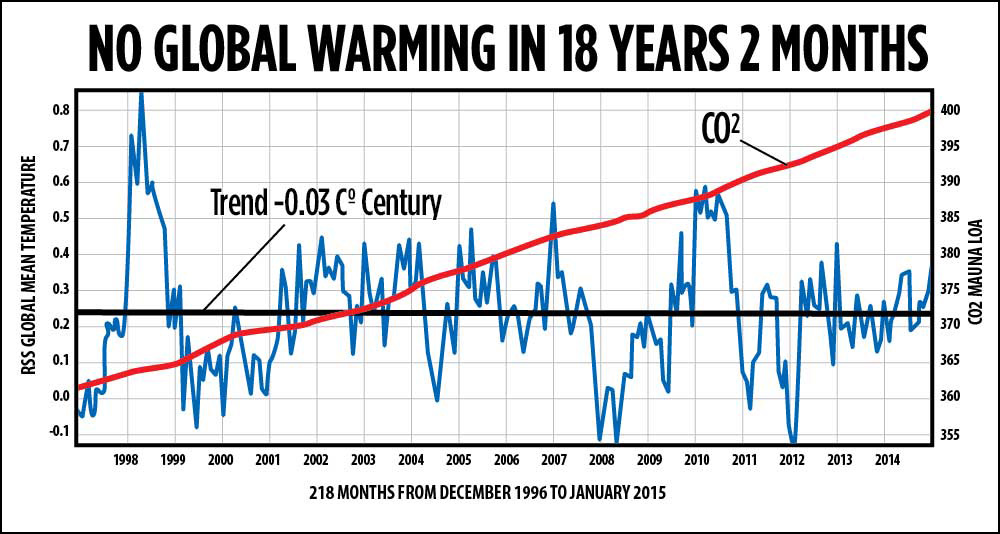
“Most remarkably, the total amount of CFCs, ozone-depleting molecules that are well-known greenhouse gases, has decreased around 2000,” Lu said. “Correspondingly, the global surface temperature has also dropped. In striking contrast, the CO2 level has kept rising since 1850 and now is at its largest growth rate.”

In his research, Lu discovers that while there was global warming from 1950 to 2000, there has been global cooling since 2002. The cooling trend will continue for the next 50 years, according to his new research observations.

As well, there is no solid evidence that the global warming from 1950 to 2000 was due to CO2.

Read the rest of this article at Insciences.

Read the peer reviewed scientific paper at Physics Reports.

Comments 5 Comments »

From the Weekly Standard

The climate campaigners play their trump card, but it may turn out to be a joker.

jokercard1By Steven F. Hayward — The climate campaign, built step-by-step over the last 20 years, has reached its Waterloo. The Copenhagen conference that ended Friday was an exercise in political theater. It not only failed to produce a binding agreement, but the potential emissions curbs it endorsed fall far below what climate orthodoxy demands, while the proposed wealth transfer from rich nations to poor nations is a political nonstarter. Back home, cap and trade legislation remains on life support, even though it has been significantly watered down so as to postpone real costs to consumers for a decade or more. In the midst of this gloom, the climate campaign has played its trump card in the United States: The Environmental Protection Agency formally announced on December 7 its intention to regulate greenhouse gases through the Clean Air Act.

That trump card, however, may turn out to be a joker.

The Clean Air Act (CAA), enacted in 1970 and last updated in 1990, is an abysmal policy mechanism for controlling greenhouse gases, and was never intended for this kind of problem. But the EPA’s gambit is not about policy–it is all about politics. The EPA’s grasp for dominion over greenhouse gases has been a long time in coming, starting as an effort to bring pressure on the Bush administration to relent in its opposition to a U.N.-led international climate treaty, and continuing under Obama as a means of pressuring Congress and the business community to support cap and trade.

The key antecedent to this gambit was a botched Supreme Court decision in 2007, Massachusetts v. EPA, in which a 5-4 majority (Justice Anthony Kennedy sided with the Court’s four liberals) ruled that greenhouse gases like carbon dioxide were indeed “pollutants” under the capacious definitions of the Clean Air Act, thereby giving the EPA jurisdiction to regulate them without any legislative mandate from Congress.

Environmental groups had petitioned the EPA to regulate greenhouse gases under the Clean Air Act and had encouraged several states to ask for federal authority to impose their own regulations on automobile emissions. The Bush EPA took the position that it did not have the authority to regulate greenhouse gases, and would decline to regulate them even if it did have the legal authority. Once the Supreme Court ruled, however, the slippery slope logic of environmental law took over, making it inevitable that the EPA would eventually move to regulate greenhouse gases. In a nutshell, environmental statutes and case law have evolved so as to make federal judges into the sock puppets of environmentalists, and greens have become highly skilled in bringing lawsuits to compel federal agencies to do their bidding. (This explains, for example, the Bush administration’s decision to list the polar bear as an endangered species.)

The EPA gambit has business groups in an uproar, but is this a case of crying wolf, in a mirror image of environmental alarms? Industry protested every version of the Clean Air Act (a Ford executive named Lee Iacocca predicted in 1970 that the CAA would shut down the entire American auto industry), and although the cost of reducing air pollution was not trivial (over $500 billion according to the EPA’s likely underestimate), it has not decimated the American economy. In fact, on the surface the Clean Air Act appears to be the largest public policy success story of the last generation: The dramatic reduction in air pollution is greater in magnitude than the reduction in the crime rate in the 1990s or the fall in welfare rolls since welfare reform. You’d never know this from the media or the greens, who hate good environmental news as much as vampires hate garlic.

Read the rest of the column.

Comments 26 Comments »

Bad Behavior has blocked 2145 access attempts in the last 7 days.