This rather amusing video was produced by a project of Greenpeace. While we agree with their assertion that carbon credits are a bad idea, we strongly disagree with their “solution.” Rather than carbon credits, Greenpeace seeks draconian and unrealistic cuts in carbon emissions that would cast the civilized world into a preindustrial state, all over unproven and hotly contested anthropogenic global warming theories.
GlobalClimateScam.com doesn’t support either idea.
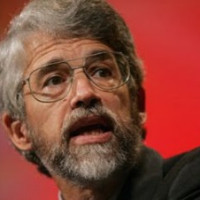
In 1971, John Holdren edited and contributed an essay to a book entitled Global Ecology: Readings Toward a Rational Strategy for Man. He wrote (along with colleague Paul Ehrlich) the book’s sixth chapter, called “Overpopulation and the Potential for Ecocide.†(Click here to view a photograph of the table of contents, showing Holdren’s essay on pages 64-78; click on the image to the left to view the cover). In their chapter, Holdren and Ehrlich speculate about various environmental catastrophes, and on pages 76 and 77 Holdren the climate scientist speaks about the probable likelihood of a “new ice age†caused by human activity (air pollution, dust from farming, jet exhaust, desertification, etc).
John Holdren is now not only the “Science Czar†for the United States, but he’s also one of the original leaders of the “alarmist†wing of the Global Warming debate — and he now promotes the notion that the current climate data points to a looming planetary overheating catastrophe of unimaginable dimensions (he helped make the charts and graphs for Al Gore’s film An Inconvenient Truth, for example).
Polling data reveals Americans are growing increasingly skeptical about man-made global warming fears and claims. Voters are rejecting so-called “solutions” like cap-and-trade as well. Below is a small sampling of recent polling data on global warming.
1) Gallup survey found global warming ranked dead last in the U.S. among ENVIRONMENTAL issues – 8th out of 8 Env. Issues – March 2009 – Excerpt: (Air and water pollution, toxic waste, animal and plant extinction and loss of tropical rainforests, all ranked as greater concerns than global warming.) “Since more Americans express little to no worry about global warming than say this about extinction, global warming is clearly the environmental issue of least concern to them. In fact, global warming is the only issue for which more Americans say they have little to no concern than say they have a great deal of concern.”
2) Gallup Poll Editor: Gore has ‘Failed’ — ‘The public is just not that concerned’ about global warming – May 5, 2009 – Excerpt: Gallup Poll Editor Frank Newport says he sees no evidence that Al Gore’s campaign against global warming is winning. “It’s just not caught on,” says Newport. “They have failed.” Or, more bluntly: “Any measure that we look at shows Al Gore’s losing at the moment. The public is just not that concerned.” [...] Ask people to name their biggest concerns, and just 1 percent to 2 percent cite the environment. “The environment doesn’t show up at all,” says Newport. “It’s Al Gore’s greatest frustration,” says Newport. “We seem less concerned than more about global warming over the years…Despite the movies and publicity and all that, we’re just not seeing it take off with the American public. And that was occurring even before the latest economic recession.” He adds: “As Al Gore I think would say, the greatest challenge facing humanity . . . has failed to show up in our data.”
4) Gallup Poll: ‘Record-High 41% of Americans Now Say Global Warming is Exaggerated’ – March 11, 2009 – Excerpt: This represents the highest level of public skepticism about mainstream reporting on global warming seen in more than a decade of Gallup polling on the subject. [...] Now, according to Gallup’s 2009 Environment survey, more Americans say the problem is exaggerated rather than underestimated, 41% vs. 28%. [...] The 2009 Gallup Environment survey measured public concern about eight specific environmental issues. Not only does global warming rank last on the basis of the total percentage concerned either a great deal or a fair amount, but it is the only issue for which public concern dropped significantly in the past year. [...] It is the first time since 1997 that the rate of concern has not increased.
“The American public… just like your teenage kids, aren’t acting in a way that they should act. The American public has to really understand in their core how important this issue is.â€
In case you haven’t heard, that was Secretary of Energy Steven Chu discussing your ability to curb greenhouse gas emissions. As long as we’re acting like teenagers, we might as well be treated like them. According to the Obama administration, we can’t understand what greenhouse gases are, so we’ll use the terms “carbon pollution†or “heat-trapping emissions†instead. From Lauren Morello, E&E reporter:
“We know that our planet’s future depends on a global commitment to permanently reduce greenhouse gas pollution,†President Obama said yesterday at the U.N. Summit on Climate Change in New York, one of several references to “greenhouse gas pollution†and “carbon pollution†sprinkled throughout his speech. The president also referred to “carbon pollution†in April, during a much-publicized speech to the National Academy of Sciences, and again in June, in a press conference just before the House voted to pass a broad climate and energy bill.
And he’s not alone. Top Obama administration science officials, including Energy Secretary Steven Chu and U.S. EPA Administrator Lisa Jackson, have also adopted similar vocabulary, a subtle linguistic shift in the ongoing climate debate. In fact, during an hour long June briefing to launch a major government climate change report, a panel that included White House science adviser John Holdren and National Oceanic and Atmospheric Administration chief Jane Lubchenco mentioned greenhouse gases just once — instead warning about the perils of “heat-trapping gases†or “heat-trapping pollutants.â€
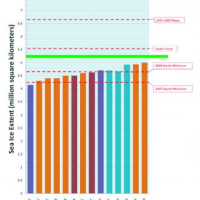
From the NSIDC, Sea ice reaches it’s annual minimum extent growing by 370,000 square miles over 2007. An area 1 1/2 times the size of Texas. The recovery is 220,000 sq miles above last year alone yet the NSIDC claims below that the scientists don’t consider this a recovery.
They cite younger thinner ice again and a lower level than the 30 year mean as the reasons this is not a recovery. I have difficulty ignoring a near 400,000 sq mile increase in ice level. So I hope they don’t mind if I do consider it at least a partial recovery.
From a post on CA SteveM posted a graph from the NSIDC’s compiled 2008 projections of sea ice by the different ‘experts’ in the field. Since 2008 minimum is clearly marked and 220,000 sq miles is equal to 570,000 sq kilometers of increase. We can determine where on the NSIDC graph the actual Arctic sea ice turned out.
All I can say is, be glad you’re not an expert on sea ice. The linear trend is actually closer than the majority of the experts.
Scientists see no temperature increase (on average) in the oceans or on the surface of the Earth over the last decade. That hasn’t stopped an activist group from infiltrating high schools with the panicky message that we are on the verge of a “planetary emergency” due to global warming.
These alarmists are the recently formed Alliance for Climate Education, an Oakland, Calif., nonprofit created by wealthy wind energy entrepreneur Michael Haas. The organization has targeted five metropolitan areas and now is opening a Washington office.
Haas, who donated $24,600 to President Obama’s campaign and victory funds last year, stands to reap millions of dollars in government subsidies that climate change-driven energy policies would bring.
Meanwhile the teenagers targeted by ACE are treated to hip presentations with slick animation to propagate the idea that they and everyone in their spheres of influence must modify their behaviors so as to stop global warming. This is achieved by cutbacks in their energy use, which ACE believes produces too many greenhouse gases (from fossil fuel combustion like coal and oil) that warm the planet.
The evidence is inexorably mounting that the climate alarmists have been taking us all for a ride. It is only be a matter of time before their agenda is exposed as one of the biggest con tricks of all time. Thus they are already scrambling to breathe new life into the CO2 emissions scare. It will become obvious (by the passage of years if nothing else) that increasing carbon dioxide in the atmosphere does not, after all, cause any significant climate change, thus it will be necessary to blame CO2 (and hence man) for some other catastrophic event. So, prepare yourself for the coming “ocean acidification†scam.
The media have already entered the fray with lying narratives that sound like science fiction scripts, warning about the catastrophe of ‘acid oceans’ and ‘toxic seas’. The BBC have churned out headlines such as ‘Marine life faces ‘acid threatâ€, ‘Acid oceans ‘need urgent action†and ‘Acidic seas fuel extinction fears’. Newspapers such as the Daily Telegraph and the Times have got in on the act with scary headlines such as ‘Mussels face extinction as oceans turn acidic’, ‘Pollution to devastate shellfish by turning seas acidic’ and ‘Acid seas threaten to make British shellfish extinct’. Just recently, it has got all the more strident: the Sunday Times (March 8, 2009) chimes in under the headline The toxic sea:
Each one of us dumps a tonne of carbon dioxide into the oceans every year, turning them into acidified soups — and threatening to destroy most of what lives in them.
And from the Guardian (March 10, 2009) under the headline Carbon emissions creating acidic oceans not seen since dinosaurs:
Human pollution is turning the seas into acid so quickly that the coming decades will recreate conditions not seen on Earth since the time of the dinosaurs…The rapid acidification is caused by the massive amounts of carbon belched out from chimneys and exhausts that dissolve in the ocean…the pH of surface waters, where the CO2 is absorbed from the atmosphere, has fallen about 0.1 units since the industrial revolution, though it will take longer for the acid to reach deeper water.
Note the continual use of the word acid. Yet there is not the slightest possibility that seawater will turn to acid, or even become mildly acidic, so this is drivel. Note also the claim that pH has changed by 0.1 units over the last 200 years: it was not possible a hundred years ago, never mind 200 years ago, to measure pH to the accuracy necessary to support that assertion, so it’s just posturing. Finally, notice that CO2 is branded ‘human pollution’, though CO2 is an entirely natural and absolutely essential nutrient for plant photosynthesis, without which all life on earth would certainly become extinct very quickly.
As an aside, we should note that if lower alkalinity per se were so unfavourable to shellfish as is claimed then we would have no freshwater shellfish and snails – but we do. The freshwater mussel has lived for thousands of years in waters that are genuinely acidic and with highly variable pH, not only seasonally, but geographically. With spring snowmelt and high rainfall, the pH of rivers and lakes can fall to below pH 5, and experiments have shown that mussels can survive this acidity indefinitely without any deleterious effects to their shells. Note: a pH of 5 has 1,000 times as many ‘acidic’ H+ ions per litre as seawater, and 100 times more than pure water. This is not to say that sea creatures can survive in fresh water – they are adapted to a radically different saline environment – the point at issue is that the idea of a small change in ocean pH due to increased dissolved carbon dioxide having a deleterious effect on marine shells of living organisms is not as obvious as the alarmists make out.
Imagine if Pope Benedict gave a speech saying the Catholic Church has had it wrong all these centuries; there is no reason priests shouldn’t marry. That might generate the odd headline, no?
Or if Don Cherry claimed suddenly to like European hockey players who wear visors and float around the ice never body-checking opponents.
Or Jack Layton insisted out of the blue that unions are ruining the economy by distorting wages and protecting unproductive workers.
Or Stephen Harper began arguing that it makes good economic sense for Ottawa to own a car company. (Oh, wait, that one happened.)
But at least, the Tories-buy-GM aberration made all the papers and newscasts.
When a leading proponent for one point of view suddenly starts batting for the other side, it’s usually newsworthy.
So why was a speech last week by Mojib Latif of Germany’s Leibniz Institute not give more prominence?
Prof. Latif is one of the leading climate modellers in the world. He is the recipient of several international climate-study prizes and a lead author for the United Nations’ Intergovernmental Panel on Climate Change (IPCC). He has contributed significantly to the IPCC’s last two five-year reports that have stated unequivocally that man-made greenhouse emissions are causing the planet to warm dangerously.
Yet last week in Geneva, at the UN’s World Climate Conference — an annual gathering of the so-called “scientific consensus” on man-made climate change — Prof. Latif conceded the Earth has not warmed for nearly a decade and that we are likely entering “one or even two decades during which temperatures cool.”
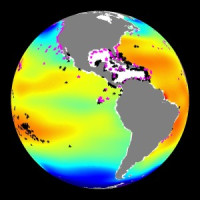
The global warming theory has been based all along on the idea that the Atlantic and Pacific Oceans would absorb much of the greenhouse warming caused by a rise in man-made carbon dioxide, then they would let off that heat and warm the atmosphere and the land.
But as Prof. Latif pointed out, the Atlantic, and particularly the North Atlantic, has been cooling instead. And it looks set to continue a cooling phase for 10 to 20 more years. “How much?” he wondered before the assembled delegates. “The jury is still out.”
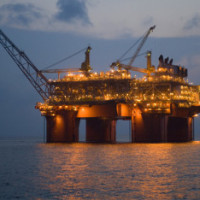
The Department of Interior’s Minerals Management Service is currently deliberating on offshore drilling permissions for the years 2010-2015. If an area is not approved now, drilling for domestic oil will be off-limits there until at least 2015.
The Minerals Management Service says it will ultimately decide the fate of 31 proposed lease sales to drill in the outer continental shelf based on public input through the process of “notice and comment.â€
The notice and comment deadline for the current six-year approval cycle is September 21st, 2009.
We all remember $4 gas last summer, and higher energy costs are in our very near future. If we don’t produce more American energy now, higher prices will certainly be exacerbated.
America is a beacon of capitalism, so it can be jarring to discover one of its largest industries is a redoubt of socialism. State governments have been running the electricity business, currently a $330-billion-a-year industry, since Theodore Roosevelt pounded his White House bully pulpit.
Central planning of the electricity industry started during the Progressive Era, as is the case with many misguided policies. Early in the 20th century, intervention-minded progressives, such as Wisconsin’s Robert “Fighting Bob” La Follette, concluded that electric companies would consolidate into “natural” monopolies that preyed on consumers. This was a curious conclusion to reach at a time when electric companies were competing vigorously in many cities.
Their remedy for this theoretical drift toward natural monopoly was, incredibly, to establish real government-mandated monopolies. States created commissions with the regulatory power to outlaw competition among utilities and set the price of electricity for consumers. By the end of the Great Depression, almost all Americans bought their electricity from government-backed monopolies, and it remains so to this day.
The progressives reasoned that electricity providers couldn’t abuse consumers if they labored under the state’s thumb, but it’s far from that simple. Without competition, there is no spur for innovation, which is why electricity transmission and distribution–the system of wires, towers and poles that transmits electricity from the power plant to your home–haven’t changed much since the regulators stepped in.
That’s unfortunate, because while the power system remains frozen in time, American society as a whole has changed dramatically. The U.S. has become a wired nation, a people wholly dependent on reliable electricity to power their computers, phones and iPods. And America’s anachronistic electricity supply chain is failing to keep pace with demand. Massive blackouts in California (2005), Florida (2008) and the entire Northeast (2003) serve as stark reminders of the fragility of the U.S. grid.
Congress wants to overhaul the system by spending a king’s ransom on technologies that would give utilities the ability to moderate consumer demand–by, say, remotely turning down millions of thermostats during periods of peak use. In theory, this might avoid the supply crunches that can stress the system to the breaking point, leading to blackouts. Proponents call this a “smart grid” approach, but it’s really a stupid policy, especially when the U.S. could modernize the system without spending a penny from the government treasury.