Archive for the “Ice” Category

By David Rose

The supposed ‘consensus’ on man-made global warming is facing an inconvenient challenge after the release of new temperature data showing the planet has not warmed for the past 15 years.

The figures suggest that we could even be heading for a mini ice age to rival the 70-year temperature drop that saw frost fairs held on the Thames in the 17th Century.

Based on readings from more than 30,000 measuring stations, the data was issued last week without fanfare by the Met Office and the University of East Anglia Climatic Research Unit. It confirms that the rising trend in world temperatures ended in 1997.

Read the rest at UK’s Daily Mail.

Comments 30 Comments »

Not going to melt any time soon, says boffin

By Lewis Page

New research has shown that the mighty ice sheet covering the Antarctic froze into being when the world had a much higher level of carbon dioxide in its atmosphere than it does today.

By analysing ancient algae found in deep-sea core samples, Professor Matthew Huber and his colleagues determined that the mile-thick ice which now covers the south polar continent formed around 34 million years ago. At that stage the atmosphere held much more CO2 than it does now, some 600 parts per million (ppm) as opposed to today’s level of 390 ppm.

Read the rest at The Register.

Comments 10 Comments »

By Madeline Morgenstern

A Canadian campaign to fight global warming is using perhaps the ultimate scare tactic to raise cash for the cause: Santa Claus and his reindeer are going to drown — unless you give money, and fast.

The “Where Will Santa Live” website depicts Kris Kringle and two of his trusty reindeer struggling in the rising waters of the North Pole. Santa’s sleigh is keeping afloat on pontoons, and Rudolph and his buddy each have a pair of water wings to keep them from going under.

“The North Pole, once a wintery wonderland, is no longer safe for Santa’s workshop,” the website states. “Climate change is melting the snow and ice, and the rising water is getting too close for comfort. Santa must relocate — fast — to make sure that all the nice boys and girls still have a Happy Holiday.”

So how to do your part to keep Santa from drowning? The site offers a whole host of supplies for sale to help –  things like a “Dri-Fit Santa Suit” ($49.99), a “Solar Shine Reindeer Beacon” ($29.99), and those “Magic Sleigh Pontoons.”

There’s a catch, though: You (or Santa) won’t actually receive any of the things you buy. They’re “symbolic gifts” that are simply a colorful way of donating to the David Suzuki Foundation, a Canadian environmental activism group. Instead, you’ll get an e-card with a description of your “gift” and “that warm, tingly feeling that comes with knowing you helped keep Canada cold.”

Read the rest at The Blaze.

Comments 1 Comment »

white_coca_cola_canBy Paul Chesser

For years Coca-Cola has given millions of dollars to eco-extreme group World Wildlife Fund, whose alarmism and perpetration of falsehoods are unmatched among its cohorts in climate activism. Now Coke has initiated a new campaign with WWF that features its iconic advertising species in an effort to drive more funding to the international nonprofit group to “protect the polar bears’ Arctic home.” 

The promotion will include new packaging for Coke over the holiday season, changing its familiar red cans to white, and featuring an image of a mother polar bear and her cubs on the side. Coke says it will donate $2 million over five years to WWF for “polar bear conservation efforts,” and will also match donations made at iCoke.ca. Last year Coke gave WWF $1.64 million for its various activities globally.

“The planet is changing very quickly, and nowhere more quickly than in the Arctic,” says Gerald Butts, president of WWF-Canada.

“I’s really important that we all understand that they need our help,” he added. “Climate change is changing livelihoods, it’s changing migration patterns for species, and we want to plan ahead. We want a future for the Arctic where the communities of people who live there are vibrant and sustainable, and the iconic species,” in particular the polar bear,  “has a long-term future on the planet.”

Read the rest at the National Legal and Policy Center.

Comments 67 Comments »

polar_bear_clinging1By Audrey Hudson

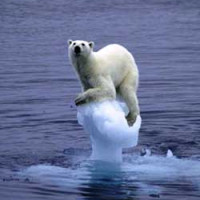
Polar bears drowning in an Alaskan sea because the ice packs are melting-it’s the iconic image of the global warming debate.

But the validity of the science behind the image-presented as an ignoble testament to our environment in peril by Al Gore in his film An Inconvenient Truth-is now part of a federal investigation that has the environmental community on edge.

Special agents from the Interior Department’s inspector general’s office are questioning the two government scientists about the paper they wrote on drowned polar bears, suggesting mistakes were made in the math and as to how the bears actually died, and the department is eyeing another study currently underway on bear populations.

Biologist Charles Monnett, the lead scientist on the paper, was placed on administrative leave July 18. Fellow biologist Jeffrey Gleason, who also contributed to the study, is being questioned, but has not been suspended.

Read the rest at Human Events.

Comments 34 Comments »

polar_bear_clinging1Investors Business Daily Editorial

Climate Change: The scientist who claimed that global warming threatens polar bears is under investigation. There’s a hole in Earth’s greenhouse. A cooler era lies ahead. That hiss is the hot air coming out of alarmists’ balloon.

The global warming fraud is coming apart faster than the alarmists can repackage and rebrand their fairy tale. Their elaborately constructed yarn can’t hold together much longer. There are just too many loose ends:

• Charles Monnett, the scientist who predicted that polar bears would drown from a lack of sea ice, “is being investigated for scientific misconduct, possibly over the veracity” of the article in which he makes that claim, the Associated Press reported Thursday. Monnett, a federal wildlife biologist with the U.S. Bureau of Ocean Energy Management, Regulation and Enforcement, has been placed on leave pending the probe’s outcome.

Read the rest at Investors Business Daily.

Comments 8 Comments »

arctic-ocean-noaaBy Dennis T. Avery

James Hansen of NASA, an ardent believer in man-made warming, announced recently that “The 12-month running mean global temperature in the Goddard Space Institute analysis has reached a new record in 2010 . . . NASA, June 3, 2010. The main factor is our estimated temperature change for the Arctic region.” The GISS figures show that recent temperatures in the Arctic have been up to four degrees C warmer than the long-term mean.Should we be alarmed? Probably not very.

My esteemed colleague Art Horn, at the Energy Tribune blog, has blown the whistle on Hansen and GISS. He points out that GISS has no thermometers in the Arctic! It has hardly thermometers that are even near the Arctic Circle. GISS estimates its arctic temperatures from land-based thermometers that supposedly each represent the temperatures over 1200 square kilometers. That’s a pretty heroic assumption.

Read the rest at Exit Stage Right.

Comments 72 Comments »

graphicBy Don Surber

So let us see, the hockey stick of Michael Mann predicted that the temperature of the Earth would rise exponentially and melt the polar ice caps.

That seems to have ebbed.

And now from a real scientist, Hiroshi L. Tanaka of the University of the University of Tsukuba in Japan: “It is concluded that the arctic warming before 1989 especially in winter was explained by the positive trend of the AOI. Moreover the intensified Beaufort High and the drastic decrease of the sea ice concentrations in September after 1989 were associated with the recent negative trend of the AOI [Arctic Oscillation]. Since the decadal variation of the AO is recognized as the natural variability of the global atmosphere, it is shown that both of decadal variabilities before and after 1989 in the Arctic can be mostly explained by the natural variability of the AO not by the external response due to the human activity.”

The high-pressure sales techniques of junk scientists like Michael Mann is one tip-off that he and his crackpot theory is a scam. The other tip-off is Al Gore and company have done nothing to ameliorate their carbon footprint is another tip-off.

Read the rest of this entry at Daily Mail Blogs.

Comments 3 Comments »

pachauriRajendra Pachauri, the Chairman of the Intergovernmental Panel on Climate Change (IPCC), will defend his handling of a crisis that has shaken the world’s faith in his organisation at a meeting of environmental leaders in Bali.

By Geoffrey Lean

He will try to save his job and shore up support for the IPCC in the wake of the discovery of errors in its latest report.

He is attending a special closed meeting of environment and climate ministers in the fringes of the annual assembly of the United Nations Environment Programme’s (UNEP) Governing Council, the biggest such event since Copenhagen climate summit that ended in confusion and recriminations last December.

The governments are publicly backing Dr Pachauri, who they re-elected unopposed less than 18 months ago – the EU said last night that he had “done a good job, in general” and “deserves full confidence”.  However privately, officials have expressed a wish that he will decide to step down before long.

The IPCC was engulfed in crisis when it emerged that it had relied on unsubstantiated reports from environmental groups to make a headline-grabbing prediction that the glaciers of the Himalayas would disappear by 2035.

Dr Pachauri’s robust response to counterclaims that that the glaciers were not melting so rapidly – which he dismissed as “voodoo science” – only increased pressure on his position.

Read the rest of this article at the Telegraph.

Comments 12 Comments »

india-flag-jpgThe Indian government has established its own body to monitor the effects of global warming because it “cannot rely” on the United Nations’ Intergovernmental Panel on Climate Change, the group headed by its own leading scientist Dr R.K Pachauri.

By Dean Nelson

The move is a significant snub to both the IPCC and Dr Pachauri as he battles to defend his reputation following the revelation that his most recent climate change report included false claims that most of the Himalayan glaciers would melt away by 2035. Scientists believe it could take more than 300 years for the glaciers to disappear.

The body and its chairman have faced growing criticism ever since as questions have been raised on the credibility of their work and the rigour with which climate change claims are assessed.

In India the false claims have heightened tensions between Dr Pachauri and the government, which had earlier questioned his glacial melting claims. In Autumn, its environment minister Mr Jairam Ramesh said while glacial melting in the Himalayas was a real concern, there was evidence that some were actually advancing despite global warming.

Dr Pachauri had dismissed challenges like these as based on “voodoo science”, but last night Mr Ramesh effectively marginalized the IPC chairman even further.

He announced the Indian government will established a separate National Institute of Himalayan Glaciology to monitor the effects of climate change on the world’s ‘third ice cap’, and an ‘Indian IPCC’ to use ‘climate science’ to assess the impact of global warming throughout the country.

“There is a fine line between climate science and climate evangelism. I am for climate science. I think people misused [the] IPCC report, [the] IPCC doesn’t do the original research which is one of the weaknesses… they just take published literature and then they derive assessments, so we had goof-ups on Amazon forest, glaciers, snow peaks.

Read the rest of this story at the Telegraph.

Comments 2 Comments »

himalayan-glaciersBy Ben Webster

The head of the UN’s climate change body is under pressure to resign after one of his strongest allies in the environmental movement said his judgment was flawed and called for a new leader to restore confidence in climatic science.

Rajendra Pachauri, chairman of the Intergovernmental Panel on Climate Change (IPCC), has insisted that he will remain in post for another four years despite having failed to act on a serious error in the body’s 2007 report.

John Sauven, director of Greenpeace UK , said that Dr Pachauri should have acted as soon as he had been informed of the error, even though issuing a correction would have embarrassed the IPCC on the eve of the Copenhagen climate summit.

A journalist working for Science had told Dr Pachauri several times late last year that glaciologists had refuted the IPCC claim that Himalayan glaciers would disappear by 2035. Dr Pachauri refused to address the problem, saying: “I don’t have anything to add on glaciers.” He suggested that the error would not be corrected until 2013 or 2014, when the IPCC next reported.

The IPCC issued a correction and apology on January 20, three days after the error had made global headlines. Mr Sauven said: “Mistakes will always be made but it’s how you handle those mistakes which affects the credibility of the institution. Pachauri should have put his hand up and said ‘we made a mistake’. It’s in these situations that your character and judgment is tested. Do you make the right judgment call? He clearly didn’t.”

Read the rest of this story at the London Times.

Comments No Comments »

Earth Heating Up

Earth Heating Up

By Ninad D. Sheth

It was presented as fact. The UN’s Intergovernmental Panel on Climate Change, led by India’s very own RK Pachauri, even announced a consensus on it. The world was heating up and humans were to blame. A pack of lies, it turns out.

The climate change fraud that is now unravelling is unprecedented in its deceit, unmatched in scope—and for the liberal elite, akin to 9 on the Richter scale. Never have so few fooled so many for so long, ever.

The entire world was being asked to change the way it lives on the basis of pure hyperbole. Propriety, probity and transparency were routinely sacrificed.

The truth is: the world is not heating up in any significant way. Neither are the Himalayan glaciers going to melt as claimed by 2035. Nor is there any link at all between natural disasters such as Hurricane Katrina and global warming. All that was pure nonsense, or if you like, ‘no-science’!

The climate change mafia, led by Dr Rajendra K Pachauri, chairperson of the Intergovernmental Panel on Climate Change (IPCC), almost pulled off the heist of the century through fraudulent data and suppression of procedure. All the while, they were cornering millions of dollars in research grants that heaped one convenient untruth upon another. And as if the money wasn’t enough, the Nobel Committee decided they should have the coveted Peace Prize.

But let’s begin at the beginning. Mr Pachauri has no training whatsoever in climate science. This was known all the time, yet he heads the pontification panel which proliferates the new gospel of a hotter world. How come? Why did the United Nations not choose someone who was competent? After all, this man is presumably incapable of differentiating between ocean sediments and coral terrestrial deposits, nor can he go about analysing tree ring records and so on. That’s not jargon; these are essential elements of a syllabus in any basic course on climatology.

You cannot blame him. His degree and training is in railroad engineering. You read it right. This man was educated to make railroads from point A to point B.

THE GATHERING STORM

There are many casualties in this sad story of greed and hubris. The big victim is the scientific method. This was pointed out in great detail by John P Costella of the Virginia-based Science and Public Policy Institute. Science is based on three fundamental pillars. The first is fallibility. The fact that you can be wrong, and if so proven by experimental input, any hypothesis can be—indeed, must be—corrected.

This was systematically stymied as early as 2004 by the scientific in-charge of the University of East Anglia’s Climate Change Unit. This university was at the epicentre of the ‘research’ on global warming. It is here that Professor Phil Jones kept inconvenient details that contradicted climate change claims out of reports.

The second pillar of science is that by its very nature, science is impersonal. There is no ‘us’, there is no ‘them’. There is only the quest. However, in the entire murky non-scientific global warming episode, if anyone was a sceptic he was labelled as one of ‘them’. At the very apex, before his humiliating retraction, Pachauri had dismissed a report by Indian scientists on glaciers as “voodoo science”.

The third pillar of science is peer group assessment. This allows for validation of your thesis by fellow scientists and is usually done in confidence. However, the entire process was set aside by the IPCC while preparing the report. Thus, it has zero scientific value.

The fact that there was dissent within the climate science teams, that some people objected to the very basis of the grand claims of global warming, did not come out through the due process. It came to light when emails at the Climate Research Centre at East Anglia were hacked in November 2009. It is from the hacked conversations that a pattern of conspiracy and deceit emerge. It is a peek into the world of global warming scaremongering—amplify the impact of CO2, stick to dramatic timelines on destruction of forests, and never ask for a referral or raise a contrary point. You were either a believer in a hotter world or not welcome in this ‘scientific fold’.

HOUSE OF CARDS AND COLOUR OF CASH

So we have the fact that a non-expert heads the IPCC. We have the fact that glaciers are not melting by 2035; this major scaremongering is now being defended as a minor error (it was originally meant to be 2350, some have clarified). The date was spouted first by Syed Hasnain, an Indian glacier expert, in an interview to a magazine. It had no scientific validity, and, as Hasnain has himself said, was speculative.

On the basis of that assertion, The Energy and Resources Institute (Teri) that Pachauri heads and where Hasnain works in the glaciology team, got two massive chunks of funding. The first was estimated to be a $300,000 grant from Carnegie Corporation and the second was a part of the $2 million funding from the European Union. So you write a report that is false on glaciers melting and get millions to study the impact of a meltdown which will not be happening in the first place. Now if this is not a neat one, what is?

Read the rest of this article at Open.

Comments 16 Comments »

pachauriBy Steve Everly

The story behind the IPCC director’s involvement in winning huge grants to study the impacts of a debunked claim about glaciers melting in the Himalayas had another layer added today when the Times Online (U.K.) reported that he knew about the bogus claim before announcing his latest award to study it.

Dr. Rajendra Pachauri, the head of the U.N. IPCC, knew about the lack of credibility of the claim that glaciers in the Himalayas would melt by 2035, which was included in the 2007 IPCC report, as far back as prior to the Copenhagen climate conference in December 2009.

But according to Pachauri, he didn’t find out about the problematic claim, for which the IPCC was forced to apologize last week, until early January 2010. Pachauri said he didn’t recognize the error until “about ten days” before his recent conversation with the Times on January 22nd.

On January 15th, however, approximately three days after the time when Pachauri claimed to have found out about the error, his Energy and Resources Institute (TERI) announced a collaboration with the Global Center of Iceland, funded primarily by the Carnegie Corporation of New York, to study the impacts of Himalayan glacier melt, noting specifically that “credible” science suggested the glaciers could be gone in the next few decades.

So Pachauri knew about the false claim, did not instruct his organization to cancel the collaboration to study the impacts of that false claim, and his organization will be accepting money for research on that false claim.

Read the rest of this story at American Solutions.

Comments 25 Comments »

jerry-lewisConfidence Melting Away: Doubts Grow in Climate Change Debate

By Gerald Traufetter

The Siachen Glacier is home to the world’s highest crisis region. Here, at 6,000 meters (19,680 feet) above sea level, Indian and Pakistani soldiers face off, ensconced in heavily armed positions.

The ongoing border dispute between the two nuclear powers has already claimed the lives of 4,000 men — most of them having died of exposure to the cold.

Now the Himalayan glacier is also at the center of a scientific dispute. In its current report, the Intergovernmental Panel on Climate Change (IPCC) predicts that the glacier, which is 71 kilometers (44 miles) long, could disappear by 2035. It also predicts that the other 45,000 glaciers in the world’s highest mountain range will be virtually gone by then, with drastic consequences for billions of people in Asia, whose life depends on water that originates in the Himalayas. The IPCC report led environmental activists to sound the alarm about a drama that could be unfolding at the “world’s third pole.”

“This prognosis is, of course, complete nonsense,” says John Shroder, a geologist and expert on glaciers at the University of Nebraska in Omaha. The results of his research tell a completely different story.
For the past three decades, the US glaciologist has been traversing the majestic mountains of the Himalayan region, particularly the Karakorum Range, with his measuring instruments. The discoveries he has made along the way are not consistent with the assessment long held by the IPCC. “While many glaciers are shrinking, others are stable and some are even growing,” says Shroder.

Untenable Claim

The gaffe over the Himalayan glaciers has triggered an outcry in the world of climatology. Some are already using the word “Glaciergate” in reference to the scandal over a scientifically untenable claim in the fourth IPCC assessment report, which the UN climate body publishes every five years. The fourth assessment report was originally published in 2007. Last week, the IPCC withdrew the erroneous claim and apologized for the error.

German Environment Minister Norbert Röttgen, a member of the center-right Christian Democratic Union (CDU), is also upset about the incident. “The error in the IPCC report is serious and should not have happened,” Röttgen told SPIEGEL. “Scientific accuracy is a vital condition to support the credibility of the political conclusions we draw as a result.” Although the minister still has confidence in the overall validity of the IPCC report, he wants to see “a thorough investigation into how the error originated and was communicated.”

But why wasn’t this clearly nonsensical claim noticed long ago by at least one of the 3,000 scientists who contributed to the IPCC report? “What’s really amazing is that such a blunder remained uncorrected for so long,” says Shroder.

Read the rest of this story at ABC News (Yes. Really. ABC News).

Comments 24 Comments »

pachauriInvestors Business Daily Editorial

Global Warming: If we’re serious about restoring science to its rightful place, the head of the U.N.’s panel on climate change should step down. Evidence shows he quarterbacked a deliberate and premeditated fraud.The U.N.’s Intergovernmental Panel on Climate Change has been forced to back off its now-discredited claim that the Himalayan glaciers would soon disappear. But it’s not true, the panel’s vice chairman, Jean-Pascal van Ypersele, told the BBC, that it was simply a “human mistake.”

The panel’s chairman, Dr. Rajendra K. Pachauri, who was forced to admit the claim had no basis in observable scientific fact, said its inclusion was merely a “poor application” of IPCC procedures, acting as if the original source of the claim, Indian scientist Dr. Syed Hasnain, was a total stranger.

In fact, as Christopher Booker of the London Telegraph points out, Dr. Hasnain “has for the past two years been working as a senior employee of the Energy and Resources Institute (TERI), the Delhi-based company of which Dr. Pachauri was director-general.”

So after the 2007 assessment that included Hasnain’s claim, Pachauri was impressed enough to hire him as an employee. Pachauri should have been familiar with both his work and the fact the claim had not been peer-reviewed, and aware that it had been challenged by reputable geologists.

Read the rest of this piece at Investors Business Daily.

Comments 19 Comments »

Bad Behavior has blocked 2771 access attempts in the last 7 days.