Since the flurry of activity surrounding its passage by the House in late June, little has been heard about the historic climate change bill aimed at curbing global warming. But the Senate will be tackling the controversial measure when it returns to Washington next week.
A new Rasmussen Reports national telephone survey finds that public sentiment on the bill, which opponents claim will have a negative overall impact on the U.S. economy, is largely unchanged over the last two months.
Thirty-five percent (35%) of Americans favor the climate change bill, while 40% are opposed to it. However, the antis feel more strongly: Twenty-six percent (26%) Strongly Oppose the bill versus 10% who Strongly Favor it.
Nearly one-in-four adults (24%) are not sure whether passage of the bill is a good idea or not. These findings are virtually the same as in late June.
Women favor the bill more strongly than men. Older voters are more likely to oppose it.
Fifty-eight percent (58%) of Democrats support the climate control bill, while the identical number (58%) of Republicans and the plurality (47%) of adults not affiliated with either party oppose it. Thirty-nine percent (39%) of Republicans Strongly Oppose, while 20% of Democrats Strongly Favor the bill.
Given the limited coverage of the climate change legislation and the dominance of the health care debate over the summer, these numbers could change significantly as the legislative debate unfolds.
“I expect all the bad consequences from the chambers of Commerce and manufacturers establishing in different parts of this country, which your Grace seems to foresee…. The regulations of Commerce are commonly dictated by those who are most interested to deceive and impose upon the Public.†– Adam Smith, 1785 letter. In The Correspondence of Adam Smith.
By Robert Peltier
The American Clean Energy and Security Act of 2009 (H.R. 2454, aka Waxman–Markey) was narrowly adopted by the House of Representatives on June 26. As has become standard practice, few legislators were familiar with the final 1,428-page bill, given all the horse-trading hours before the final vote.
Waxman–Markey was a low point in the political process, but what made passage possible was worse: highly organized support from some quarters of the electric utility industry and a lack of protestation from much of the rest.
Some industry parties believe that their lobbyists successfully watered down an extremely disruptive legislative draft to the point that the final was merely distasteful. But compared to killing the bill, which could have been done had the industry been so minded, getting “a seat at the table†resulted in passage.
I remember when â€getting a seat†in legislative negotiations included infiltrating and defeating bad proposals. Today, it means ensuring your company gets a piece of the political pork. Such “rent-seeking†substitutes political capitalism for principled free-market capitalism and leaves virtually all of us poorer.
A tornado touchdown in Minneapolis and driving rains threatened to waylay the Symposium on Climate Change organized by the Free Market Institute on Wednesday.
Fortunately, no one was ushered into the storm shelters at the Earle Brown Heritage Center and the storm quickly passed allowing the presentation to go on as planned.
Because of the controversial nature of the climate change debate, managers at the Earle Brown Center took the precaution of staffing security at the event, but aside from a brief misunderstanding about a yellow feather-suit being donned in a restroom, there was no threat of anarchy. Minnesotans for Global Warming’s exhibit included a man in a Chicken Little costume, who security officer Larry Deiman initially mistook for a potentially disruptive protestor. The half-dressed Chicken Little quickly explained himself and got to work in the hall announcing his trademark alarm, “the sky is falling!â€
Dr. Fred Singer, author of Unstoppable Global Warming: Every 1,500 Years kicked off the event with a detailed debunking of several popular climate science misconceptions and a thorough analysis of problems with several IPCC reports.
State Senator Jungbauer explained the state of arctic ice, the nature of sea level rise and Greenland’s ice cover in a breakout session.
There were several other national and local climate experts making presentations, including Dr. Pekarek from St. Cloud University.
About 300 people attended the event. The Minnesota Taxpayers League, Minnesotans for Global Warming and Minnesota Majority maintained information booths there.
For some, the symposium was a refresher course in skepticism of man-made (anthropogenic) global warming. For others it was an eye-opener. “I came here with an open mind,†said one attendee, who stopped at the Minnesota Majority / GlobalClimateScam.com booth, “I didn’t really know what to think [about global warming]. A lot of the things I heard here, I’d never heard before,†she said.
Update: Video from the Symposium is now available.
Competitive Enterprise Institute Senior Fellow Marlo Lewis has released a new 40 minute film called Policy Peril: Why Global Warming Policies Are More Dangerous Than Global Warming Itself.
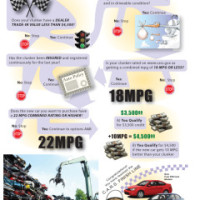
If you watch television you’ve seen the ads: “So bring in that old jalopy and get up to $4,500 towards the purchase of a new or select used vehicle. That’s right, get up to $4,500 for that old piece of junk, plus you keep the rebates. You have to hurry! Since funds are limited for this program it’s first come, first served!†Well, we’re about to find out just how limited those funds were. The Obama administration’s cash-for-clunkers program has been such a “success†that in just the first week of full implementation, the $1 billion originally allocated for the program is about to be exhausted already. Does this mean the program is over? We don’t know. Nobody does. And that is just the beginning of why this program is a perfect illustration of why Obamanomics will fail.
Does Nothing for Environment: Sens. Dianne Feinstein (D-CA) and Susan Collins (R-ME) are open to allocating more money for the program, but only if the rules are changed so that the program might actually do something for environment; because right now it is not. Edmunds.com auto analyst Jessica Caldwell explains why: “What you buy has to have an increase in fuel economy from what you traded in. But in some cases, that increase can be minimal. Owners of large pickup trucks like a Ford F150 only have to buy a replacement that increases efficiency by one mile per gallon. And they still get a $3,500 rebate. The environmental impact is negligible and the impact on national fuel demand and consumption is very small. The only real benefit in a like-for-like swap can be improved emissions standards on newer vehicles. Rather than discourage those people, they included them in this program.†Caldwell didn’t even mention the pollution costs of actually building a new car and the disposal of the old car, rather than just the pollution caused by driving the vehicle.
Hurts Working Americans: The federal government’s push to help auto makers has unintended consequences which will hut many lower-income Americans. Economist, Freakonomics author and New York Times blogger Steven Levitt writes: “People who drive clunkers are generally not in the market for new cars. Presumably their replacement car will be a used car. The increased demand for used cars will lead to higher prices for used cars.†Driving up the cost of older cars may be an intended consequence for policymakers to encourage people to buy new, but it’s a bad deal for consumers.
Some people who are serious about wanting to reduce their “carbon footprint” on the Earth have one choice available to them that may yield a large long-term benefit – have one less child.
A recent study by statisticians at Oregon State University concluded that in the United States, the carbon legacy and greenhouse gas impact of an extra child is almost 20 times more important than some of the other environmentally sensitive practices people might employ their entire lives – things like driving a high mileage car, recycling, or using energy-efficient appliances and light bulbs.
The research also makes it clear that potential carbon impacts vary dramatically across countries. The average long-term carbon impact of a child born in the U.S. – along with all of its descendants – is more than 160 times the impact of a child born in Bangladesh.
“In discussions about climate change, we tend to focus on the carbon emissions of an individual over his or her lifetime,” said Paul Murtaugh, an OSU professor of statistics. “Those are important issues and it’s essential that they should be considered. But an added challenge facing us is continuing population growth and increasing global consumption of resources.”
In this debate, very little attention has been given to the overwhelming importance of reproductive choice, Murtaugh said. When an individual produces a child – and that child potentially produces more descendants in the future – the effect on the environment can be many times the impact produced by a person during their lifetime.
Under current conditions in the U.S., for instance, each child ultimately adds about 9,441 metric tons of carbon dioxide to the carbon legacy of an average parent – about 5.7 times the lifetime emissions for which, on average, a person is responsible.
And even though some developing nations have much higher populations and rates of population growth than the U.S., their overall impact on the global equation is often reduced by shorter life spans and less consumption. The long-term impact of a child born to a family in China is less than one fifth the impact of a child born in the U.S., the study found.
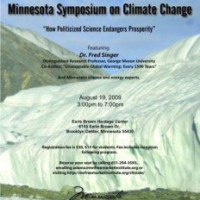
On Wednesday, August 19th, Dr. Fred Singer (physicist, research professor at George Mason University and author of Unstoppable Global Warming: Every 1500 Years) will headline the Minnesota Symposium on Climate Change at the Earle Brown Center. The program begins at 3:00 and will be followed by a reception at 7:00.
Dr. Pekarek from St. Cloud State University as well as other noted Minnesota Climate experts will also speak.
Following a general presentation, there will be a series of breakout sessions following either the economics or science of global warming theories and policies.