Archive for the “Real Solutions” Category


moncktonThe Minnesota Free Market Institute will be premiering the new documentary film, “Climate Chains” at an event featuring keynote speaker, Lord Christopher Monckton on Wednesday, October 14th. Monckton was an advisor to former British Prime Minister Margaret Thatcher, serves as the chief policy adviser to the Institute of Science and Public Policy and is known as the man congressional Democrats were afraid would humiliate Al Gore if he’d been allowed to testify alongside him in a congressional hearing back in April. Naturally, that couldn’t be allowed. Career climate alarmists fear Lord Monckton.

Climate Chains was produced by the Cascade Policy Institute and it addresses the perils of cap and trade legislation while examining free market solutions to actual environmental concerns.

This FREE event promises to be entertaining and informative.

Wednesday, October 14th
7:00pm
Free Admission

Benson Great Hall
Bethel University
3900 Bethel Drive
St. Paul, Minnesota 55112

Comments 14 Comments »

ncpa-earthBy H. Sterling Burnett

Many people are concerned that an increasing concentration of greenhouse gases in the atmosphere — due primarily to such human activities as burning fossil fuels for energy — is causing the Earth to warm, with potentially harmful results. In response, many developed countries agreed to the Kyoto Protocol on Climate Change, committing them to limit and eventually reduce their greenhouse gas emissions. The United States chose not to participate, in part because the agreement exempts such developing countries as China and India, although they have the world’s fastest-growing economies and emissions.

However, the Obama administration supports a cap-and-trade system similar to the one implemented by the Kyoto agreement. The U.S. Senate will debate a cap-and-trade proposal in fall 2009 under the American Clean Energy and Security Act. The initial version of the bill would have auctioned all of the emissions allowances, but business lobbies and special interests influenced Congress to give away 85 percent of them.

Climate researcher Chip Knappenberger estimates the bill would only reduce global temperatures by about one-tenth of a degree by 2050. The U.S. Energy Information Administration estimates it would reduce U.S. gross domestic product (GDP) by 0.2 percent over the period from 2012 to 2030 — but other organizations estimate the cost to be much higher:

  • Cap-and-trade would cost an average of $314 billion a year in lost GDP, according to Heritage Foundation estimates, or $9.4 trillion over the period from 2012 to 2035.
  • It could cost taxpayers up to $200 billion year, or $1,761 per family annually, according to a U.S. Treasury Department report.
  • It would increase the cost of residential electricity 31 percent to 50 percent by 2030, says the American Council for Capital Formation and the National Association of Manufacturers.
  • Job losses would total 2.5 million by 2030, estimates the National Black Chamber of Commerce.

In contrast to the economic costs of limits on greenhouse gas emissions there are responses to climate change that would have substantial economic benefits.

Climate change is mainly projected to add to existing problems, rather than create new ones. Focused adaptation addresses these problems — including malaria, hunger and coastal flooding — directly now, rather than indirectly in the future via emissions reductions. For example, according to the World Health Organization, malaria’s current yearly death toll of one million could be halved with annual expenditures of $1.5 billion or less (in 2003 dollars). By contrast, limiting emissions to 1990 levels, as called for under the Kyoto Protocol, would reduce the total number of people at risk from malaria in 2085 by 0.2 percent, while costing about $165 billion in 2010 alone.

Read the rest of this report from the National Center for Policy Analysis.

Comments 13 Comments »

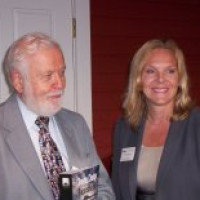
Dr. Fred Singer and Event Organizer, Pat Anderson

Dr. Fred Singer and Event Organizer, Pat Anderson

A tornado touchdown in Minneapolis and driving rains threatened to waylay the Symposium on Climate Change organized by the Free Market Institute on Wednesday.

Fortunately, no one was ushered into the storm shelters at the Earle Brown Heritage Center and the storm quickly passed allowing the presentation to go on as planned.

Because of the controversial nature of the climate change debate, managers at the Earle Brown Center took the precaution of staffing security at the event, but aside from a brief misunderstanding about a yellow feather-suit being donned in a restroom, there was no threat of anarchy. Minnesotans for Global Warming’s exhibit included a man in a Chicken Little costume, who security officer Larry Deiman initially mistook for a potentially disruptive protestor. The half-dressed Chicken Little quickly explained himself and got to work in the hall announcing his trademark alarm, “the sky is falling!”

Dr. Fred Singer, author of Unstoppable Global Warming: Every 1,500 Years kicked off the event with a detailed debunking of several popular climate science misconceptions and a thorough analysis of problems with several IPCC reports.

State Senator Jungbauer explained the state of arctic ice, the nature of sea level rise and Greenland’s ice cover in a breakout session.

There were several other national and local climate experts making presentations, including Dr. Pekarek from St. Cloud University.

About 300 people attended the event. The Minnesota Taxpayers League, Minnesotans for Global Warming and Minnesota Majority maintained information booths there.

For some, the symposium was a refresher course in skepticism of man-made (anthropogenic) global warming. For others it was an eye-opener. “I came here with an open mind,” said one attendee, who stopped at the Minnesota Majority / GlobalClimateScam.com booth, “I didn’t really know what to think [about global warming]. A lot of the things I heard here, I’d never heard before,” she said.

Update: Video from the Symposium is now available.

Comments 18 Comments »

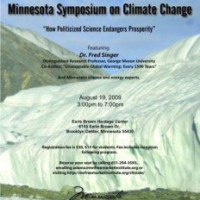
climate-change-symposiumOn Wednesday, August 19th, Dr. Fred Singer (physicist, research professor at George Mason University and author of Unstoppable Global Warming: Every 1500 Years) will headline the Minnesota Symposium on Climate Change at the Earle Brown Center. The program begins at 3:00 and will be followed by a reception at 7:00.

Dr. Pekarek from St. Cloud State University as well as other noted Minnesota Climate experts will also speak.

Following a general presentation, there will be a series of breakout sessions following either the economics or science of global warming theories and policies.

This event is being sponsored by the Minnesota Free Market Institute. Minnesota Majority will maintain a GlobalClimateScam.com booth there and Minnesotans For Global Warming are expected as well.

Registration is $30. Students with a current student ID get in for half-price.

Register online here.

Comments 15 Comments »

Bjorn Lomborg, Author - the Skeptical Environmentalist

By Bjorn Lomborg

The continuous presentation of scary stories about global warming in the popular media makes us unnecessarily frightened. Even worse, it terrifies our kids.

Al Gore famously depicted how a sea-level rise of 20 feet (six meters) would almost completely flood Florida, New York, Holland, Bangladesh, and Shanghai, even though the United Nations estimates that sea levels will rise 20 times less than that, and do no such thing.

When confronted with these exaggerations, some of us say that they are for a good cause, and surely there is no harm done if the result is that we focus even more on tackling climate change. A similar argument was used when George W. Bush’s administration overstated the terror threat from Saddam Hussein’s Iraq.

But this argument is astonishingly wrong. Such exaggerations do plenty of harm. Worrying excessively about global warming means that we worry less about other things, where we could do so much more good.

We focus, for example, on global warming’s impact on malaria ― which will be to put slightly more people at risk in 100 years ― instead of tackling the half-billion people suffering from malaria today with prevention and treatment policies that are much cheaper and dramatically more effective than carbon reduction would be.

Exaggeration also wears out the public’s willingness to tackle global warming. If the planet is doomed, people wonder, why do anything? A record 54 percent of American voters now believe the news media make global warming appear worse than it really is.

A majority of people now believes ― incorrectly ― that global warming is not even caused by humans. In the United Kingdom, 40 percent believe that global warming is exaggerated and 60 percent doubt that it is manmade.

But the worst cost of exaggeration, I believe, is the unnecessary alarm that it causes ― particularly among children. Recently, I discussed climate change with a group of Danish teenagers. One of them worried that global warming would cause the planet to “explode” ― and all the others had similar fears.

In the U.S., the ABC television network recently reported that psychologists are starting to see more neuroses in people anxious about climate change. An article in the Washington Post cited nine-year-old Alyssa, who cries about the possibility of mass animal extinctions from global warming.

In her words: “I don’t like global warming because it kills animals, and I like animals.” From a child who is yet to lose all her baby teeth: “I worry about [global warming] because I don’t want to die.”

The newspaper also reported that parents are searching for “productive” outlets for their eight-year-olds’ obsessions with dying polar bears. They might be better off educating them and letting them know that, contrary to common belief, the global polar bear population has doubled and perhaps even quadrupled over the past half-century, to about 22,000.

Read the rest at The Korea Times.

Comments 7 Comments »

Roy Innis, National Chairman of Congress of Racial EqualityBy Roy Innis 

The U.S. civil rights revolution of the 1950s and ’60s was one of the greatest social and political liberations in history. It gave African-Americans and other minorities new opportunities and new levels of success in virtually every walk of life.

But today we face unprecedented new challenges to indispensable but often neglected rights enunciated in our Declaration of Independence: “That all men are endowed by their Creator with certain unalienable rights; that among these are life, liberty, and the pursuit of happiness.”

These fundamental rights are under assault in subtle, often insidious ways. Sometimes it is with the best of intentions, by good people who don’t realize they are impairing other people’s rights, hopes and dreams. At other times, it is by people who are willing, even determined, to sacrifice individual rights in the name of a proclaimed threat or greater common good.

One critical challenge involves restrictions on access to energy and economic opportunity - and thus on liberties and rights - in the name of protecting the environment.

Energy is the master resource of modern society. It transforms constitutionally protected civil rights into rights we actually enjoy: jobs, homes, transportation, health care and other earmarks of life, liberty and the pursuit of happiness. With abundant, reliable, affordable energy, much is possible. Without it, hope, opportunity, progress, job creation and civil rights are hobbled.

Laws and policies that restrict access to America’s abundant energy drive up the price of fuel and electricity. They cause widespread layoffs and leave workers and families struggling to survive, as the cost of everything they eat, drive, wear and do spirals higher. They roll back the progress for which civil rights revolutionaries like the Rev. Martin Luther King struggled and died.

They create unnecessary obstacles to the natural, justifiable desire of minority Americans to share in the American Dream. They prevent us from resolving conflicts through compromise and impose needless and unfair burdens on our poorest families. These regressive, energy-killing laws and policies deny minority and other poor families a seat at the energy lunch counter and send us to the back of the economic bus.

The Congress of Racial Equality and I care deeply about our environment. But we also care about having jobs, and affordable food, heat and transportation. We care about impoverished Third World families achieving their dreams.

We want to know that the environmental values we cherish really are threatened the way environmental activists say they are. And we want to know that the solutions they advocate really will safeguard those values, at reasonable cost, without creating enormous new problems, like global grain shortages.

Today, unfortunately, these common-sense requests are under assault by activists who want to eliminate fossil fuels, base public policies on unfounded ecological scare stories, and stifle debate by attacking anyone who challenges their assertions.

Energy reality must no longer be denied. Fully 85 percent of all the energy Americans use comes from fossil fuels. Add in nuclear and hydroelectric power, and we’ve reached 96 percent. Biomass (3 percent) is mostly waste from paper mills and sawmills.

A mere 0.8 percent is wind and solar power. These renewable sources are not alternatives to fossil fuel use. They are supplements. Just to provide electricity to meet New York City’s needs would require blanketing Connecticut with 300-foot-tall wind turbines that generate power only eight hours a day, on average. That is neither economically nor ecologically sustainable.

Read the rest of this piece at The Washington Times.

Comments 8 Comments »

Wind TurbinesBy Paul Driessen 

T. Boone Pickens is being lionized for his “socially responsible” efforts to legislate national “clean” wind and solar energy mandates.

We’re “the Saudi Arabia of wind,” he argues. We need to “overcome our addiction to foreign oil,” by harnessing that wind to replace natural gas in electricity generation, and using that gas to power more cars and buses. If Congress would simply “mandate the formation of wind and solar transmission corridors, and renew the subsidies” for this renewable energy, America can achieve this transformation in ten years, he insists.

Pickens’ pitch makes good ad copy, especially in league with Senator Harry Reid’s bombast about oil, gas and coal “making us sick.” However, his policy prescriptions would impose vast new energy, economic and environmental problems.

Hydrocarbon fuels created America, gave us the technologies and living standards we enjoy today, enabled us to eradicate diseases that plagued earlier generations, and boosted our life expectancy from 50 in 1900 to nearly 80 today. They still provide 85% of our energy, and we could greatly reduce our reliance on oil imports if we would simply end the outrageous policies that keep our nation’s abundant energy resources locked up.

We have enough oil, natural gas, oil shale, coal and uranium to provide power for centuries. We have a growing consensus that we need to drill, onshore and off. But partisan intransigence and absurd environmental claims prevent us from utilizing them. Instead, we’re offered bromides like wind.

Wind contributes more every year to our energy mix. However, it still provides only 1% of our electricity – compared to 49% for coal, 22% for natural gas, 19% for nuclear and 7% for hydroelectric.

Wind power is intermittent, unreliable, noisy and expensive (even with subsidies). Many modern turbines are 400 feet tall and carry 130-foot-long, 7-ton blades that slice up raptors and other birds. They operate only 8 hours a day, on average, compared to 85% of the time for coal, gas and nuclear plants. They rarely provide power during peak summer daytime hours, when air-conditioning demand is highest, but wind speed is low to nonexistent.

Using wind to replace all gas-fired power plants would require some 300,000 1.5-MW turbines, covering Midwestern “wind belt” acreage equivalent to South Carolina. The noise, scenic impacts and bird kills caused by such an “eco-friendly” energy source defy imagination.

Building and installing these turbines requires 5 to 10 times more steel and concrete than is needed to build far more reliable coal or nuclear plants to generate the same amount of electricity, says Berkeley engineer Per Peterson. Add in the financing, steel and cement needed to build transmission lines from distant wind farms to urban consumers, and the effects multiply.

That means vastly more quarries, mines, cement plants and steel mills to supply those raw materials. But radical greens oppose such facilities. So under the Pickens proposal, we would likely import more steel and cement, instead of oil.

Moreover, since adequate wind is available only a third of the time, we would also need expensive gas-fired generating plants that mostly sit idle, but kick in whenever the wind dies down. That means still more money, cement and steel – and still higher electricity prices.

A successful oilman, investor, deal-maker and speculator, Pickens’ large natural gas holdings position him to make billions from selling gas for backup electricity generation under his wind energy proposal – especially if drilling bans remain in effect, keeping gas prices in the stratosphere. Launching the enterprise with the backing of federal mandates and subsidies minimizes his financial risk and attracts “free market” investors, by putting the risks for this fanciful scheme on the backs of taxpayers.

In short, Pickens’ proposal is “true green” – in the financial and public relations arenas, though hardly in the ecological sphere.

Pickens says we can’t drill our way to freedom from foreign oil. But that’s true only if we keep our best prospects off limits to drilling. Open ANWR and the OCS, and the situation changes dramatically.

Read the rest of this article at Town Hall.

Comments 5 Comments »

Linda RunbeckBy Linda C. Runbeck

A recent Pioneer Press column by Sen. Amy Klobuchar called for a federal energy policy with multiple strategies, or in her words, ’silver buckshot,’ to bring gas prices under control and increase our energy reserves.

A good approach, but she fails to include the simplest and most easily accomplished ways to reach that goal — including some that she, as a U.S. senator, could put on the table tomorrow.

For example, Klobuchar said President Bush should “use his bargaining power” with OPEC countries to get them to increase their oil production, yet she neglects discussion of our own domestic sources.

Domestic energy production will stabilize energy prices and create independence from foreign oil. Shouldn’t our leaders be talking about such proven sources as nuclear power, hydropower and clean coal and putting on the table such winners as more refineries and domestic drilling?

Of course they should, yet Congress continues to vote to put vast sources of energy off-limits. Some regions, like the Outer Continental Shelf and Alaska’s Arctic National Wildlife Refuge, are known to contain huge reserves of oil and natural gas.

These proven solutions are not without their down-sides and environmental costs — and Congress must intensify the demand for technological answers — but we are a producer nation that is totally dependent on abundant and reliable energy. Our domestic supplies of coal, oil and natural gas offer the most immediate hope for a nation whose energy needs are increasing, not decreasing.

High gasoline prices are a worldwide problem of supply and demand spiked by increasing demand from China and India and near-capacity production. When Klobuchar puts the blame on traders and the futures market and proposes new regulations, she risks hurting U.S. investors and distorting the very market that operates to warn us of pending limited supplies and increased worldwide demand.

Alternatives to fossil fuel are essential, but they must pollute less and be cost effective and efficient to produce. Unfortunately, Klobuchar’s alternatives score poorly. The ethanol mandate she claimed victory for in late 2007 requires a 700 percent increase in ethanol production by 2022, but will come at a huge cost of increased food prices and reduced supply.

Despite assurances from Klobuchar that cellulosic ethanol is just around the corner, a February 2008 study from Iowa State University concludes it’s a risky bet that it can supply the billions of gallons Congress mandated by 2022, and it’s even more expensive to subsidize than corn-based ethanol.

Klobuchar is also poised to penalize oil and natural gas producers with increased drilling fees on public lands while Congress leans toward increased taxes and elimination of tax deductions. Such responses will translate directly into higher prices at the pump and slow the development of domestic energy supplies. In fact, the extremely low oil prices of the 1990s mothballed many small domestic producers; now, they should be encouraged to get their production facilities up and running again.

Higher fees and taxes on energy producers will further penalize the consumer and the legions of small investors and retirees whose investments in mutual funds or diversified retirement plans stand to lose.

Klobuchar is right: The nation needs a “smart, strong long-term energy strategy.” While conservation and alternative fuels must be included, alone they do not meet current or future needs. Until we find the “bridge” to more environmentally friendly energy alternatives, we must depend on proven sources of abundant and cost-effective energy to supply our food and fuel our homes, jobs, businesses and transportation.

Congress should focus on encouraging domestic energy production and making sure our U.S. energy producers are working overtime to increase our energy reserves. What we don’t need are counterproductive efforts by Congress that disadvantage U.S. companies working hard to produce the proven conventional energy resources that keep us moving. Whether it’s a silver bullet or silver buckshot, we have to make sure we’re aiming at the right target.

Linda Runbeck is a former Minnesota state senator and is president of the American Property Coalition, based in St. Paul.

Comments 3 Comments »

Here’s a copy the remarks made by Václav Klaus, president of the Czech Republic, delivered at the 2008 International Conference on Climate Change.

Mr. Chairman, ladies and gentlemen,

I would like first of all to thank the organizers of this important conference for making it possible and also for inviting one politically incorrect politician from Central Europe to come and speak here. This meeting will undoubtedly make a significant contribution to the moving away from the irrational climate alarmism to the much needed climate realism.

I know it is difficult to say anything interesting after two days of speeches and discussions here. If I am not wrong, I am the only speaker from a former communist country and I have to use this as a comparative — paradoxically — advantage. Each one of us has his or her experiences, prejudices and preferences. The ones that I have are — quite inevitably — connected with the fact that I have spent most of my life under the communist regime. A week ago, I gave a speech at an official gathering at the Prague Castle commemorating the 60th anniversary of the 1948 communist putsch in the former Czechoslovakia. One of the arguments of my speech there, quoted in all the leading newspapers in the country the next morning, went as follows: “Future dangers will not come from the same source. The ideology will be different. Its essence will, nevertheless, be identical — the attractive, pathetic, at first sight noble idea that transcends the individual in the name of the common good, and the enormous self-confidence on the side of its proponents about their right to sacrifice the man and his freedom in order to make this idea reality.” What I had in mind was, of course, environmentalism and its currently strongest version, climate alarmism.

This fear of mine is the driving force behind my active involvement in the Climate Change Debate and behind my being the only head of state who in September 2007 at the UN Climate Change Conference, only a few blocks away from here, openly and explicitly challenged the current global warming hysteria. My central argument was — in a condensed form — formulated in the subtitle of my recently published book devoted to this topic which asks: “What is Endangered: Climate or Freedom?” My answer is clear and resolute: “it is our freedom.” I may also add “and our prosperity.”

What frustrates me is the feeling that everything has already been said and published, that all rational arguments have been used, yet it still does not help. Global warming alarmism is marching on. We have to therefore concentrate (here and elsewhere) not only on adding new arguments to the already existing ones, but also on the winning of additional supporters of our views. The insurmountable problem as I see it lies in the political populism of its exponents and in their unwillingness to listen to arguments. They — in spite of their public roles — maximize their own private utility function where utility is not any public good but their own private good — power, prestige, carrier, income, etc. It is difficult to motivate them differently. The only way out is to make the domain of their power over our lives much more limited. But this will be a different discussion.

We have to repeatedly deal with the simple questions that have been many times discussed here and elsewhere:

1) Is there a statistically significant global warming?

2) If so, is it man-made?

3) If we decide to stop it, is there anything a man can do about it?

4) Should an eventual moderate temperature increase bother us?

Read the complete speech at Heartland Institue.

Comments 1 Comment »

There have been a host of debates this year between the Democratic and Republican candidates for president. Many of these candidates believe that among our top priorities is to address global warming by reducing carbon emissions. All or most seem to agree that decreasing America’s energy dependence is another. Yet few if any of the candidates have mentioned that nuclear energy-or, as I prefer, terrestrial energy-could serve both these ends.

Right now there are 103 operating nuclear reactors in America, but most are owned by utilities (which also own coal plants). The few spin-offs that concentrate mainly on nuclear-Entergy, of Jackson, Mississippi, and Exelon, of Chicago-are relatively small players. As for a nuclear infrastructure, it hardly exists. There is only one steel company in the world today that can cast the reactor vessels (the 42-foot, egg-shaped containers at the core of a reactor): Japan Steel Works. As countries around the world begin to build new reactors, the company is now back-ordered for four years. Unless some enterprising American steel company takes an interest, any new reactor built in America will be cast in Japan.

This is an extraordinary fate for what was once regarded as an American technology. France, China, Russia, Finland, and Japan all perceive the enormous opportunity that nuclear energy promises for reducing carbon emissions and relieving the world’s energy problems as reflected in recent soaring oil prices. Yet in America, we remain trapped in a Three Mile Island mentality, without even a public discussion of the issue. As folk singer Ani Di-Franco puts it, the structure of the atom is so perfect that it is “blasphemy / To use it to make bombs / Or electricity.”

It is time to step back and question whether this prejudice makes sense.

Read the full article fom Imprimis

Comments 1 Comment »

Bad Behavior has blocked 2146 access attempts in the last 7 days.