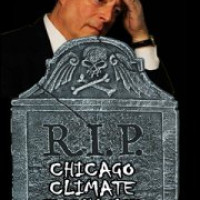
Cap-And-Trade: While senators froth over Goldman Sachs and derivatives, a climate trading scheme being run out of the Chicago Climate Exchange would make Bernie Madoff blush. Its trail leads to the White House.
Lost in the recent headlines was Al Gore’s appearance Monday in Denver at the annual meeting of the Council of Foundations, an association of the nation’s philanthropic leaders.
“Time’s running out (on climate change),” Gore told them. “We have to get our act together. You have a unique role in getting our act together.”
Gore was right that foundations will play a key role in keeping the climate scam alive as evidence of outright climate fraud grows, just as they were critical in the beginning when the Joyce Foundation in 2000 and 2001 provided the seed money to start the Chicago Climate Exchange. It started trading in 2003, and what it trades is, essentially, air. More specifically perhaps, hot air.
The Chicago Climate Exchange (CCX) advertises itself as “North America’s only cap-and-trade system for all six greenhouse gases, with global affiliates and projects worldwide.” Barack Obama served on the board of the Joyce Foundation from 1994 to 2002 when the CCX startup grants were issued. As president, pushing cap-and-trade is one of his highest priorities. Now isn’t that special?
The effort to enact comprehensive climate and energy legislation this year suffered a critical blow Saturday when Sen. Lindsey O. Graham (S.C.), the key Republican proponent of the bill, withdrew his support because of what he said was a “cynical political” decision by Democrats to advance immigration legislation first.
The move forced the other two authors of the climate and energy bill, Sens. John F. Kerry (D-Mass.) and Joseph I. Lieberman (I-Conn.), to cancel a much-anticipated news conference planned for Monday at which they were to unveil the plan they negotiated with Graham.
Graham, who spent weeks working with Sen. Charles E. Schumer (D-N.Y.) on an immigration measure that will appeal to both parties, wrote in an open letter Saturday to leaders of the climate effort, “Moving forward on immigration — in this hurried, panicked manner — is nothing more than a cynical political ploy.”
In an interview, Graham said he has become convinced that Democrats have decided to push for an immigration overhaul in an effort to mobilize Hispanic voters, a key political bloc, and that only a focused effort on a climate and energy bill could ensure its passage.
Democrats denied that election-related considerations were driving the focus on immigration, and the White House, Reid, and Kerry and Lieberman said they would continue to press ahead with the climate and energy effort.
Even so, Graham’s departure greatly undermines Democrats’ prospects of picking up the handful of Republican votes needed for passage. “If Senator Graham leaves the effort, a long shot becomes a no-shot,” said Joe Stanko, who heads up government relations for the law firm Hunton & Williams and represents several industries that would face new federal regulation under a climate bill.
In November last year a file appeared on the internet containing thousands of emails and other documents from the Climatic Research Unit at the University of East Anglia in Britain. How this file got into the public domain is still uncertain, but the emails, whose authenticity is no longer in question, provided a startling view into the world of climate research.
In what has become known as Climategate, one could see unambiguous evidence of the unethical suppression of information and opposing viewpoints, and even data manipulation.
Moreover, the emails showed collusion with other prominent researchers in the US and elsewhere. The CRU supplies many of the authors for the UN Intergovernmental Panel on Climate Change.
One might have thought the revelations would discredit the science underlying proposed global warming policy. Indeed, the revelations may have played some role in the failure of last December’s Copenhagen climate conference to agree on new carbon emissions limits.
But with the political momentum behind policy proposals and billions in research funding at stake, the effect of the emails appears to have been small.
The general approach of the scientific community (at least in the US and Britain) has been to see whether people will bother to look at the files in detail (they mostly have not) and to wait until time diffuses the initial impressions to reassert the original message of a climate catastrophe that must be fought with widespread carbon control. This reassertion, however, continues to be suffused by illogic, nastiness and outright dishonesty.
There were, of course, the inevitable investigations of individuals such as Penn State University’s Michael Mann (who manipulated data to create the famous “hockey stick” climate graph) and Phil Jones (director of the CRU).
The investigations were brief, lacked depth and were conducted mainly by individuals already publicly committed to the popular view of climate alarm. The results were whitewashes that are incredible given the data.
Measure could affect states’ climate control activities (Adds reaction from American Petroleum Institute)
By Richard Cowan
A long-awaited compromise bill to reduce U.S. emissions of carbon dioxide and other gases blamed for global warming will be unveiled by a group of senators on April 26, sources said on Thursday.
The legislative language to be sketched out in 11 days, according to government and environmental sources, is being drafted by Democratic Senator John Kerry, Republican Senator Lindsey Graham and independent Senator Joseph Lieberman.
Backers of the environmental bill hope the unveiling will pave the way for the full Senate to debate and pass a measure in June or July if the compromise attracts enough support from a group of moderate Republicans and Democrats.
We need a more authoritative world. We’ve become a sort of cheeky, egalitarian world where everyone can have their say. It’s all very well, but there are certain circumstances – a war is a typical example – where you can’t do that. You’ve got to have a few people with authority who you trust who are running it. And they should be very accountable too, of course.
But it can’t happen in a modern democracy. This is one of the problems. What’s the alternative to democracy? There isn’t one. But even the best democracies agree that when a major war approaches, democracy must be put on hold for the time being. I have a feeling that climate change may be an issue as severe as a war. It may be necessary to put democracy on hold for a while.
By Leo Hickman
When I recently interviewed James Lovelock for the G2 section of the Guardian, we spoke for nearly two hours about the various events of the past few months – a period in which he’d remained silent because he’d been over-wintering with his wife Sandy in her native Missouri. There was a lot to talk about: the stolen emails from the University of East Anglia, the UN climate summit in Copenhagen, the intense scrutiny placed on the IPCC, and the rather nippy winter experienced across much of the Northern Hemisphere. As is inevitable with an interview appearing in the newspaper, space was at a premium so the quotes used were tightly edited. But, just as I did with my interview with Al Gore last year, I have decided to publish a transcript of his key points here online for anyone interested in hearing in much more detail what Lovelock had to say on some of these controversial and much-discussed topics.
Lovelock’s reaction to first reading about the stolen CRU emails [he later clarified that he hadn't read the originals, saying: "Oddly, I felt reluctant to pry"]:
I was utterly disgusted. My second thought was that it was inevitable. It was bound to happen. Science, not so very long ago, pre-1960s, was largely vocational. Back when I was young, I didn’t want to do anything else other than be a scientist. They’re not like that nowadays. They don’t give a damn. They go to these massive, mass-produced universities and churn them out. They say: “Science is a good career. You can get a job for life doing government work.” That’s no way to do science.
I have seen this happen before, of course. We should have been warned by the CFC/ozone affair because the corruption of science in that was so bad that something like 80% of the measurements being made during that time were either faked, or incompetently done.
Fudging the data in any way whatsoever is quite literally a sin against the holy ghost of science. I’m not religious, but I put it that way because I feel so strongly. It’s the one thing you do not ever do. You’ve got to have standards.
You can make mistakes; they’re helpful. In the old days, it was perfectly OK to make a mistake and say so. You often learned from it. Nowadays if you’re dependent on a grant – and 99% of them are – you can’t make mistakes as you won’t get another one if you do. It’s an awful moral climate and it was all set up for the best of reasons. I think it was felt there was far too much inequality in science and there was an enormous redress. Looking around the country [at the wider society] this was good on the whole, but in some special professions you want the best, the elite. Elitism is important in science. It is vital.
The main target may not be the rule itself, which came after painstaking negotiations with the auto industry, but what it portends.
“It will trigger other requirements under the Clean Air Act that other companies outside the auto industry don’t like,” said Columbia Law School professor Michael Gerrard, director of the school’s Center for Climate Change Law. “The Chamber of Commerce and other industry associations have been trying to fight this in every possible venue.”
The rules announced today establish increasingly strict fuel economy standards and greenhouse gas emission standards for 2012 to 2016 model year vehicles. By 2016, new cars and trucks will average 35.5 miles per gallon. Carbon dioxide emissions will be reduced by about 960 million metric tons over the lifetime of the vehicles regulated.
“The standards themselves are noncontroversial, and EPA has done a strong job building consensus with other states, the auto industry, and environmental groups on those standards. Thus, it is unlikely industry would seek to challenge those standards themselves,” said Roger Martella Jr., a partner in Sidley Austin’s environmental practice group and former general counsel of the EPA, in an email. “The determining factor likely will be how EPA decides an upcoming rule, called the PSD tailoring rule, to mitigate the impacts on stationary sources.”
Stationary sources of air pollution include facilities like factories and power plants.
New oil drilling, if it happens, is many years away, while cap-and-trade legislation is here and now
By Philip Elliot, AP
Reversing a ban on oil drilling off most U.S. shores, President Barack Obama on Wednesday announced an expansive new policy that could put new oil and natural gas platforms in waters along the southern Atlantic coastline, the eastern Gulf of Mexico and part of Alaska.
Speaking at Andrews air base outside Washington, Obama said, “This is not a decision that I’ve made lightly.” He addressed the expected outcry from disappointed environmentalists by saying he had studied the issue for more than a year and concluded it was the right call given the nation’s voracious thirst for energy and the need to produce jobs and keep American businesses competitive.
“We’re announcing the expansion of offshore oil and gas exploration but in ways that balance the need to harness domestic energy resources and the need to protect America’s natural resources,” Obama said, standing in front of a Navy F-18 fighter scheduled to fly on Earth Day with a half-biomass fuel mix.
The president said his decision is part of a broader strategy that also includes expanding the production of nuclear power and clean energy sources, to “move us from an economy that runs on fossil fuels and foreign oil to one that relies more on homegrown fuels and clean energy.”
It’s been a heady few months for climate sceptics - or “deniers” as the opposition loves to call us. Starting with “climategate”, through a progression of “gates” with much else in between - including the apparent collapse at Copenhagen - it seemed as if we had the warmists on the run.Certainly, we’ve scored some hits and, aided and abetted by Mother Nature who has been generous in her deliveries of global warming this winter, we have seen a turnaround in public opinion, with a distinct loss of enthusiasm for the surfeit of alarmism on offer.
The successes have led to a certain amount of triumphalism amongst the sceptics, with a feeling in certain quarters that we are winning the game. But any such sentiment is, to say the very least, premature. In fact, a more realistic appraisal might suggest that we have not even dented the underlying agenda.
Herein lies a certain definitional problem, as we have certainly dented the confidence of many so-called climate “scientists”, worried some of the hangers-on and made serious inroads into the intellectual argument, challenging the science.
But as to the “agenda”, this has nothing to do with science or even climate change. The climate change scare is merely a front used to conceal on the one hand and, on the other, to legitimise a far more sinister movement which has at its root politics, power and money. And its agenda might have suffered a few setbacks and some delays, but it is essentially intact.
2010 will be remembered as the year Global Warming died. Global Warming was Mann made using clever computer ‘tricks’ and ‘massaged’ data. After slowly developing in the womb of junk science for several years, the primary birth announcement and christening occurred when Al Gore published Earth in the Balance in 1992. Gore, the self proclaimed genius who had “created the internet” , eagerly adopted Global Warming and put his new baby in the public spotlight.
Global Warming was a very good earner who attracteded billions of investor’s dollars to Gore’s for-profit corporation called Generation Investment Management. From day one Global Warming was all about making money. His detractors dared to call him a fraudster and a control freak who wanted to tell everyone how to live.
Gore’s book was really quite boring and it failed to get Global Warming the attention (and money) Gore felt his baby deserved, so Gore followed up with An Inconvenient Truth in 2006. The movie will go down in history as an excellent example of what happens when one person, with a hidden financial agenda, tells one side of a story.
Despite it’s success, the wildly popular movie was the beginning of the end for Global Warming. It triggered a quick and lethal downward spiral. The movie galvanized scientists who recognized a bogus pseuo-scientific scam when they saw one. Powerful opposition groups formed around the world. Books were written by scholars that destroyed the credibility of Al Gore’s pride and joy.
Global Warming was a cash cow, and his opposition had no money, but the opposition (”skeptics”) had something more powerful than money: The Truth.
It is becoming difficult to keep pace with the speed at which the global warming scam is now unravelling. The latest reversal of scientific “consensus” is on livestock and the meat trade as a major cause of global warming – one-fifth of all greenhouse gas emissions, according to eco-vegetarian cranks. Now a scientific report delivered to the American Chemical Society says it is nonsense. The Washington Times has called it “Cowgate”.
The cow-burp hysteria reached a crescendo in 2006 when a United Nations report ominously entitled “Livestock’s Long Shadow” claimed: “The livestock sector is a major player, responsible for 18 per cent of greenhouse gas emissions measured in CO2e (carbon dioxide equivalents). This is a higher share than transport.” This led to demands in America for a “cow tax” and a campaign in Europe at the time of the Copenhagen car crash last December called Less Meat=Less Heat.
Now a report to the American Chemical Society by Frank Mitloehner, an air quality expert at the University of California at Davis, has denounced such scare-mongering as “scientifically inaccurate”. He reveals that the UN report lumped together digestive emissions from livestock, gases produced by growing animal feed and meat and milk processing, to get the highest possible result, whereas the traffic comparison only covered fossil fuel emissions from cars. The true ratio, he concludes, is just 3 per cent of greenhouse gas emissions in America are attributable to rearing of cattle and pigs, compared with 26 per cent from transport.
Mitloehner also makes the deadly serious point: “Producing less meat and milk will only mean more hunger in poor countries.” Precisely. The demonising of cows and pigs is just another example of global warmists’ callous indifference to starvation in the developing world, as in the case of the unbelievably immoral and reckless drive for biofuels – pouring Third World resources for subsistence into Western liberals’ fuel tanks – and, notoriously, carbon trading.
Week by week the AGW collapse intensifies. Himalayan glaciers, polar bears, Arctic ice, Amazon rainforests, all discredited. Now it turns out the great cow-burp scare is bovine excrement too. The global warming scam is, to the majority of people, an object of derision. The scientific community has also at last wakened up. They are smelling the coffee in more and more institutions these days.
After a hard-fought victory on health care reform, President Barack Obama’s allies in Congress are pledging to move forward on climate change — but some environmentalists remain skeptical.
Twenty-two Democratic senators have signed a letter calling for climate legislation within the year, although some observers question whether the White House will want another divisive vote as November midterm elections approach.Senator John Kerry, the chief architect of climate legislation, said White House officials can now “pour their energy and attention” into the issue after Sunday’s down-to-the-wire vote on expanding health care coverage.
“In the wake of health care’s passage, we have a strong case to make that this can be the next breakthrough legislative fight,” the Massachusetts Democrat argued on Monday.
“Climate legislation is the single best opportunity we have to create jobs, reduce pollution and stop sending billions overseas for foreign oil from countries that would do us harm,” Kerry said.
“If we sell those arguments, we’ve got a winning issue on jobs, on security and on public health. This can happen.”
The Minority Staff of the Senate Committee on Environment and Public Works released a report today titled, “‘Consensus’ Exposed: The CRU Controversy.” The report covers the controversy surrounding emails and documents released from the University of East Anglia’s Climatic Research Unit (CRU). It examines the extent to which those emails and documents affect the scientific work of the UN’s IPCC, and how revelations of the IPCC’s flawed science impacts the EPA’s endangerment finding for greenhouse gases.
The report finds that some of the scientists involved in the CRU controversy violated ethical principles governing taxpayer-funded research and possibly federal laws. In addition, the Minority Staff believes the emails and accompanying documents seriously compromise the IPCC-based “consensus” and its central conclusion that anthropogenic emissions are inexorably leading to environmental catastrophes.
In its examination of the controversy, the Minority Staff found that the scientists:
Obstructed release of damaging data and information;
Manipulated data to reach preconceived conclusions;
Colluded to pressure journal editors who published work questioning the climate science “consensus”; and
Assumed activist roles to influence the political process.
Michele wanted to get both sides of the global warming debate represented in the discussion, so her first guest was Jay Drake-Hamilton, science policy director for Fresh Energy. She advocated for federal dollars to weatherize homes and buildings and renewable energy sources, while arguing that global warming is going to cause increasingly extreme weather events like the snowstorms on the east coast.
I countered that the global warming theory is unraveling before our eyes, citing climategate, Phil Jones’ recent admissions of missing data, lack of warming and unreliable tree ring data to back my case.
Three big companies quit an influential lobbying group that had focused on shaping climate-change legislation, in the latest sign that support for an ambitious bill is melting away.
Oil giants BP PLC and ConocoPhillips and heavy-equipment maker Caterpillar Inc. said Tuesday they won’t renew their membership in the three-year-old U.S. Climate Action Partnership, a broad business-environmental coalition that had been instrumental in building support in Washington for capping emissions of greenhouse gases.
The move comes as debate over climate change intensifies and concerns mount about the cost of capping greenhouse-gas emissions.
On a range of issues, from climate change to health care, skepticism is growing in Washington that Congress will pass any major legislation in a contentious election year in which Republicans are expected to gain seats. For companies, the shifting winds have reduced pressure to find common ground, leading them to pursue their own, sometimes conflicting interests.
Last week, the head of the Pharmaceutical Research and Manufacturers of America, Billy Tauzin, said he would step down as president of the industry’s main lobby in Washington, amid criticism from some in the industry over the alliance he made last year with the White House to support health-care legislation.
The administration had worked hard to persuade industry groups to climb aboard its major legislative initiatives—a tack many business interests saw as sensible following the Democrats’ big gains in the 2008 elections. But “unlikely bedfellows make for breakups,” said Kevin Book, managing director of Clearview Energy Partners, a consulting firm.
Spokesmen for ConocoPhillips and BP said the companies still support legislation to reduce greenhouse-gas emissions, but believe they can accomplish more working outside USCAP’s umbrella. Caterpillar said it plans to focus on commercializing green technologies.
ConocoPhillips’s senior vice president for government affairs, Red Cavaney, said the USCAP was focused on getting a climate-change bill passed, whereas Conoco is increasingly concerned with what the details of such a bill would be.
“USCAP was starting to do more and more on trying to get a bill out without trying to work as much on the substance of it,” Mr. Cavaney said.
A spokesman for USCAP said it intends to continue its work. More than 20 other large companies, including oil company Royal Dutch Shell PLC and industrial heavyweights General Electric Co. and Honeywell International Inc., remain in the coalition with environmental groups such as the Environmental Defense Fund and Natural Resources Defense Council. The USCAP said it expects to add new members in coming months.
“We think there’s momentum to get [a climate bill] done,” USCAP spokesman Tad Segal said. “President [Barack] Obama’s State of the Union address made it clear the administration is behind us.”
The chairman of the UN’s Intergovernmental Panel on Climate Change (IPCC), has used bogus claims that Himalayan glaciers were melting to win grants worth hundreds of thousands of pounds.
Rajendra Pachauri’s Energy and Resources Institute (TERI), based in New Delhi, was awarded up to £310,000 by the Carnegie Corporation of New York and the lion’s share of a £2.5m EU grant funded by European taxpayers.
It means that EU taxpayers are funding research into a scientific claim about glaciers that any ice researcher should immediately recognise as bogus. The revelation comes just a week after The Sunday Times highlighted serious scientific flaws in the IPCC’s 2007 benchmark report on the likely impacts of global warming.
The IPCC had warned that climate change was likely to melt most of the Himalayan glaciers by 2035 - an idea considered ludicrous by most glaciologists. Last week a humbled IPCC retracted that claim and corrected its report.
Since then, however, The Sunday Times has discovered that the same bogus claim has been cited in grant applications for TERI.
One of them, announced earlier this month just before the scandal broke, resulted in a £310,000 grant from Carnegie.