By Gerald Warner — When your attempt at recreating the Congress of Vienna with a third-rate cast of extras turns into a shambles, when the data with which you have tried to terrify the world is daily exposed as ever more phoney, when the blatant greed and self-interest of the participants has become obvious to all beholders, when those pesky polar bears just keep increasing and multiplying – what do you do?
No contest: stop issuing three rainforests of press releases every day, change the heading to James Bond-style “Do not distribute” and “leak” a single copy, in the knowledge that human nature is programmed to interest itself in anything it imagines it is not supposed to see, whereas it would bin the same document unread if it were distributed openly.
After that, get some unbiased, neutral observer, such as the executive director of Greenpeace, to say: “This is the single most important piece of paper in the world today.” Unfortunately, the response of all intelligent people will be to fall about laughing; but it was worth a try – everybody loves a tryer – and the climate alarmists are no longer in a position to pick and choose their tactics.
But boy! Was this crass, or what? The apocalyptic document revealing that even if the Western leaders hand over all the climate Danegeld demanded of them, appropriately at the venue of Copenhagen, the earth will still fry on a 3C temperature rise is the latest transparent scare tactic to extort more cash from taxpayers. The danger of this ploy, of course, is that people might say “If we are going to be chargrilled anyway, what is the point of handing over billions – better to get some serious conspicuous consumption in before the ski slopes turn into saunas.”
This “single most important piece of paper in the world” comes, presumably, from an authoritative and totally neutral source? Yes, of course. It’s from the – er – UN Framework Committee on Climate Change that is – er – running the Danegeld Summit. Some people might be small-minded enough to suggest this paper has as much authority as a “leaked” document from Number 10 revealing that life would be hell under the Tories.
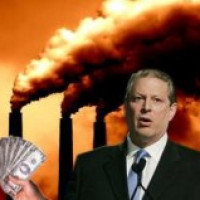
This week has been truly historic. It has marked the beginning of the landslide that is collapsing the whole AGW imposture. The pseudo-science of global warming is a global laughing stock and Copenhagen is a farce. In the warmist camp the Main Man is a railway engineer with huge investments in the carbon industry. That says it all. The world’s boiler being heroically damped down by the Fat Controller. Al Gore, occupant of the only private house that can be seen from space, so huge is its energy consumption, wanted to charge punters $1,200 to be photographed with him at Copenhagen. There is a man who is really worried about the planet’s future.
If there were not $45trillion of Western citizens’ money at stake, this would be the funniest moment in world history. What a bunch of buffoons. Not since Neville Chamberlain tugged a Claridge’s luncheon bill from his pocket and flourished it on the steps of the aircraft that brought him back from Munich has a worthless scrap of paper been so audaciously hyped. There was one good moment at Copenhagen, though: some seriously professional truncheon work by Danish Plod on the smellies. Otherwise, this event is strictly for Hans Christian Andersen
Barack Obama emerged from the chaotic final hours of the Copenhagen summit last night having salvaged an agreement for action on global warming – and his own reputation as a politician who can bridge the most challenging of political divides.
After 15 hours of negotiations, an exhausted looking Obama said he managed to secure a deal on climate change incorporating America’s three main goals of emissions cuts, financial aid for the poorest countries, and a measure of accountability for emissions pledges from developing countries.
But he acknowledged the skimpy 2.5 page draft produced at the end of his effort was not the comprehensive agreement he had come to Copenhagen for.
“I think it is important that instead of setting up a bunch of goals that just end up not being met, that we get moving,” he said. “We just keep moving forward.”
Obama’s hectic day of negotiations began immediately on his arrival in Copenhagen, when he encountered what he described as a “fundamental deadlock” between rich and developing countries.
Much of that was a product of the deep resentment at America for its emissions reductions target: a 17% reduction over 2005 levels by 2020. That offer too was conditional on Congress passing climate change legislation. In the final days of the summit, a more vexing issue emerged over America’s demands that China and other rapidly emerging countries offer an accounting of their actions to curb the growth of greenhouse gas emissions.
Today the gloves came off and the true purpose of the “global warming” scare became nakedly visible. Ugo Chavez, the Socialist president of Venezuela, blamed “global warming” on capitalism – and received a standing ovation from very nearly all of the delegates, lamentably including those from those of the capitalist nations of the West that are on the far Left – and that means too many of them.
Previously Robert Mugabe, dictator of Rhodesia, who had refused to leave office when he had been soundly defeated in a recent election, had also won plaudits at the conference for saying that the West ought to pay him plenty of money in reparation of our supposed “climate debt”.
Inside the conference center, “world leader” after “world leader” got up and postured about the need to Save The Planet, the imperative to do a deal, the necessity to save the small island nations from drowning, etc., etc., etc.
Outside, in the real world, it was snowing, and a foretaste of the Brave New World being cooked up by “world leaders” in their fantasy-land was already evident. Some 20,000 observers from non-governmental organizations – nearly all of them true-believing Green groups funded by taxpayers – had been accredited to the conference.
However, without warning the UN had capriciously decided that all but 300 of them were to be excluded from the conference today, and all but 90 would be excluded on the final day.
Of course, this being the inept UN, no one had bothered to notify those of the NGOs that were not true-believers in the UN’s camp. So Senator Steve Fielding of Australia and I turned up with a few dozen other delegates, to be left standing in the cold for a couple of hours while the UN laboriously worked out what to do with us.
In the end, they decided to turn us away, which they did with an ill grace and in a bad-tempered manner. As soon as the decision was final, the Danish police moved in. One of them began the now familiar technique of manhandling me, in the same fashion as one of his colleagues had done the previous day.
Once again, conscious that a police helicopter with a high-resolution camera was hovering overhead, I thrust my hands into my pockets in accordance with the St. John Ambulance crowd-control training, looked my assailant in the eye and told him, quietly but firmly, to take his hands off me.
He complied, but then decided to have another go. I told him a second time, and he let go a second time. I turned to go and, after I had turned my back, he gave me a mighty shove that flung me to the ground and knocked me out.
I came to some time later (not sure exactly how long), to find my head being cradled by my friends, some of whom were doing their best to keep the police thugs at bay while the volunteer ambulance-men attended to me.
US president offers no further commitment on reducing emissions or on finance to poor countries
By Suzanne Goldenberg and Allegra Stratton
Barack Obama stepped into the chaotic final hours of the Copenhagen summit today saying he was convinced the world could act “boldly and decisively” on climate change.
Obama, who had been skittish about coming to Copenhagen at all unless it could be cast as a foreign policy success, looked visibly frustrated as he appeared before world leaders.
He offered no further commitments on reducing emissions or on finance to poor countries beyond Hillary Clinton’s announcement yesterday that America would support a $100bn global fund to help developing nations adapt to climate change.
He did not even press the Senate to move ahead on climate change legislation, which environmental organisations have been urging for months.
The president’s speech followed the publication of draft text, obtained by the Guardian this morning, that reveals the enormous progress needed from world leaders in the final hours of the Copenhagen climate change summit to achieve a strong deal. The draft says countries “ought” to limit global warming to 2C, but crucially does not bind them to do so. The text, drafted by a select group of 28 leaders – including UK prime minister, Gordon Brown – in the early hours of this morning, also proposes extending negotiations for another year until the next scheduled UN meeting on climate change in Mexico City in December 2010.
In his address, Obama did say America would follow through on his administration’s clean energy agenda, and that it would live up to its pledges to the international community.
“We have charted our course, we have made our commitments, and we will do what we say,” Obama said.
But in the absence of any evidence of that commitment the words rang hollow and there was a palpable sense of disappointment in the audience.
UN fails in last-ditch efforts to get world leaders to commit to a maximum 2C rise as draft texts get weaker
By Suzanne Goldenberg, John Vidal and Jonathan Watts
The UN’s climate summit was heading for meltdown this afternoon with countries unable to agree on emission cuts and blaming each other for the descent towards a humiliating fiasco.
Last-ditch efforts by the UN to get the 120 world leaders to at least commit to hold temperatures to a maximum rise of 2C in the next century were failing, as a series of draft political agreement — each weaker than the last — were circulated among countries.
Versions of the overarching political text seen by the Guardian showed that profound disagreements between countries had not been resolved. Only weak, long-term aspirations for an overall global emissions cut of 50% by 2050 and an 80% cut by 2050 for rich countries. These commitments, and the 2C pledge, were assumed to be givens in any deal.
As the draft text reached its sixth version, there were some glimmers of hope, as some nations put more encouraging language into the agreement, including a reference to a limit of 1.5C being supported by the science. But more versions are expected.
No commitments were sought for any of the major areas of dispute, such as a mid-term 2020 target to reduce greenhouse gas emissions. The European Union’s plan to raise its pledge from a 20% cut to 30% cut in emissions by 2020 was blocked, dashing hopes of prompting a series on increased offers from other nations. The latest text even dropped a deadline for reaching a legally binding treaty by the end of 2010. At the start of the week Gordon Brown was insisting that six months was the maximum acceptable delay.
A financial package intended to raise billions of dollars to help poor countries to adapt to climate change and develop green technology was also in doubt as rich countries declined to guarantee the money, simply affirming that they “supported a goal of mobilising $100bn by 2020″.
The lack of ambition and near total absence of commitment from the leaders is a bitter disappopintment for the British prime minister, Gordon Brown, and the UK government which has led worldwide efforts to forge an ambitious, legally binding global agreement to stop the rise in carbon emissions by 2020 and reduce them dramatically in the following 30 years.
Negotiators will now continue to work on individual agreements like deforestation, technology, finance but without strong leadership the chances are that it will take years to complete.
Hopes that Barack Obama would deploy his authority as the leader of the world’s largest economy — and his personal political charisma — to try to broker a last-minute deal were also frustrated. A visibly angry Obama told world leaders that it was past time for them to come to an agreement. “The time for talk is over,” he said.
But Obama did not offer any new pledges of action — either in increased emissions cuts or clarity on America’s contributions to a climate fund for poor countries. He also held the line against China, saying America would not yield on the vexed issue of measuring and verifying emissions cuts promised by developing countries.
In the Grand Ceremonial Hall of the University of Copenhagen, a splendid Nordic classical space overlooking the Church of our Lady in the heart of the old city, rows of repellent, blue plastic chairs surrounded the podium from which no less a personage than Dr. Rajendra Pachauri, chairman of the IPCC, was to speak.
I had arrived in good time to take my seat among the dignitaries in the front row. Rapidly, the room filled with enthusiastic Greenies and enviro-zombs waiting to hear the latest from ye Holy Bookes of Ipecac, yea verily.
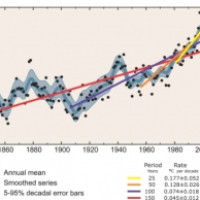
The official party shambled in and perched on the blue plastic chairs next to me. Pachauri was just a couple of seats away, so I gave him a letter from me and Senator Fielding of Australia, pointing out that the headline graph in the IPCC’s 2007 report, purporting to show that the rate of warming over the past 150 years had itself accelerated, was fraudulent.
Would he use the bogus graph in his lecture? I had seen him do so when he received an honorary doctorate from the University of New South Wales. I watched and waited.
Sure enough, he used the bogus graph. I decided to wait until he had finished, and ask a question then.
Pachauri then produced the now wearisome list of lies, fibs, fabrications and exaggerations that comprise the entire case for alarm about “global warming”. He delivered it in a tired, unenthusiastic voice, knowing that a growing majority of the world’s peoples – particularly in those countries where comment is free – no longer believe a word the IPCC says.
They are right not to believe. Science is not a belief system. But here is what Pachauri invited the audience in Copenhagen to believe.
1. Pachauri asked us to believe that the IPCC’s documents were “peer-reviewed”. Then he revealed the truth by saying that it was the authors of the IPCC’s climate assessments who decided whether the reviewers’ comments were acceptable. That – whatever else it is – is not peer review.
2. Pachauri said that greenhouse gases had increased by 70% between 1970 and 2004. This figure was simply nonsense. I have seen this technique used time and again by climate liars. They insert an outrageous statement early in their presentations, see whether anyone reacts and, if no one reacts, they know they will get away with the rest of the lies. I did my best not to react. I wanted to hear, and write down, the rest of the lies.
3. Next came the bogus graph, which is featured three times, large and in full color, in the IPCC’s 2007 climate assessment report. The graph is bogus not only because it relies on the made-up data from the Climate Research Unit at the University of East Anglia but also because it is overlain by four separate trend-lines, each with a start-date carefully selected to give the entirely false impression that the rate of warming over the past 150 years has itself been accelerating, especially between 1975 and 1998. The truth, however – neatly obscured by an ingenious rescaling of the graph and the superimposition of the four bogus trend lines on it – is that from 1860-1880 and again from 1910-1940 the warming rate was exactly the same as the warming rate from 1975-1998
4. Pachauri said that there had been an “acceleration” in sea-level rise from 1993. He did not say, however, that in 1993 the method of measuring sea-level rise had switched from tide-gages to satellite altimetry against a reference geoid. The apparent increase in the rate of sea-level rise is purely an artefact of this change in the method of measurement.
5. Pachauri said that Arctic temperatures would rise twice as fast as global temperatures over the next 100 years. However, he failed to point out that the Arctic was actually 1-2 Celsius degrees warmer than the present in the 1930s and early 1940s. It has become substantially cooler than it was then.
6. Pachauri said the frequency of heavy rainfall had increased. The evidence for this proposition is largely anecdotal. Since there has been no statistically-significant “global warming” for 15 years, there is no reason to suppose that any increased rainfall in recent years is attributable to “global warming”.
7. Pachauri said that the proportion of tropical cyclones that are high-intensity storms has increased in the past three decades. However, he was very careful not to point out that the total number of intense tropical cyclones has actually fallen sharply throughout the period.
8. Pachauri said that the activity of intense Atlantic hurricanes had increased since 1970. This is simply not true, but it appears to be true if – as one very bad scientific paper in 2006 did – one takes the data back only as far as that year. Take the data over the whole century, as one should, and no trend whatsoever is evident. Here, Pachauri is again using the same statistical dodge he used with the UN’s bogus “warming-is-getting-worse” graph: he is choosing a short run of data and picking his start-date with care so as falsely to show a trend that, over a longer period, is not significant.
9. Pachauri said small islands like the Maldives were vulnerable to sea-level rise. Not if they’re made of coral, which is more than capable of outgrowing any sea-level rise. Besides, as Professor Morner has established, sea level in the Maldives is no higher now than it was 1250 years ago, and has not risen for half a century.
10. Pachauri said that if the ice-sheets of Greenland or West Antarctica were to melt there would be “meters of sea-level rise”. Yes, but his own climate panel has said that that could not happen for thousands of years, and only then if global mean surface temperatures stayed at least 2 C (3.5 F) warmer than today’s.
COPENHAGEN (AP) - Danish police fired pepper spray and beat protesters with batons outside the U.N. climate conference on Wednesday, as disputes inside left major issues unresolved just two days before world leaders hope to sign a historic agreement to fight global warming.
With the talks clearly deadlocked, Connie Hedegaard, former Danish climate minister, resigned from the conference presidency to allow her boss, Danish Prime Minister Lars Loekke Rasmussen to preside as world leaders from 115 nations streamed into Copenhagen. She was to continue overseeing the closed-door negotiations.
Hundreds of protesters were trying to disrupt the 193-nation conference, the latest action in days of demonstrations to demand “climate justice” - firm action to combat global warming. Police said 230 protesters were detained.
Inside the cavernous Bella Center convention hall, negotiators dealing with core issues debated until just before dawn without setting new goals for reducing greenhouse gas emissions or for financing poorer countries’ efforts to cope with coming climate change, key elements of any deal.
“I regret to report we have been unable to reach agreement,” John Ashe of Antigua, chairman of one negotiating group, reported to conference Wednesday morning.
Activists tag Greenpeace Rainbow Warrior with “Propaganda Warrior” banner; Arctic Sunrise hit with “Ship of Lies” banner earlier in the day
Global warming skeptics from CFACT yesterday pulled off an international climate caper using GPS triangulation from Greenpeace’s own on-board camera photos to locate and sail up long-side of the infamous Greenpeace vessel, Rainbow Warrior. Then in Greenpeace-like fashion, the CFACT activists unfurled a banner reading “Propaganda Warrior” which underscored how the radical green group’s policies and agenda are based on myths, lies, and exaggerations.
Earlier in the day the activists daringly boarded Greenpeace’s Arctic Sunrise with neither stealth nor force, but by baffling the crew with doughnuts, and unfurled a banner that read “Ship of Lies” off the starboard side.
“Greenpeace has been using these kinds of tactics for decades, and now they can find out what it’s like to have a little taste of their own medicine, “ said CFACT executive director Craig Rucker who masterminded the operation.
CFACT unfurled the banners for two reasons, CFACT president David Rothbard explained. “Greenpeace ships, like the Rainbow Warrior and Arctic Sunrise, have become global symbols for radical environmentalism, and we wanted to call attention to the harm these groups are causing. And second, it seemed appropriate to use one of Greenpeace’s favorite tactics to make this point.”
Greenpeace protesters frequently hang banners from factories and office buildings, paint slogans on smokestacks, and employ other publicity stunts. Some are relatively harmless, but others reflect a willingness to lie or even destroy property to make a point.
In 1995, Greenpeace launched a $2-million public relations campaign against Shell Oil, claiming the company was planning to dump tons of oil and toxic waste in the ocean by sinking its Brent Spar platform as an artificial reef. It was a full year before the group issued a written apology, admitting it knew all along that there had been no oil or chemical wastes on the platform.
Greenpeace has frequently destroyed bio-engineered crops, wiping out millions of dollars in research efforts designed to develop food plants that are more nutritious, withstand floods and droughts better, and resist insect infestations without the need for chemical pesticides. It has also waged an unrelenting campaign against insecticides and insect repellants that could prevent malaria, a vicious disease that infects 500 million people a year, kills over 1 million and leaves millions more with permanent brain damage.
By Sarah Palin — With the publication of damaging e-mails from a climate research center in Britain, the radical environmental movement appears to face a tipping point. The revelation of appalling actions by so-called climate change experts allows the American public to finally understand the concerns so many of us have articulated on this issue. “Climate-gate,” as the e-mails and other documents from the Climate Research Unit at the University of East Anglia have become known, exposes a highly politicized scientific circle — the same circle whose work underlies efforts at the Copenhagen climate change conference. The agenda-driven policies being pushed in Copenhagen won’t change the weather, but they would change our economy for the worse.
The e-mails reveal that leading climate “experts” deliberately destroyed records, manipulated data to “hide the decline” in global temperatures, and tried to silence their critics by preventing them from publishing in peer-reviewed journals. What’s more, the documents show that there was no real consensus even within the CRU crowd. Some scientists had strong doubts about the accuracy of estimates of temperatures from centuries ago, estimates used to back claims that more recent temperatures are rising at an alarming rate.
This scandal obviously calls into question the proposals being pushed in Copenhagen. I’ve always believed that policy should be based on sound science, not politics.
So many new developments: which story do we pick? Maybe best to summarise, instead. After all, it’s not like you’re going to find much of this reported in the MSM.
2. Danes caught fiddling their carbon credits. (Hat tip: Philip Stott) Carbon trading is the Emperor’s New Clothes of international finance. It was invented by none other than Ken Lay, whose Enron would currently be one of the prime beneficiaries in the global alternative energy market, if it hadn’t been shown to be (nearly) as fraudulent as the current AGW scam. It is a licence to fleece, cheat and rob. Still, jolly embarrassing for the Danes to get caught red handed, what with their hosting a conference shortly in which the world’s leaders will try, straight-faced, to persuade us that carbon emissions trading is the only viable way of defeating ManBearPig.
3. Hats off to The Daily Express – the first British newspaper to make the AGW scam its front page story.
The piece was inspired by another bravura performance by Professor Ian Plimer, the Aussie geologist who argues that climate change has been going on quite naturally, oblivious of human activity, for the last 4,567 million years.
4. BBC finally gets round to reporting – sort of – that Climatic Research Unit at University of East Anglia may have been up to no good. It’s true that this report on their website is so hedged with special pleading for the temporarily suspended director Phil Jones the man might have written it himself. But on the BBC Radio 4 Today programme this morning, I did hear the newsreader reporting it as more than just a routine theft story. Which is a start.
5. Legal actions ahoy! Over the next few weeks, one thing we can be absolutely certain of is concerted efforts by the rich, powerful and influential AGW lobby to squash the Climategate story. We’ve seen this already in the “nothing to see here” response of Dr Rajendra Pachauri, the jet-setting, troll-impersonating railway engineer who runs the IPCC and wants to stop ice being served with water in restaurants. This is why those of us who oppose his scheme to carbon-tax the global economy back to the dark ages must do everything in our power to bring the scandal to a wider audience. One way to do this is law suits.
Alan Carlin — the EPA scientist whose skeptical report was hushed — thinks Obama and the EPA just placed a terrible bet with the politically motivated CO2 endangerment finding. Carlin has carried out or supervised economic and scientific research on public policy issues for over 40 years — first at The RAND Corporation, and since 1971 at the U.S. Environmental Protection Agency.
By Alan Carlin
On Monday, the EPA announced its endangerment finding for greenhouse gases. One can infer from the timing of the announcement that the administration may have taken this action at this time in order to bring something to the table at the Copenhagen COP15 meeting.
From a scientific viewpoint, it was an odd time to do so — given that the very recent Climategate disclosures would presumably have taken some time to digest and analyze for their possible effects on vital conclusions. So the timing may have been based more on the political, rather than the scientific, factors involved.
But from a larger viewpoint, the U.S. president who was going to find a way to resolve partisan bickering in Washington has now embarked on a major escalation of the conflict — by using the power he holds over executive branch agencies to fight his enemies in Congress over the issue of global warming.
Although the EPA has always been, organizationally, an arm of the administration in power, until this administration the EPA has generally been able to maintain the appearance (if not the reality) of being science-based.
That is now much harder to maintain.
Originally, the rumor was that the purpose of the endangerment finding would be to pressure Congress into approving a cap and trade bill. Now, it appears fairly clear that the administration will not be able to gather the needed votes in the Senate to pass the bill — at least this year, and probably even next year, either with or without an endangerment finding. So there would seem to be little reason to push the endangerment finding now — unless they intended to use it as the basis for negotiating at COP15.
Some Major Political Risks
This EPA endangerment approach carries major risks for the administration. The first risk is that the EPA’s apparently politically motivated endangerment finding may be overturned in the now-inevitable court reviews.
The second risk is that when greenhouse gas regulations should be announced — and certainly when they should ever be implemented — the full responsibility will obviously fall onto the administration, rather than being shared between the administration and Congress (which is what would occur if Congress ever adopted a cap and trade bill). If constituents end up being unhappy with the resulting regulations, and particularly the greatly increased energy costs and decreased employment that will result, it will be obvious who was responsible.
And there may well be some very unhappy constituents.
A third risk is that they will not be able to contain the EPA’s actions, since the law clearly specifies that much smaller sources are subject to regulation than they now contemplate, and legal action may force the EPA to regulate smaller sources whether it wants to or not.
Secretary-General, United Nations
New York, NY
United States of America
8 December 2009
Dear Secretary-General,
Climate change science is in a period of ‘negative discovery’ - the more we learn about this exceptionally complex and rapidly evolving field the more we realize how little we know. Truly, the science is NOT settled.
Therefore, there is no sound reason to impose expensive and restrictive public policy decisions on the peoples of the Earth without first providing convincing evidence that human activities are causing dangerous climate change beyond that resulting from natural causes. Before any precipitate action is taken, we must have solid observational data demonstrating that recent changes in climate differ substantially from changes observed in the past and are well in excess of normal variations caused by solar cycles, ocean currents, changes in the Earth’s orbital parameters and other natural phenomena.
We the undersigned, being qualified in climate-related scientific disciplines, challenge the UNFCCC and supporters of the United Nations Climate Change Conference to produce convincing OBSERVATIONAL EVIDENCE for their claims of dangerous human-caused global warming and other changes in climate. Projections of possible future scenarios from unproven computer models of climate are not acceptable substitutes for real world data obtained through unbiased and rigorous scientific investigation.
Specifically, we challenge supporters of the hypothesis of dangerous human-caused climate change to demonstrate that:
1.Variations in global climate in the last hundred years are significantly outside the natural range experienced in previous centuries;
2.Humanity’s emissions of carbon dioxide and other ‘greenhouse gases’ (GHG) are having a dangerous impact on global climate;
3.Computer-based models can meaningfully replicate the impact of all of the natural factors that may significantly influence climate;
4.Sea levels are rising dangerously at a rate that has accelerated with increasing human GHG emissions, thereby threatening small islands and coastal communities;
5.The incidence of malaria is increasing due to recent climate changes;
6.Human society and natural ecosystems cannot adapt to foreseeable climate change as they have done in the past;
7.Worldwide glacier retreat, and sea ice melting in Polar Regions , is unusual and related to increases in human GHG emissions;
8.Polar bears and other Arctic and Antarctic wildlife are unable to adapt to anticipated local climate change effects, independent of the causes of those changes;
9.Hurricanes, other tropical cyclones and associated extreme weather events are increasing in severity and frequency;
10.Data recorded by ground-based stations are a reliable indicator of surface temperature trends.
It is not the responsibility of ‘climate realist’ scientists to prove that dangerous human-caused climate change is not happening. Rather, it is those who propose that it is, and promote the allocation of massive investments to solve the supposed ‘problem’, who have the obligation to convincingly demonstrate that recent climate change is not of mostly natural origin and, if we do nothing, catastrophic change will ensue. To date, this they have utterly failed to do so.
Signed by:
1.Habibullo I. Abdussamatov, Dr. Sci., mathematician and astrophysicist, Head of the Russian-Ukrainian Astrometria project on the board of the Russian segment of the ISS, Head of Space Research Laboratory at the Pulkovo Observatory of the Russian Academy of Sciences, St. Petersburg, Russia
2.Göran Ahlgren, docent organisk kemi, general secretary of the Stockholm Initiative, Professor of Organic Chemistry, Stockholm, Sweden
3.Syun-Ichi Akasofu, PhD, Professor of Physics, Emeritus and Founding Director, International Arctic Research Center of the University of Alaska, Fairbanks, Alaska, U.S.A.
4.J.R. Alexander, Professor Emeritus, Dept. of Civil Engineering, University of Pretoria, South Africa; Member, UN Scientific and Technical Committee on Natural Disasters, 1994-2000, Pretoria, South Africa.
5.Jock Allison, PhD, ONZM, formerly Ministry of Agriculture Regional Research Director, Dunedin, New Zealand
Since President Obama cannot get a formal climate treaty ratified by the US Senate, he instead plans to sign an “executive agreement” which will commit the United States to most of the same terms included in the original draft of the treaty but will not be called a “treaty”.
This video was exhibited to kick-off the UN climate conference on Monday. It requires no additional explanation. Double-click the video to go to the Youtube site if you feel compelled to leave a comment for the producers.