Archive for the “Copenhagen Treaty” Category

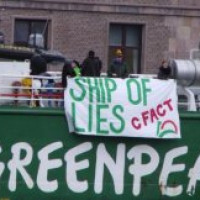
ship-of-liesActivists tag Greenpeace Rainbow Warrior with “Propaganda Warrior” banner; Arctic Sunrise hit with “Ship of Lies” banner earlier in the day

Global warming skeptics from CFACT yesterday pulled off an international climate caper using GPS triangulation from Greenpeace’s own on-board camera photos to locate and sail up long-side of the infamous Greenpeace vessel, Rainbow Warrior. Then in Greenpeace-like fashion, the CFACT activists unfurled a banner reading “Propaganda Warrior” which underscored how the radical green group’s policies and agenda are based on myths, lies, and exaggerations.

Earlier in the day the activists daringly boarded Greenpeace’s Arctic Sunrise with neither stealth nor force, but by baffling the crew with doughnuts, and unfurled a banner that read “Ship of Lies” off the starboard side.

“Greenpeace has been using these kinds of tactics for decades, and now they can find out what it’s like to have a little taste of their own medicine, “ said CFACT executive director Craig Rucker who masterminded the operation. 

CFACT unfurled the banners for two reasons, CFACT president David Rothbard explained. “Greenpeace ships, like the Rainbow Warrior and Arctic Sunrise, have become global symbols for radical environmentalism, and we wanted to call attention to the harm these groups are causing.  And second, it seemed appropriate to use one of Greenpeace’s favorite tactics to make this point.”

Greenpeace protesters frequently hang banners from factories and office buildings, paint slogans on smokestacks, and employ other publicity stunts. Some are relatively harmless, but others reflect a willingness to lie or even destroy property to make a point.

In 1995, Greenpeace launched a $2-million public relations campaign against Shell Oil, claiming the company was planning to dump tons of oil and toxic waste in the ocean by sinking its Brent Spar platform as an artificial reef. It was a full year before the group issued a written apology, admitting it knew all along that there had been no oil or chemical wastes on the platform.

Greenpeace has frequently destroyed bio-engineered crops, wiping out millions of dollars in research efforts designed to develop food plants that are more nutritious, withstand floods and droughts better, and resist insect infestations without the need for chemical pesticides. It has also waged an unrelenting campaign against insecticides and insect repellants that could prevent malaria, a vicious disease that infects 500 million people a year, kills over 1 million and leaves millions more with permanent brain damage.

Read the rest of this story at CFACT.

Comments 18 Comments »

Comments 16 Comments »

From the Washington Post

sarah-palinBy Sarah Palin — With the publication of damaging e-mails from a climate research center in Britain, the radical environmental movement appears to face a tipping point. The revelation of appalling actions by so-called climate change experts allows the American public to finally understand the concerns so many of us have articulated on this issue.  “Climate-gate,” as the e-mails and other documents from the Climate Research Unit at the University of East Anglia have become known, exposes a highly politicized scientific circle — the same circle whose work underlies efforts at the Copenhagen climate change conference. The agenda-driven policies being pushed in Copenhagen won’t change the weather, but they would change our economy for the worse.

The e-mails reveal that leading climate “experts” deliberately destroyed records, manipulated data to “hide the decline” in global temperatures, and tried to silence their critics by preventing them from publishing in peer-reviewed journals. What’s more, the documents show that there was no real consensus even within the CRU crowd. Some scientists had strong doubts about the accuracy of estimates of temperatures from centuries ago, estimates used to back claims that more recent temperatures are rising at an alarming rate.

This scandal obviously calls into question the proposals being pushed in Copenhagen. I’ve always believed that policy should be based on sound science, not politics.

Read the rest of the column.

Comments 22 Comments »

Al Gore hunts manbearpig in South Park

Al Gore hunts manbearpig in South Park

By James Delingpole

So many new developments: which story do we pick? Maybe best to summarise, instead. After all, it’s not like you’re going to find much of this reported in the MSM.

1. Australia’s Senate rejects Emissions Trading Scheme for a second time. Or: so turkeys don’t vote Christmas. Expect to see a lot more of this: politicians starting to become aware their party’s position on AGW is completely out of kilter with the public mood and economic reality. Kevin Rudd’s Emissions Trading Scheme – what Andrew Bolt calls “a $114 billion green tax on everything” – would have wreaked havoc on the coal-dependent Australian economy. That’s why several opposition Liberal frontbenchers resigned rather than vote with the Government on ETS; why Liberal leader Malcolm Turnbull lost his job; and why the Senate voted down the ETS.

2. Danes caught fiddling their carbon credits. (Hat tip: Philip Stott) Carbon trading is the Emperor’s New Clothes of international finance. It was invented by none other than Ken Lay, whose Enron would currently be one of the prime beneficiaries in the global alternative energy market, if it hadn’t been shown to be (nearly) as fraudulent as the current AGW scam. It is a licence to fleece, cheat and rob. Still, jolly embarrassing for the Danes to get caught red handed, what with their hosting a conference shortly in which the world’s leaders will try, straight-faced, to persuade us that carbon emissions trading is the only viable way of defeating ManBearPig.

3. Hats off to The Daily Express – the first British newspaper to make the AGW scam its front page story.

The piece was inspired by another bravura performance by Professor Ian Plimer, the Aussie geologist who argues that climate change has been going on quite naturally, oblivious of human activity, for the last 4,567 million years.

4. BBC finally gets round to reporting – sort of – that Climatic Research Unit at University of East Anglia may have been up to no good. It’s true that this report on their website is so hedged with special pleading for the temporarily suspended director Phil Jones the man might have written it himself. But on the BBC Radio 4 Today programme this morning, I did hear the newsreader reporting it as more than just a routine theft story. Which is a start.

5. Legal actions ahoy! Over the next few weeks, one thing we can be absolutely certain of is concerted efforts by the rich, powerful and influential AGW lobby to squash the Climategate story. We’ve seen this already in the “nothing to see here” response of Dr Rajendra Pachauri, the jet-setting, troll-impersonating railway engineer who runs the IPCC and wants to stop ice being served with water in restaurants. This is why those of us who oppose his scheme to carbon-tax the global economy back to the dark ages must do everything in our power to bring the scandal to a wider audience. One way to do this is law suits.

Read the rest of this article at the London Telegraph.

Comments 6 Comments »

Alan Carlin

Alan Carlin

Alan Carlin — the EPA scientist whose skeptical report was hushed — thinks Obama and the EPA just placed a terrible bet with the politically motivated CO2 endangerment finding.  Carlin has carried out or supervised economic and scientific research on public policy issues for over 40 years — first at The RAND Corporation, and since 1971 at the U.S. Environmental Protection Agency.

By Alan Carlin

On Monday, the EPA announced its endangerment finding for greenhouse gases. One can infer from the timing of the announcement that the administration may have taken this action at this time in order to bring something to the table at the Copenhagen COP15 meeting.

From a scientific viewpoint, it was an odd time to do so — given that the very recent Climategate disclosures would presumably have taken some time to digest and analyze for their possible effects on vital conclusions. So the timing may have been based more on the political, rather than the scientific, factors involved.

But from a larger viewpoint, the U.S. president who was going to find a way to resolve partisan bickering in Washington has now embarked on a major escalation of the conflict — by using the power he holds over executive branch agencies to fight his enemies in Congress over the issue of global warming.

Although the EPA has always been, organizationally, an arm of the administration in power, until this administration the EPA has generally been able to maintain the appearance (if not the reality) of being science-based.

That is now much harder to maintain.

Originally, the rumor was that the purpose of the endangerment finding would be to pressure Congress into approving a cap and trade bill. Now, it appears fairly clear that the administration will not be able to gather the needed votes in the Senate to pass the bill — at least this year, and probably even next year, either with or without an endangerment finding. So there would seem to be little reason to push the endangerment finding now — unless they intended to use it as the basis for negotiating at COP15.

Some Major Political Risks

This EPA endangerment approach carries major risks for the administration. The first risk is that the EPA’s apparently politically motivated endangerment finding may be overturned in the now-inevitable court reviews.

The second risk is that when greenhouse gas regulations should be announced — and certainly when they should ever be implemented — the full responsibility will obviously fall onto the administration, rather than being shared between the administration and Congress (which is what would occur if Congress ever adopted a cap and trade bill). If constituents end up being unhappy with the resulting regulations, and particularly the greatly increased energy costs and decreased employment that will result, it will be obvious who was responsible.

And there may well be some very unhappy constituents.

A third risk is that they will not be able to contain the EPA’s actions, since the law clearly specifies that much smaller sources are subject to regulation than they now contemplate, and legal action may force the EPA to regulate smaller sources whether it wants to or not.

Read the rest of this piece at Pajamas Media.

More at PJTV: Whistleblower an Inconvenient Voice in Obama’s EPA)

Comments 16 Comments »

letterHis Excellency Ban Ki Moon

Secretary-General, United Nations
New York, NY
United States of America

8 December 2009

Dear Secretary-General,

Climate change science is in a period of ‘negative discovery’ – the more we learn about this exceptionally complex and rapidly evolving field the more we realize how little we know. Truly, the science is NOT settled.

Therefore, there is no sound reason to impose expensive and restrictive public policy decisions on the peoples of the Earth without first providing convincing evidence that human activities are causing dangerous climate change beyond that resulting from natural causes. Before any precipitate action is taken, we must have solid observational data demonstrating that recent changes in climate differ substantially from changes observed in the past and are well in excess of normal variations caused by solar cycles, ocean currents, changes in the Earth’s orbital parameters and other natural phenomena.

We the undersigned, being qualified in climate-related scientific disciplines, challenge the UNFCCC and supporters of the United Nations Climate Change Conference to produce convincing OBSERVATIONAL EVIDENCE for their claims of dangerous human-caused global warming and other changes in climate. Projections of possible future scenarios from unproven computer models of climate are not acceptable substitutes for real world data obtained through unbiased and rigorous scientific investigation.

Specifically, we challenge supporters of the hypothesis of dangerous human-caused climate change to demonstrate that:

1.Variations in global climate in the last hundred years are significantly outside the natural range experienced in previous centuries;
2.Humanity’s emissions of carbon dioxide and other ‘greenhouse gases’ (GHG) are having a dangerous impact on global climate;
3.Computer-based models can meaningfully replicate the impact of all of the natural factors that may significantly influence climate;
4.Sea levels are rising dangerously at a rate that has accelerated with increasing human GHG emissions, thereby threatening small islands and coastal communities;
5.The incidence of malaria is increasing due to recent climate changes;
6.Human society and natural ecosystems cannot adapt to foreseeable climate change as they have done in the past;
7.Worldwide glacier retreat, and sea ice melting in Polar Regions , is unusual and related to increases in human GHG emissions;
8.Polar bears and other Arctic and Antarctic wildlife are unable to adapt to anticipated local climate change effects, independent of the causes of those changes;
9.Hurricanes, other tropical cyclones and associated extreme weather events are increasing in severity and frequency;
10.Data recorded by ground-based stations are a reliable indicator of surface temperature trends.

It is not the responsibility of ‘climate realist’ scientists to prove that dangerous human-caused climate change is not happening. Rather, it is those who propose that it is, and promote the allocation of massive investments to solve the supposed ‘problem’, who have the obligation to convincingly demonstrate that recent climate change is not of mostly natural origin and, if we do nothing, catastrophic change will ensue. To date, this they have utterly failed to do so.

Signed by:

1.Habibullo I. Abdussamatov, Dr. Sci., mathematician and astrophysicist, Head of the Russian-Ukrainian Astrometria project on the board of the Russian segment of the ISS, Head of Space Research Laboratory at the Pulkovo Observatory of the Russian Academy of Sciences, St. Petersburg, Russia
2.Göran Ahlgren, docent organisk kemi, general secretary of the Stockholm Initiative, Professor of Organic Chemistry, Stockholm, Sweden
3.Syun-Ichi Akasofu, PhD, Professor of Physics, Emeritus and Founding Director, International Arctic Research Center of the University of Alaska, Fairbanks, Alaska, U.S.A.
4.J.R. Alexander, Professor Emeritus, Dept. of Civil Engineering, University of Pretoria, South Africa; Member, UN Scientific and Technical Committee on Natural Disasters, 1994-2000, Pretoria, South Africa.
5.Jock Allison, PhD, ONZM, formerly Ministry of Agriculture Regional Research Director, Dunedin, New Zealand

Read the rest of this entry »

Comments 10 Comments »

Since President Obama cannot get a formal climate treaty ratified by the US Senate, he instead plans to sign an “executive agreement” which will commit the United States to most of the same terms included in the original draft of the treaty but will not be called a “treaty”.

Comments 18 Comments »

This video was exhibited to kick-off the UN climate conference on Monday. It requires no additional explanation. Double-click the video to go to the Youtube site if you feel compelled to leave a comment for the producers.

Comments 26 Comments »

epaco2-180Deliberately timed to coincide with the start of the United Nations’ climate conference in Copenhagen, the Environmental Protection Agency on Monday declared that carbon dioxide, a naturally occurring gas that’s essential to life on Earth, poses a threat to human health and welfare. This determination clears the way for the federal government to begin restricting energy production and restructuring the entire American economy.


The EPA cited a 2007 Supreme Court ruling declaring that carbon dioxide is a pollutant, subject to regulation under the Clean Air Act, but the science upon which that ruling was based has now been called into question when emails and internal documents between the UN’s leading climate change scientists were leaked to the public. Contained with in the files was evidence of suppression, manipulation and destruction of climate data. The emails revealed that the entire historical climate record that is the basis for all determinations of climate change is based on inaccurate data and has been manipulated to match a political and economic agenda.


If the EPA acts unilaterally to restrict carbon dioxide emissions, the impact on the economy could be even worse than a cap and trade law enacted by Congress. The reasons for this move by the Obama Administration’s EPA appear to be two-fold: First, to establish authority for President Obama to make enforceable agreements at the UN’s climate conference even in lieu of a treaty or Congressional approval; and Second to give the administration leverage to coerce the Senate into enacting a cap and trade law just to lessen the economic damage that could be wrought by the EPA’s heavy-handed restrictions of CO2.


At this moment, our national economy is under threat by carbon regulation schemes on three fronts: The Copenhagen conference designed to create a world carbon regulatory authority which could undermine our sovereignty; The cap and trade bill that’s been passed by the House of Representatives and now awaits Senate approval; and the Obama Administration’s decision that it can regulate carbon dioxide via the EPA even without approval by Congress.


For a preview of what this could mean to American families, one can look to Germany, where due to restrictions on carbon dioxide emissions, electricity costs three-times more than in the US and gasoline is now $8.00 per gallon.


You must make your voice heard loud and clear right now. This is no longer a far-away possibility. It’s happening as you read this. Time’s up.


Take Action: If you don’t think it’s a good idea to dramatically slash domestic energy production at a cost of trillions of dollars and untold American jobs over the politics of a discredited climate scare, pick up your phone and call the White House right now. Tell the Obama Administration you won’t stand for this unparalleled fleecing of the American public. Call (202) 456-1111 to be heard today.


Visit NoCapAndTrade.com for more ways to take action.

Comments 27 Comments »

cop15-a-haitian-delegatio-001Developing countries react furiously to leaked draft agreement that would hand more power to rich nations, sideline the UN’s negotiating role and abandon the Kyoto protocol

By John Vidal

The UN Copenhagen climate talks are in disarray today after developing countries reacted furiously to leaked documents that show world leaders will next week be asked to sign an agreement that hands more power to rich countries and sidelines the UN’s role in all future climate change negotiations.

The document is also being interpreted by developing countries as setting unequal limits on per capita carbon emissions for developed and developing countries in 2050; meaning that people in rich countries would be permitted to emit nearly twice as much under the proposals.

The so-called Danish text, a secret draft agreement worked on by a group of individuals known as “the circle of commitment” – but understood to include the UK, US and Denmark – has only been shown to a handful of countries since it was finalised this week.

The agreement, leaked to the Guardian, is a departure from the Kyoto protocol’s principle that rich nations, which have emitted the bulk of the CO2, should take on firm and binding commitments to reduce greenhouse gases, while poorer nations were not compelled to act. The draft hands effective control of climate change finance to the World Bank; would abandon the Kyoto protocol – the only legally binding treaty that the world has on emissions reductions; and would make any money to help poor countries adapt to climate change dependent on them taking a range of actions.

The document was described last night by one senior diplomat as “a very dangerous document for developing countries. It is a fundamental reworking of the UN balance of obligations. It is to be superimposed without discussion on the talks.”

A confidential analysis of the text by developing countries also seen by the Guardian shows deep unease over details of the text. In particular, it is understood to:

Force developing countries to agree to specific emission cuts and measures that were not part of the original UN agreement;

  • Divide poor countries further by creating a new category of developing countries called “the most vulnerable”;
  • Weaken the UN’s role in handling climate finance;
  • Not allow poor countries to emit more than 1.44 tonnes of carbon per person by 2050, while allowing rich countries to emit 2.67 tonnes.

Developing countries that have seen the text are understood to be furious that it is being promoted by rich countries without their knowledge and without discussion in the negotiations.

“It is being done in secret. Clearly the intention is to get [Barack] Obama and the leaders of other rich countries to muscle it through when they arrive next week. It effectively is the end of the UN process,” said one diplomat, who asked to remain nameless.

Antonio Hill, climate policy adviser for Oxfam International, said: “This is only a draft but it highlights the risk that when the big countries come together, the small ones get hurting. On every count the emission cuts need to be scaled up. It allows too many loopholes and does not suggest anything like the 40% cuts that science is saying is needed.”

Hill continued: “It proposes a green fund to be run by a board but the big risk is that it will run by the World Bank and the Global Environment Facility [a partnership of 10 agencies including the World Bank and the UN Environment Programme] and not the UN. That would be a step backwards, and it tries to put constraints on developing countries when none were negotiated in earlier UN climate talks.”

Read the rest of this story at the Guardian.

Read the “Danish Text.”

Comments 11 Comments »

Niger Innis

Niger Innis

Highlights social injustice of proposed climate change policies


The Congress of Racial Equality (CORE) announced today that they have joined the No Cap and Trade Coalition in the fight against cap-and-trade legislation and the proposed Copenhagen climate treaty. The coalition is comprised of over 30 state and federal public policy groups and think tanks and maintains a website at www.NoCapAndTrade.com.

Niger Innis, national spokesperson for CORE, will become a spokesperson for the No Cap-and Trade Coalition, helping to spread the message that this dangerous public policy will impede social justice, transfer wealth from the United States to foreign countries and potentially strip the United States of its sovereignty.

“CORE is committed to the coalition’s efforts to stop cap-and-trade as well as the Copenhagen treaty,” said Niger Innis. “This endeavor is a continuation of an almost three year effort that CORE has made in its national energy campaign – CORE believes that access to affordable energy is a civil and human right and will work with the No Cap-and-Trade Coalition to spread this message.”

“The No Cap-and-Trade Coalition is very excited about working with CORE and having Niger Innis as a spokesperson,” said Jeff Davis of Minnesota Majority, the coalition’s organizer. “We believe his message that cap-and-trade schemes will be devastating to all Americans, but with a disproportionate impact on the poor in this country, will resonate with all people, regardless of politics.”

On December 7, 2009, the United Nations Framework Convention on Climate Change (UNFCCC) will begin a conference in Copenhagen, Denmark where President Obama intends to consent to an operational agreement with immediate effect if the proposed treaty can’t be agreed upon. The treaty, or any similar executive agreements, could result in a massive transfer of wealth from the United States to third world countries, tax hikes, price inflation, job losses and more damage to the faltering American economy. A draft of the treaty includes establishing a new world government along with a world energy tax. Were such a treaty ratified, it could be a threat to the sovereignty of the United States.

If domestic cap-and-trade legislation were passed, it could result in a loss of 1.9 million American jobs in 2012 and 2.5 million American jobs by 2025. From 2012-2019, the CBO estimates direct government spending at $822 billion with revenue at $845 billion from taxes on energy producers.

The No Cap-and-Trade Coalition has launched a petition on its website at www.NoCapAndTrade.com and through it, has transmitted over 150,000 citizen messages to the president and Congress in opposition to cap and trade schemes. Member organizations have been independently working in the fight against cap-and-trade and the Copenhagen treaty and some are running advertisements to educate the public.

CORE plans to help the No Cap-and-Trade Coalition work with lawmakers to understand that only through the free-market development of technology and the refinement of conservation endeavors, can the United States achieve a sustainable energy policy for this generation and generations to come.

Visit NoCapAndTrade.com for more information.

Comments 5 Comments »

epa-200x200By Jeffrey Ball and Charles Forelle

Officials gather in Copenhagen this week for an international climate summit, but business leaders are focusing even more on Washington, where the Obama administration is expected Monday to formally declare carbon dioxide a dangerous pollutant.

An “endangerment” finding by the Environmental Protection Agency could pave the way for the government to require businesses that emit carbon dioxide and five other greenhouse gases to make costly changes in machinery to reduce emissions — even if Congress doesn’t pass pending climate-change legislation. EPA action to regulate emissions could affect the U.S. economy more directly, and more quickly, than any global deal inked in the Danish capital, where no binding agreement is expected.

Many business groups are opposed to EPA efforts to curb a gas as ubiquitous as carbon dioxide.

An EPA endangerment finding “could result in a top-down command-and-control regime that will choke off growth by adding new mandates to virtually every major construction and renovation project,” U.S. Chamber of Commerce President Thomas Donohue said in a statement. “The devil will be in the details, and we look forward to working with the government to ensure we don’t stifle our economic recovery,” he said, noting that the group supports federal legislation.

EPA action won’t do much to combat climate change, and “is certain to come at a huge cost to the economy,” said the National Association of Manufacturers, a trade group that stands as a proxy for U.S. industry.

Dan Riedinger, spokesman for the Edison Electric Institute, a power-industry trade group, said the EPA would be less likely than Congress to come up with an “economywide approach” to regulating emissions. The power industry prefers such an approach because it would spread the burden of emission cuts to other industries as well.

Electricity generation, transportation and industry represent the three largest sources of U.S. greenhouse-gas emissions.

An EPA spokeswoman declined to comment Sunday on when the agency might finalize its proposed endangerment finding. Congressional Republicans have called on the EPA to withdraw it, saying recently disclosed emails written by scientists at the Climatic Research Unit of the U.K.’s University of East Anglia and their peers call into question the scientific rationale for regulation.

The spokeswoman said that the EPA is confident the basis for its decision will be “very strong,” and that when it is published, “we invite the public to review the extensive scientific analysis informing” the decision.

EPA action would give President Barack Obama something to show leaders from other nations when he attends the Copenhagen conference on Dec. 18 and tries to persuade them that the U.S. is serious about cutting its contribution to global greenhouse-gas emissions.

The vast majority of increased greenhouse-gas emissions is expected to come from developing countries such as China and India, not from rich countries like the U.S. But developing countries have made it clear that their willingness to reduce growth in emissions will depend on what rich countries do first. That puts a geopolitical spotlight on the U.S.

At the heart of the fight over whether U.S. emission constraints should come from the EPA or Congress is a high-stakes issue: which industries will have to foot the bill for a climate cleanup. A similar theme will play out in Copenhagen as rich countries wrangle over how much they should have to pay to help the developing world shift to cleaner technologies.

“There is no agreement without money,” says Rosário Bento Pais, a top climate negotiator for the European Commission, the European Union’s executive arm. “That is clear.”

An endangerment finding would allow the EPA to use the federal Clean Air Act to regulate carbon-dioxide emissions, which are produced whenever fossil fuel is burned. Under that law, the EPA could require emitters of as little as 250 tons of carbon dioxide per year to install new technology to curb their emissions starting as soon as 2012.

Read the rest of this article at Wall Street Journal.

Also see:

Comments 5 Comments »

News Coverage

Even as Copenhagen looms, broadcast news ignores e-mails suggesting warming alarmists ‘manipulated’ data, conspired to destroy information and thwarted peer reviews

By Julia Seymour

It’s been nearly two weeks since a scandal shook many people’s faith in the scientists behind global warming alarmism. The scandal forced the University of East Anglia (UK) to divulge that it threw away raw temperature data and prompted the temporary resignation of Phil Jones of the university’s Climate Research Unit. 

Despite that resignation and calls by a U.S. senator to investigate the matter, ABC, CBS and NBC morning and evening news programming has remained silent – not mentioning a word about the scandal since it broke on Nov. 20, even as world leaders including President Barack Obama prepare to meet in Copenhagen, Denmark next week to promote a pact to reduce greenhouse gases. 

Other news outlets, including The New York Times, Washington Post, CNN and Associated Press have deemed ClimateGate worthy of reporting, but the networks were too busy reporting on celebrity car accidents and the killer whale that ate a great white shark. Instead of airing a broadcast news segment that might inform the public about the science scandal, both ABC and CBS relegated the story to their Web sites. There was one mention of the scandal on ABC’s Sunday talk show: “This Week with George Stephanopoulos.” 

The ClimateGate scandal, as it is being called, has the hallmarks of a major news story: private emails purporting to show unethical or illegal behavior supplied by a hacker or whistleblower, high profile scientists like James Hansen and Michael Mann, and a potential conspiracy to distort science for political gain. But the networks haven’t bothered with the story. 

Patrick J. Michaels, a climatologist and BMI adviser, said Nov. 20 of the leaked e-mails and documents: “This isn’t a smoking gun, it’s a mushroom cloud.” 

White House press secretary Robert Gibbs responded to a question about ClimateGate by insisting that “global warming is happening” and that for most people it isn’t really a question anymore. That is the same message viewers get from the network news about climate change. 

An examination of morning and evening news programs on ABC, CBS and NBC since Nov. 20 yielded zero mentions of the scandal, even in the Nov. 25 reports about Obama going to Copenhagen to discuss the need for emissions reductions. But during the same time period, the networks reported on pro-golfer Tiger Woods’ “minor” car accident at least 37 times. They also found time to report on an orphaned Moose and the meal selection at the president’s State Dinner.

ClimateGate began after someone (hacker or whistleblower) attacked servers of University of East Anglia’s Climate Research Unit (CRU) and made thousands of e-mails  and documents public. Those e-mails appear to show a conspiracy to falsify temperature data, a willingness to destroy information rather than release it under Freedom of Information (FOI) law and the intimidation of publications willing to publish skeptical articles.

Read the rest of this article at Business and Media Institute.

Comments 18 Comments »

la-times-climate-dust-up1By Candance Moore

That thumping sound you hear is the Los Angeles Times moving the goal posts in the global warming debate.

On November 22, while responding to the growing scandal about alleged proof that global warming is a hoax, the Times brushed it off with a puzzling claim that science should have no bearing on climate legislation.

What a difference a few leaked e-mail messages could make: just over a month ago, the exact same paper had insisted science was behind the push for regulation. Now with the validity of that science in doubt, the Times was quick to find a different angle.

In an article titled “A Climate Change Dust-up,” writers Jim Tankersley and Henry Chu began with reassurance that the scandal was nothing to fear because the hacked e-mail messages would not make a difference either way:

Is it a “Warmist Conspiracy,” or a case of an email being “taken completely out of context”?

Regardless, the latest dust-up over the science of climate change appears unlikely to affect the dynamics of either a pending debate in the Senate or international climate negotiations in Copenhagen next month.

The whole point of the meeting in Copenhagen has been to limit pollution that supposedly destroys the planet based on evidence gathered and purported by researchers specifically involved in the email scandal. If the very premise of global warming has possibly been exposed as a fraud, why would that not be of interest to those who want to legislate global warming?

Because, according to the Times, the fight to stop possibly nonexistent global warming would be about saving the economy:

But advocates of action to curb global warming dismiss those claims, and political leaders and analysts say the Senate bill to limit greenhouse gas emissions will sink or swim based on economics, not science.

“The scientists are going to fight about this for decades,” said Robert Dillon, a spokesman for Sen. Lisa Murkowski of Alaska, one of several Senate Republicans who say they are open to some form of a climate bill. “We should be doing something to curb our emissions that would not harm the economy, and would in fact boost the economy,” he said.

So the Times believed in doing something about emissions whether or not we knew that they were harmful. It was suddenly okay for the science to remain unsettled, and in fact, the Senate was encouraged to limit greenhouse gases even if science was unable to prove a connection between carbon dioxide emissions and temperature.

But if the entire logic of this effort to save the economy was based on the hope that green jobs would put Americans to work, someone should have told the Times that President Obama has already been funding green jobs without a climate bill.

Equally preposterous, nowhere did the article explain exactly how limiting a company’s carbon dioxide output would cause it to expand payrolls.

Not to worry, for according to global warming activists it would all work with or without the data to back it up.

Read the rest of this article at Newsbusters.

Comments 37 Comments »

sun-earth-180Global warming appears to have stalled. Climatologists are puzzled as to why average global temperatures have stopped rising over the last 10 years. Some attribute the trend to a lack of sunspots, while others explain it through ocean currents.

By Gerald Traufetter

At least the weather in Copenhagen is likely to be cooperating. The Danish Meteorological Institute predicts that temperatures in December, when the city will host the United Nations Climate Change Conference, will be one degree above the long-term average.
Otherwise, however, not much is happening with global warming at the moment. The Earth’s average temperatures have stopped climbing since the beginning of the millennium, and it even looks as though global warming could come to a standstill this year.

Ironically, climate change appears to have stalled in the run-up to the upcoming world summit in the Danish capital, where thousands of politicians, bureaucrats, scientists, business leaders and environmental activists plan to negotiate a reduction in greenhouse gas emissions. Billions of euros are at stake in the negotiations.

Read the rest of this article at Der Spiegel

Comments 2 Comments »

Bad Behavior has blocked 2204 access attempts in the last 7 days.