Archive for the “Real Science” Category

1uxfqdhta4beoz8uus5m1tuieb3y1r2In climate-change discussions, two Princeton professors go against the grain

By Mark F. Bernstein

The issue of climate change, or global warming, has become a rallying cry: The Earth’s surface temperatures are ­rising due to increased levels of carbon dioxide and other ­greenhouse gases in the atmosphere, much of it produced by human activity. Unless action is taken, and soon, global warming could cause crops to fail and sea levels to rise, leading to ­widespread social disruptions and endangering many species of life on the planet. President Obama, who has renewed the American commitment to combating this problem, declared at the recent United Nations ­climate-change conference in Copenhagen: “Climate change threatens us all.”

That’s one thing scientists agree on, right? Well, not everyone.

In some quarters, climate change has become almost a civic religion. Like any religion it has its priests — Al   Gore, perhaps — and its holy books — think Gore’s An Inconvenient Truth or his more provocatively titled best-seller, Earth in the Balance. It also has its heretics — doubters — and not all of them are outside the scientific community. Even among scientists, there are a few who dispute the certainty that global warming is a looming catastrophe. Two of the most vocal dissenters are professors in the Princeton physics department: William Happer *64 and Robert Austin.  

One person’s skeptic is another person’s crackpot, of course, and so climate dissenters have come in for much public abuse. Happer, the Cyrus Fogg Bracket Professor of Physics, got into a contretemps with Sen. Barbara Boxer, a California Democrat, while testifying last year before the Senate Environment and Public Works Committee. Boxer derided Happer’s testimony as “the most extraordinary argument I have ever heard” and warned, “I will fight you.” The exchange, which ended up on YouTube, was seized upon by bloggers on both sides of the debate, many of whom added their own, decidedly ad hominem, comments.

Temperatures indeed have risen, so to speak — at least in the world of physics. Happer says he’s been attacked verbally over the issue both inside and outside academia, including at Princeton. He claims that climate-change orthodoxy has had a chilling effect that has made some junior faculty around the country reluctant to voice support for his position out of fear of hurting their chances for tenure. Austin, however, says that in his experience, the Princeton physics department “has been great” and very tolerant of climate skeptics.

In an interview last year with The Daily Princetonian, Happer characterized hostility toward climate skeptics in harsh terms. “This is George Orwell,” he said. “This is ‘the Germans are the master race. The Jews are the scum of the earth.’ It’s that kind of propaganda.” In an e-mail following an interview for this article, he warns against “the capture of U.S. society” by a “scientific-technological elite.”

Although Happer credits some of his willingness to brave personal and professional criticism as an expression of his Huguenot ancestry, he adds that he has spent much of his career studying the interaction of visible and infrared radiation with gases, one of the driving forces of the greenhouse effect, which posits that CO2 in the atmosphere absorbs and redirects infrared radiation, causing temperatures to rise. Happer joined the Princeton faculty in 1980, leaving in 1991 to become director of energy research at the U.S. Depart­ment of Energy, where one of his responsibilities was to supervise the department’s work on climate change. In 1993, however, shortly after President Clinton took office, Happer testified at a House hearing that he believed that “there has been some exaggeration” concerning the dangers of ozone and climate change, an act of apostasy that he says led to his being replaced.

Since returning to the faculty, Happer has gained distinction for his work in other fields. He helped patent an invention that provides high-resolution images of the human lung. From 1995 to 2005, he led the University Research Board, which advises the University president on all research conducted at Princeton. He currently runs a lab in atomic physics and is chairman of the board of directors of the George C. Marshall Institute, an Arlington, Va.-based think tank founded by Frederick Seitz *34, himself a climate-change dissenter before his death in 2008.

Austin, a biophysicist, says that he had always “bought the party line” on climate change until he began talking to Happer. “I’ve always known Will Happer as a guy who usually has creative and insightful things to say that are not part of the mainstream,” Austin explains. Happer explained his disagreements with the climate-change consensus and brought Austin around to his position. Austin has since visited the Greenland glaciers with physicist Freeman Dyson of the Institute for Advanced Study — another ­climate-change skeptic — and says that while some glaciers may be shrinking at the edges, evidence suggests that they may be getting thicker in the middle.  

Much of the climate-change debate centers on a 2007 statement adopted by the American Physics Society (APS), a leading professional association of physicists: “The evidence is incontrovertible: Global warming is occurring. If no mitigating actions are taken, significant disruptions in the Earth’s physical and ecological systems, social systems, security, and human health are likely to occur. We must reduce emissions of greenhouse gases, beginning now.”

Austin, Happer, and a handful of other scientists urged the APS to rescind this statement in favor of one stating, “While substantial concern has been expressed that emissions may cause significant climate change, measured or reconstructed temperature records indicate that 20th- and 21st-century climate changes are neither exceptional nor persistent, and the historical and geological records show many periods warmer than today.” It goes on to say that other forces, such as ocean cycles and solar variability, also might account for rising temperatures. “Current climate models,” it concludes, “appear insufficiently reliable to properly account for natural and anthropogenic contributions to past climate change, much less project future climate.” More than 160 past and present members of the APS signed their petition, including two other Princeton faculty members: Salvatore Torquato, a professor of chemistry, and Syzmon Suckewer, a professor of mechanical and aerospace engineering.

Read the rest of this article in Princeton Alumni Weekly.

Comments 3 Comments »

al-gore-bd-suitThe Meltdown of the Climate Campaign

By Steven F. Hayward

It is increasingly clear that the leak of the internal emails and documents of the Climate Research Unit at the University of East Anglia in November has done for the climate change debate what the Pentagon Papers did for the Vietnam war debate 40 years ago-changed the narrative decisively. Additional revelations of unethical behavior, errors, and serial exaggeration in climate science are rolling out on an almost daily basis, and there is good reason to expect more.

The U.N.’s Intergovernmental Panel on Climate Change (IPCC), hitherto the gold standard in climate science, is under fire for shoddy work and facing calls for a serious shakeup. The U.S. Climate Action Partnership, the self-serving coalition of environmentalists and big business hoping to create a carbon cartel, is falling apart in the wake of the collapse of any prospect of enacting cap and trade in Congress. Meanwhile, the climate campaign’s fallback plan to have the EPA regulate greenhouse gas emissions through the cumbersome Clean Air Act is generating bipartisan opposition. The British media-even the left-leaning, climate alarmists of the Guardian and BBC-are turning on the climate campaign with a vengeance. The somnolent American media, which have done as poor a job reporting about climate change as they did on John Edwards, have largely averted their gaze from the inconvenient meltdown of the climate campaign, but the rock solid edifice in the newsrooms is cracking. Al Gore was conspicuously missing in action before surfacing with a long article in the New York Times on February 28, reiterating his familiar parade of horribles: The sea level will rise! Monster storms! Climate refugees in the hundreds of millions! Political chaos the world over! It was the rhetorical equivalent of stamping his feet and saying “It is too so!” In a sign of how dramatic the reversal of fortune has been for the climate campaign, it is now James Inhofe, the leading climate skeptic in the Senate, who is eager to have Gore testify before Congress.

Read the rest of this article at the Weekly Standard.

Comments 39 Comments »

nasa_logo1By Alan Siddons

Insulated by an outer crust, the surface of the earth acquires nearly all of its heat from the sun. The only exit for this heat to take is through a door marked “Radiation.” And therein lies a tale… 

Recently, I chanced upon an Atmospheric Science Educator Guide [PDF] published by NASA. Aimed at students in grades 5 through 8, it helps teachers explain how so-called “greenhouse gases” warm our planet Earth.

These guides are interesting on a number of levels, so I recommend that you look them over. But what caught my eye was this:

  • Question: Do all of the gases in our atmosphere absorb heat?
  • Answer: (Allow students to discuss their ideas. Don’t provide the answer at this time.)

Indeed, that’s a good one to think over yourself. Almost all of what we’re breathing is nitrogen and oxygen — do these gases absorb heat? Lakes and rocks absorb heat, after all, and thereby reach a higher temperature. So can nitrogen and oxygen molecules do the same?

Well, I won’t keep you hanging. After allowing students to discuss it, the instructor is instructed to give them the final verdict. 

  • Answer: No. Only some gases have the unique property of being able to absorb heat.

These are the infrared-absorbing “greenhouse gases,” of course, substances like carbon dioxide water vapor, and not nitrogen and oxygen. 

Now, is something wrong here? Most definitely, for NASA has a finger on the scale. Let’s review a few basics that NASA should have outlined.

Read the rest of this article at the American Thinker.

Comments 62 Comments »

iceberg_birdsClimate scientists who play fast and loose with the facts are imperiling not just their profession but the planet

By Fred Guterl

One of the most impressive visuals in Al Gore’s now famous slide show on global warming is a graph known as the “hockey stick.” It shows temperatures in the Northern Hemisphere rising slowly for most of the last thousand years and turning steeply upward in the last half of the 20th century. As evidence of the alarming rate of global warming, it tells a simple and compelling story. That’s one reason the U.N.’s Intergovernmental Panel on Climate Change included the graph in the summary of its 2001 report. But is it true?

The question occurred to Steven McIntyre when he opened his newspaper one morning in 2002 and there it was—the hockey stick. It was published with an article on the debate over whether Canada should ratify the Kyoto agreement to curb greenhouse-gas emissions. McIntyre had little knowledge of the intricate science of climate change; he didn’t even have a Ph.D. He did have a passion for numbers, however. He also had some experience in the minerals business, where, he says, people tend to use hockey-stick graphs when they are trying to pull one over on you. “Reality usually isn’t so tidy.”

As every climate scientist must know by now, McIntyre’s skepticism of the hockey stick launched him on a midlife career change: he has become the granddaddy of the global warming “denial” movement. McIntyre asserted that the data of Michael Mann, head of Penn State’s Earth System Science Center, did not support his conclusions, and that a true graph of temperatures would suggest a cyclical cause of recent warming. Following in his footsteps, a cottage industry of amateur climatologists have dug into the climate literature, tried to poke holes in the arguments, and demanded supporting data from scientists, sometimes under the auspices of Freedom of Information Act requests.

The scientists have resisted these efforts just as fiercely. For the past six years the conflict has played out in blogs, in the halls of Congress, and in deliberations of the IPCC. It came to a crescendo with the theft of private e-mails from the University of East Anglia in England in November, which raised questions about the scientific objectivity of several prominent researchers, including Phil Jones, who resigned in December as head of the Climatic Research Unit.

The battle between “alarmists” and “deniers” has taken a huge toll, not just on the reputations of Jones and the other “climategate” scientists. It has also damaged the credibility of climate science itself, and threatened more than a decade of diplomatic efforts to engineer a global reduction in greenhouse-gas emissions. The effort, which has kept a forward momentum since the Kyoto meeting in 1997, came to a cold stop in Copenhagen in December. The conference was originally intended to bring the U.S. and China into a global agreement, but produced nothing of substance. Indeed, the climate project bears a striking resemblance to health-care reform in the United States—stalled by a combination of political resistance and hubris.

What went wrong? Part of the blame lies, of course, with those who obstructed the efforts of the IPCC and the individual scientists, including bloggers who tried to sandbag scientists with spurious FOIA requests, and the perpetrators (as yet unknown) of the hack at the Climatic Research Unit. Part of the blame also falls on the climate scientists themselves. Many of them—including perhaps Rajendra Pachauri, the IPCC head—may have stepped too far over the line from science to advocacy, undermining their own credibility. Some scientists, as a result, are now calling for a change in tone from antagonism to reconciliation. Climate science, they say, needs to open its books and be more tolerant of scrutiny from the outside. Its institutions—notably the IPCC—need to go about their business with greater transparency. “The circle-the-wagons mentality has backfired,” says Judith Curry, head of Georgia Tech’s School of Earth and Atmospheric Sciences.

The first thing to fix is the institution that has borne the brunt of the recent public-relations disaster: the IPCC itself. Recently there have been several minor revelations of sloppiness. A line in the group’s 2007 report stating that glaciers in the Himalayas will melt entirely by 2035 turns out to have come not from the peer-reviewed literature, but from a 1999 article in New Scientist, a popular magazine in the U.K. More damaging, IPCC chairman Pachauri has been acting as a consultant to financial institutions, including Deutsche Bank and Pegasus, an investment firm. Although he says he has donated the proceeds to the nonprofit organization he founded in Delhi to promote charitable programs in sustainability, many people have wondered whether the head of a scientific organization that calls itself “policy neutral” should be consulting with banks. Some have called for his resignation.

Read the rest of this story at Newsweek.

Comments 55 Comments »

Earth Heating Up

Â

By Wesley Pruden

You can fool some of the people some of the time, as Abraham Lincoln observed, and you even can fool all the people some of the time. But you can’t fool all the people all the time. Al Gore and his friends got so excited about points one and especially point two that they forgot point three.

Not everybody is on to the global-warming scam, not yet, but all the people — or enough of them — are getting there. “Global warming,” or even “climate change” as Al’s marketing men now insist that it be called, is becoming the stuff of jests and jokes. Sen. James M. Inhofe of Oklahoma, a Republican, built an igloo of that hot stuff that buried Washington last week on the Capitol lawn and dubbed it “Al Gore’s new home.”

Across the Potomac, the Republicans in Virginia filmed a television commercial called “12 inches of global warming” and invited two Virginia congressmen, both Democrats who voted for the infamous cap-and-trade legislation, to help with the shovel that will become the official state tool before the streets thaw.

One day this week, there was measurable snow on the ground in 50 states. (No report yet from the other seven of the “57 states” President Obama once said he was campaigning to be the president of.) Even Hawaii reported snow on some of its mountain peaks, and several towns in northwestern Florida were lightly dusted, like the powdered sugar on a cop’s doughnut.

A few snowflakes, or even a lot of snowflakes, is hardly proof that the great global-warming scare is a fraud and a swindle, but the collapse of the “science” of global warming is transforming even the sheep into skeptics. Jeff Masters of the Weather Underground — an Internet blog and not to be confused with the violent underground Weathermen of the sordid ’60s — observes that characteristics of climate must be measured carefully over the decades and even centuries, not by occasional blizzards and storms.

But political fraud and scientific swindle can be measured by collapsing “science.” The University of East Anglia’s Climatic Research Unit in Britain was regarded as the leader in climate research and the fount of raw data on which the science was based until leaked e-mails between researchers revealed evidence of doctoring of data and manipulation of evidence. The director of the research unit, professor Phil Jones, was regarded as an archbishop in the Church of Global Warming. He was pressured to resign in the wake of the scandal. Now he has conceded to an interviewer from the BBC that based on the evidence in his findings, the globe might have been warmer in medieval times. If so, the notion that fluctuations in earthly temperatures are man-made is rendered just that, a man-made notion.

Read the rest of this piece at the Washington Times.

Comments 1 Comment »

Earth Heating Up

Earth Heating Up

By Ninad D. Sheth

It was presented as fact. The UN’s Intergovernmental Panel on Climate Change, led by India’s very own RK Pachauri, even announced a consensus on it. The world was heating up and humans were to blame. A pack of lies, it turns out.

The climate change fraud that is now unravelling is unprecedented in its deceit, unmatched in scope—and for the liberal elite, akin to 9 on the Richter scale. Never have so few fooled so many for so long, ever.

The entire world was being asked to change the way it lives on the basis of pure hyperbole. Propriety, probity and transparency were routinely sacrificed.

The truth is: the world is not heating up in any significant way. Neither are the Himalayan glaciers going to melt as claimed by 2035. Nor is there any link at all between natural disasters such as Hurricane Katrina and global warming. All that was pure nonsense, or if you like, ‘no-science’!

The climate change mafia, led by Dr Rajendra K Pachauri, chairperson of the Intergovernmental Panel on Climate Change (IPCC), almost pulled off the heist of the century through fraudulent data and suppression of procedure. All the while, they were cornering millions of dollars in research grants that heaped one convenient untruth upon another. And as if the money wasn’t enough, the Nobel Committee decided they should have the coveted Peace Prize.

But let’s begin at the beginning. Mr Pachauri has no training whatsoever in climate science. This was known all the time, yet he heads the pontification panel which proliferates the new gospel of a hotter world. How come? Why did the United Nations not choose someone who was competent? After all, this man is presumably incapable of differentiating between ocean sediments and coral terrestrial deposits, nor can he go about analysing tree ring records and so on. That’s not jargon; these are essential elements of a syllabus in any basic course on climatology.

You cannot blame him. His degree and training is in railroad engineering. You read it right. This man was educated to make railroads from point A to point B.

THE GATHERING STORM

There are many casualties in this sad story of greed and hubris. The big victim is the scientific method. This was pointed out in great detail by John P Costella of the Virginia-based Science and Public Policy Institute. Science is based on three fundamental pillars. The first is fallibility. The fact that you can be wrong, and if so proven by experimental input, any hypothesis can be—indeed, must be—corrected.

This was systematically stymied as early as 2004 by the scientific in-charge of the University of East Anglia’s Climate Change Unit. This university was at the epicentre of the ‘research’ on global warming. It is here that Professor Phil Jones kept inconvenient details that contradicted climate change claims out of reports.

The second pillar of science is that by its very nature, science is impersonal. There is no ‘us’, there is no ‘them’. There is only the quest. However, in the entire murky non-scientific global warming episode, if anyone was a sceptic he was labelled as one of ‘them’. At the very apex, before his humiliating retraction, Pachauri had dismissed a report by Indian scientists on glaciers as “voodoo science”.

The third pillar of science is peer group assessment. This allows for validation of your thesis by fellow scientists and is usually done in confidence. However, the entire process was set aside by the IPCC while preparing the report. Thus, it has zero scientific value.

The fact that there was dissent within the climate science teams, that some people objected to the very basis of the grand claims of global warming, did not come out through the due process. It came to light when emails at the Climate Research Centre at East Anglia were hacked in November 2009. It is from the hacked conversations that a pattern of conspiracy and deceit emerge. It is a peek into the world of global warming scaremongering—amplify the impact of CO2, stick to dramatic timelines on destruction of forests, and never ask for a referral or raise a contrary point. You were either a believer in a hotter world or not welcome in this ‘scientific fold’.

HOUSE OF CARDS AND COLOUR OF CASH

So we have the fact that a non-expert heads the IPCC. We have the fact that glaciers are not melting by 2035; this major scaremongering is now being defended as a minor error (it was originally meant to be 2350, some have clarified). The date was spouted first by Syed Hasnain, an Indian glacier expert, in an interview to a magazine. It had no scientific validity, and, as Hasnain has himself said, was speculative.

On the basis of that assertion, The Energy and Resources Institute (Teri) that Pachauri heads and where Hasnain works in the glaciology team, got two massive chunks of funding. The first was estimated to be a $300,000 grant from Carnegie Corporation and the second was a part of the $2 million funding from the European Union. So you write a report that is false on glaciers melting and get millions to study the impact of a meltdown which will not be happening in the first place. Now if this is not a neat one, what is?

Read the rest of this article at Open.

Comments 16 Comments »

jerry-lewisConfidence Melting Away: Doubts Grow in Climate Change Debate

By Gerald Traufetter

The Siachen Glacier is home to the world’s highest crisis region. Here, at 6,000 meters (19,680 feet) above sea level, Indian and Pakistani soldiers face off, ensconced in heavily armed positions.

The ongoing border dispute between the two nuclear powers has already claimed the lives of 4,000 men — most of them having died of exposure to the cold.

Now the Himalayan glacier is also at the center of a scientific dispute. In its current report, the Intergovernmental Panel on Climate Change (IPCC) predicts that the glacier, which is 71 kilometers (44 miles) long, could disappear by 2035. It also predicts that the other 45,000 glaciers in the world’s highest mountain range will be virtually gone by then, with drastic consequences for billions of people in Asia, whose life depends on water that originates in the Himalayas. The IPCC report led environmental activists to sound the alarm about a drama that could be unfolding at the “world’s third pole.”

“This prognosis is, of course, complete nonsense,” says John Shroder, a geologist and expert on glaciers at the University of Nebraska in Omaha. The results of his research tell a completely different story.
For the past three decades, the US glaciologist has been traversing the majestic mountains of the Himalayan region, particularly the Karakorum Range, with his measuring instruments. The discoveries he has made along the way are not consistent with the assessment long held by the IPCC. “While many glaciers are shrinking, others are stable and some are even growing,” says Shroder.

Untenable Claim

The gaffe over the Himalayan glaciers has triggered an outcry in the world of climatology. Some are already using the word “Glaciergate” in reference to the scandal over a scientifically untenable claim in the fourth IPCC assessment report, which the UN climate body publishes every five years. The fourth assessment report was originally published in 2007. Last week, the IPCC withdrew the erroneous claim and apologized for the error.

German Environment Minister Norbert Röttgen, a member of the center-right Christian Democratic Union (CDU), is also upset about the incident. “The error in the IPCC report is serious and should not have happened,” Röttgen told SPIEGEL. “Scientific accuracy is a vital condition to support the credibility of the political conclusions we draw as a result.” Although the minister still has confidence in the overall validity of the IPCC report, he wants to see “a thorough investigation into how the error originated and was communicated.”

But why wasn’t this clearly nonsensical claim noticed long ago by at least one of the 3,000 scientists who contributed to the IPCC report? “What’s really amazing is that such a blunder remained uncorrected for so long,” says Shroder.

Read the rest of this story at ABC News (Yes. Really. ABC News).

Comments 24 Comments »

climatismbookIs Mankind Destroying Earth’s climate?

  • Why have we had eight years of global cooling when all the global climate models projected eight years of warming?
  • If polar bears are endangered by global warming, why have bear populations more than doubled in the last 50 years?
  • Minimum Arctic ice in 2007 was trumpeted by the press, but why was maximum Antarctic ice in 2007 hardly mentioned?
  • After building more than 20,000 wind turbine towers, why have Germany and Denmark been unable to close a single coal-fired power plant?

“This is a serious book that carefully examines the issues that have been used to create the current climate change/global warming crisis… I endorse Climatism! for its easy-to-read, well-illustrated presentation of complex science.” -John Coleman, Meteorologist

Advance orders of Climatism! Science, Common Sense and the 21st Century’s Hottest Topic by Steve Goreham here: http://www.climatism.net/

Comments No Comments »

CO2A paper published in Geophysical Research Letters finds no statistically significant increase in the airborne proportion of anthropogenic carbon dioxide over the past 150 years. Being that climate scientists like those from the Climactic Research Unit at Hadley and alarmist members of the UN’s Intergovernmental Panel on Climate Change (IPCC) claims that increased CO2 is to blame for warming patterns over the past several decades and that the warming  will soon accelerate out of control, due to an inability of the ecosystem to cope with increased CO2 emissions, this research poses a problem. How can carbon dioxide be causing warming if the level of CO2 in the atmosphere has not actually been on the rise?

We know that mankind does produce and emit a relatively small (compared to naturally occurring CO2) amount of CO2 and industrialization has increased our overall CO2 emissions, but now it seems that it hasn’t mattered. The earth’s natural mechanisms have effectively dealt with the increase. Vegetation, like forests and ocean algae, of course thrive on CO2 and convert it into Oxygen.

A December 31st article in Science Daily noted, “Most of the carbon dioxide emitted by human activity does not remain in the atmosphere, but is instead absorbed by the oceans and terrestrial ecosystems.”

Despite the new evidence that CO2 cannot have been responsible for the recent reported warming (that ended around 1999), the warmists are undeterred. The article goes on to say, “However, some studies have suggested that the ability of oceans and plants to absorb carbon dioxide recently may have begun to decline and that the airborne fraction of anthropogenic carbon dioxide emissions is therefore beginning to increase.

“Many climate models also assume that the airborne fraction will increase. Because understanding of the airborne fraction of carbon dioxide is important for predicting future climate change, it is essential to have accurate knowledge of whether that fraction is changing or will change as emissions increase.”

So, the new line may well be: Even though it hasn’t happened at all yet, future increases in atmospheric carbon dioxide will cause global warming, because we’re on the verge of maxing out the earth’s ability to absorb CO2.

It seems the climate models may now rely on predicting a heretofore unobserved increase in anthropogenic carbon dioxide in the atmosphere in order to predict future CO2-driven global warming, even though (despite earlier claims) neither has actually been observed.

Every claim of the warmists has been disproven. Not a single catastrophic prediction has come to pass. They insist the science is settled and the debate is over but science is based on observation and duplicable results. Observation shows no CO2-induced warming and the CRU’s climate models haven’t produced one accurate result, let a lone a duplicate. The warmists it seems, will unabashedly stretch to any length to try to maintain their dreams of carbon-based economic control, but the thing about stretching something is that it also grows thin.

Abstract: Is the airborne fraction of anthropogenic CO2 emissions increasing?

Science Daily: No Rise of Airborne Fraction of Carbon Dioxide in Past 150 Years, New Research Finds

Comments 27 Comments »

graph_ipcc2007_wg1ts_ts6_bottom2By Lord Christopher Monckton

In the Grand Ceremonial Hall of the University of Copenhagen, a splendid Nordic classical space overlooking the Church of our Lady in the heart of the old city, rows of repellent, blue plastic chairs surrounded the podium from which no less a personage than Dr. Rajendra Pachauri, chairman of the IPCC, was to speak.

I had arrived in good time to take my seat among the dignitaries in the front row. Rapidly, the room filled with enthusiastic Greenies and enviro-zombs waiting to hear the latest from ye Holy Bookes of Ipecac, yea verily.

The official party shambled in and perched on the blue plastic chairs next to me. Pachauri was just a couple of seats away, so I gave him a letter from me and Senator Fielding of Australia, pointing out that the headline graph in the IPCC’s 2007 report, purporting to show that the rate of warming over the past 150 years had itself accelerated, was fraudulent.

Would he use the bogus graph in his lecture? I had seen him do so when he received an honorary doctorate from the University of New South Wales. I watched and waited.
Sure enough, he used the bogus graph. I decided to wait until he had finished, and ask a question then.

Pachauri then produced the now wearisome list of lies, fibs, fabrications and exaggerations that comprise the entire case for alarm about “global warming”. He delivered it in a tired, unenthusiastic voice, knowing that a growing majority of the world’s peoples – particularly in those countries where comment is free – no longer believe a word the IPCC says.

They are right not to believe. Science is not a belief system. But here is what Pachauri invited the audience in Copenhagen to believe.

1. Pachauri asked us to believe that the IPCC’s documents were “peer-reviewed”. Then he revealed the truth by saying that it was the authors of the IPCC’s climate assessments who decided whether the reviewers’ comments were acceptable. That – whatever else it is – is not peer review.

2. Pachauri said that greenhouse gases had increased by 70% between 1970 and 2004. This figure was simply nonsense. I have seen this technique used time and again by climate liars. They insert an outrageous statement early in their presentations, see whether anyone reacts and, if no one reacts, they know they will get away with the rest of the lies. I did my best not to react. I wanted to hear, and write down, the rest of the lies.

3. Next came the bogus graph, which is featured three times, large and in full color, in the IPCC’s 2007 climate assessment report. The graph is bogus not only because it relies on the made-up data from the Climate Research Unit at the University of East Anglia but also because it is overlain by four separate trend-lines, each with a start-date carefully selected to give the entirely false impression that the rate of warming over the past 150 years has itself been accelerating, especially between 1975 and 1998. The truth, however – neatly obscured by an ingenious rescaling of the graph and the superimposition of the four bogus trend lines on it – is that from 1860-1880 and again from 1910-1940 the warming rate was exactly the same as the warming rate from 1975-1998

4. Pachauri said that there had been an “acceleration” in sea-level rise from 1993. He did not say, however, that in 1993 the method of measuring sea-level rise had switched from tide-gages to satellite altimetry against a reference geoid. The apparent increase in the rate of sea-level rise is purely an artefact of this change in the method of measurement.

5. Pachauri said that Arctic temperatures would rise twice as fast as global temperatures over the next 100 years. However, he failed to point out that the Arctic was actually 1-2 Celsius degrees warmer than the present in the 1930s and early 1940s. It has become substantially cooler than it was then.

6. Pachauri said the frequency of heavy rainfall had increased. The evidence for this proposition is largely anecdotal. Since there has been no statistically-significant “global warming” for 15 years, there is no reason to suppose that any increased rainfall in recent years is attributable to “global warming”.

7. Pachauri said that the proportion of tropical cyclones that are high-intensity storms has increased in the past three decades. However, he was very careful not to point out that the total number of intense tropical cyclones has actually fallen sharply throughout the period.

8. Pachauri said that the activity of intense Atlantic hurricanes had increased since 1970. This is simply not true, but it appears to be true if – as one very bad scientific paper in 2006 did – one takes the data back only as far as that year. Take the data over the whole century, as one should, and no trend whatsoever is evident.  Here, Pachauri is again using the same statistical dodge he used with the UN’s bogus “warming-is-getting-worse” graph: he is choosing a short run of data and picking his start-date with care so as falsely to show a trend that, over a longer period, is not significant.

9. Pachauri said small islands like the Maldives were vulnerable to sea-level rise. Not if they’re made of coral, which is more than capable of outgrowing any sea-level rise. Besides, as Professor Morner has established, sea level in the Maldives is no higher now than it was 1250 years ago, and has not risen for half a century.

10. Pachauri said that if the ice-sheets of Greenland or West Antarctica were to melt there would be “meters of sea-level rise”. Yes, but his own climate panel has said that that could not happen for thousands of years, and only then if global mean surface temperatures stayed at least 2 C (3.5 F) warmer than today’s.

Read the rest of this analysis at Watts Up With That?

Comments No Comments »

Comments 1 Comment »

letterHis Excellency Ban Ki Moon

Secretary-General, United Nations
New York, NY
United States of America

8 December 2009

Dear Secretary-General,

Climate change science is in a period of ‘negative discovery’ – the more we learn about this exceptionally complex and rapidly evolving field the more we realize how little we know. Truly, the science is NOT settled.

Therefore, there is no sound reason to impose expensive and restrictive public policy decisions on the peoples of the Earth without first providing convincing evidence that human activities are causing dangerous climate change beyond that resulting from natural causes. Before any precipitate action is taken, we must have solid observational data demonstrating that recent changes in climate differ substantially from changes observed in the past and are well in excess of normal variations caused by solar cycles, ocean currents, changes in the Earth’s orbital parameters and other natural phenomena.

We the undersigned, being qualified in climate-related scientific disciplines, challenge the UNFCCC and supporters of the United Nations Climate Change Conference to produce convincing OBSERVATIONAL EVIDENCE for their claims of dangerous human-caused global warming and other changes in climate. Projections of possible future scenarios from unproven computer models of climate are not acceptable substitutes for real world data obtained through unbiased and rigorous scientific investigation.

Specifically, we challenge supporters of the hypothesis of dangerous human-caused climate change to demonstrate that:

1.Variations in global climate in the last hundred years are significantly outside the natural range experienced in previous centuries;
2.Humanity’s emissions of carbon dioxide and other ‘greenhouse gases’ (GHG) are having a dangerous impact on global climate;
3.Computer-based models can meaningfully replicate the impact of all of the natural factors that may significantly influence climate;
4.Sea levels are rising dangerously at a rate that has accelerated with increasing human GHG emissions, thereby threatening small islands and coastal communities;
5.The incidence of malaria is increasing due to recent climate changes;
6.Human society and natural ecosystems cannot adapt to foreseeable climate change as they have done in the past;
7.Worldwide glacier retreat, and sea ice melting in Polar Regions , is unusual and related to increases in human GHG emissions;
8.Polar bears and other Arctic and Antarctic wildlife are unable to adapt to anticipated local climate change effects, independent of the causes of those changes;
9.Hurricanes, other tropical cyclones and associated extreme weather events are increasing in severity and frequency;
10.Data recorded by ground-based stations are a reliable indicator of surface temperature trends.

It is not the responsibility of ‘climate realist’ scientists to prove that dangerous human-caused climate change is not happening. Rather, it is those who propose that it is, and promote the allocation of massive investments to solve the supposed ‘problem’, who have the obligation to convincingly demonstrate that recent climate change is not of mostly natural origin and, if we do nothing, catastrophic change will ensue. To date, this they have utterly failed to do so.

Signed by:

1.Habibullo I. Abdussamatov, Dr. Sci., mathematician and astrophysicist, Head of the Russian-Ukrainian Astrometria project on the board of the Russian segment of the ISS, Head of Space Research Laboratory at the Pulkovo Observatory of the Russian Academy of Sciences, St. Petersburg, Russia
2.Göran Ahlgren, docent organisk kemi, general secretary of the Stockholm Initiative, Professor of Organic Chemistry, Stockholm, Sweden
3.Syun-Ichi Akasofu, PhD, Professor of Physics, Emeritus and Founding Director, International Arctic Research Center of the University of Alaska, Fairbanks, Alaska, U.S.A.
4.J.R. Alexander, Professor Emeritus, Dept. of Civil Engineering, University of Pretoria, South Africa; Member, UN Scientific and Technical Committee on Natural Disasters, 1994-2000, Pretoria, South Africa.
5.Jock Allison, PhD, ONZM, formerly Ministry of Agriculture Regional Research Director, Dunedin, New Zealand

Read the rest of this entry »

Comments 10 Comments »

jerry-lewisBy James Delingpole

If you own any shares in alternative energy companies I should start dumping them NOW. The conspiracy behind the Anthropogenic Global Warming myth (aka AGW; aka ManBearPig) has been suddenly, brutally and quite deliciously exposed after a hacker broke into the computers at the University of East Anglia’s Climate Research Unit (aka Hadley CRU) and released 61 megabites of confidential files onto the internet. (Hat tip: Watts Up With That)

When you read some of those files – including 1079 emails and 72 documents – you realise just why the boffins at Hadley CRU might have preferred to keep them confidential. As Andrew Bolt puts it, this scandal could well be “the greatest in modern science”. These alleged emails – supposedly exchanged by some of the most prominent scientists pushing AGW theory – suggest:

Conspiracy, collusion in exaggerating warming data, possibly illegal destruction of embarrassing information, organised resistance to disclosure, manipulation of data, private admissions of flaws in their public claims and much more.

One of the alleged emails has a gentle gloat over the death in 2004 of John L Daly (one of the first climate change sceptics, founder of the Still Waiting For Greenhouse site), commenting:

“In an odd way this is cheering news.”

But perhaps the most damaging revelations  – the scientific equivalent of the Telegraph’s MPs’ expenses scandal – are those concerning the way Warmist scientists may variously have manipulated or suppressed evidence in order to support their cause.

Here are a few tasters. (So far, we can only refer to them as alleged emails because – though Hadley CRU’s director Phil Jones has confirmed the break-in to Ian Wishart at the Briefing Room – he has yet to fess up to any specific contents.) But if genuine, they suggest dubious practices such as:

Manipulation of evidence:

I’ve just completed Mike’s Nature trick of adding in the real temps to each series for the last 20 years (ie from 1981 onwards) amd from 1961 for Keith’s to hide the decline.

Private doubts about whether the world really is heating up:

The fact is that we can’t account for the lack of warming at the moment and it is a travesty that we can’t. The CERES data published in the August BAMS 09 supplement on 2008 shows there should be even more warming: but the data are surely wrong. Our observing system is inadequate.

Suppression of evidence:

Can you delete any emails you may have had with Keith re AR4?

Keith will do likewise. He’s not in at the moment – minor family crisis.

Can you also email Gene and get him to do the same? I don’t have his new email address.

We will be getting Caspar to do likewise.

Fantasies of violence against prominent Climate Sceptic scientists:

Next time I see Pat Michaels at a scientific meeting, I’ll be tempted to beat the crap out of him. Very tempted.

Attempts to disguise the inconvenient truth of the Medieval Warm Period (MWP):

……Phil and I have recently submitted a paper using about a dozen NH records that fit this category, and many of which are available nearly 2K back–I think that trying to adopt a timeframe of 2K, rather than the usual 1K, addresses a good earlier point that Peck made w/ regard to the memo, that it would be nice to try to “contain” the putative “MWP”, even if we don’t yet have a hemispheric mean reconstruction available that far back….

And, perhaps most reprehensibly, a long series of communications discussing how best to squeeze dissenting scientists out of the peer review process. How, in other words, to create a scientific climate in which anyone who disagrees with AGW can be written off as a crank, whose views do not have a scrap of authority.

“This was the danger of always criticising the skeptics for not publishing in the “peer-reviewed literature”. Obviously, they found a solution to that–take over a journal! So what do we do about this? I think we have to stop considering “Climate Research” as a legitimate peer-reviewed journal. Perhaps we should encourage our colleagues in the climate research community to no longer submit to, or cite papers in, this journal. We would also need to consider what we tell or request of our more reasonable colleagues who currently sit on the editorial board…What do others think?”

“I will be emailing the journal to tell them I’m having nothing more to do with it until they rid themselves of this troublesome editor.”“It results from this journal having a number of editors. The responsible one for this is a well-known skeptic in NZ. He has let a few papers through by Michaels and Gray in the past. I’ve had words with Hans von Storch about this, but got nowhere. Another thing to discuss in Nice!”

Read the rest of this story at the Telegraph.

Comments 30 Comments »

response_to_us_engerysecBy Robert Ferguson

The Senate testimony of Sec. Chu is predicated upon false assumptions, points out Christopher Monckton in a succinct letter to Senators posted by the Science and Public Policy Institute [SPPI], a Washington DC –based NGO.
 
The letter points out that Chu’s testimony cites the now-outdated 2007 Climate Assessment Report of the IPCC and a subsequent but also now-outdated MIT study, saying global warming by 2100 would be 7-11 Fº. “These excessive estimates are founded solely on computerized guesswork,” says Christopher Monckton, former adviser to UK Prime Minister Thatcher and current SPPI policy adviser.
 
Monckton reviews a number of recent papers having appeared in the peer-reviewed literature that put the man-made warming scare to rest, and render regulation of CO2 emissions needless and blindingly fatuous.
 
Particular attention is given to the recent paper of Lindzen and Choi (2009).  Using direct measurements of outgoing radiation, the two researchers found that the IPCC models get both the science and their “predictions” wrong.  Monckton presents a series of IPPC model graphs and compares them to the one produced from real measurements.  “The IPPC model predictions,” reports Monckton, “actually trend in a direction opposite to that of the graph from observed reality.”
 
Concludes Monckton, “By patient, painstaking measurement, the two researchers have trumped the computer models’ unanimously erroneous guesswork, and have definitively ended the debate over the question how much warming CO2 causes.  Therefore, Secretary Chu’s declaration that the ‘threat’ from ‘climate change’ is ‘grave’ and that current levels of CO2 emission are ‘unsustainable’ has no scientific justification.”

Read the rest of this article at Wooeb News.

Read Lord Monckton’s letter here.

Comments 37 Comments »

Cooling WorldHow Freezing Temperatures are Starting to Shatter Climate Change Theory

By Daily Mail Reporter

In the freezing foothills of Montana, a distinctly bitter blast of revolution hangs in the air.

And while the residents of the icy city of Missoula can stave off the -10C chill with thermals and fires, there may be no easy remedy for the wintry snap’s repercussions.

The temperature has shattered a 36-year record. Further into the heartlands of America, the city of Billings registered -12C on Sunday, breaking the 1959 barrier of -5C.

Closer to home, Austria is today seeing its earliest snowfall in history with 30 to 40 centimetres already predicted in the mountains.
Such dramatic falls in temperatures provide superficial evidence for those who doubt that the world is threatened by climate change.

But most pertinent of all, of course, are the growing volume of statistics.

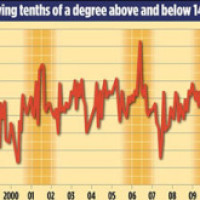
According to the National Climatic Data Centre, Earth’s hottest recorded year was 1998.

If you put the same question to NASA, scientists will say it was 1934, followed by 1998. The next three runner-ups are 1921, 2006 and 1931.

Which all blows a rather large hole in the argument that the earth is hurtling towards an inescapable heat death prompted by man’s abuse of the environment. 

Indeed, some experts believe we should forget global warming and turn our attention to an entirely differently phenomenon – global cooling.

The evidence for both remains inconclusive, which is unlikely to help the legions of world leaders meeting in Copenhagen in December to negotiate a new climate change deal.

Read the rest of this story at Daily Mail.

GCS Editor’s Note: I met Lord Christopher Monckton yesterday, and he mentioned that he’d prodded BBC reporters about when they were going to report on new data that conlusively shows the Earth has been cooling.  At that point, the only UK reporting he was aware of was on the BBC website. It seems that word is starting to spread.

Minnesota Majority / GlobalClimateScam.com will be at the Climate Chains / Lord Monckton event at Bethel tonight. Hope to see you all there!

Comments 15 Comments »

Bad Behavior has blocked 2771 access attempts in the last 7 days.