It’s been a rough five months for the credibility of many of the “leading†climate scientists.
First, the ClimateGate e-mails appeared to show unethical or illegal behavior of high profile scientists and a potential conspiracy to distort science for political gain. These weren’t just a few renegade scientists; in the following months, damning information came to light about the world’s leading climate alarmists and their work with the Intergovernmental Panel on Climate Change (IPCC), the Stern Report, the U.S. National Climate Data Center and even NASA.
Â
Even with the 40th anniversary of Earth Day coming up on April 22, Americans are skeptical about the threat of climate change. A March 2010 Gallup poll found that 48 percent of Americans think the threat of global warming is “generally exaggerated.†That’s the highest in 13 years, according to Gallup.
Â
The public’s receding fear of climate change may be related to the series of scandals and admissions that have been uncovered since Nov. 20 when e-mails from University of East Anglia’s Climatic Research Unit (CRU) were leaked. Those e-mails provided “ammunition†to climate skeptics about the authenticity and ethics surrounding the CRU’s work on global warming science.
Â
The networks news media were unshaken by the apparent bad behavior on the part of the very climate scientists and organizations whose claims they had pushed for years. Less than 10 percent of stories mentioning global warming or climate change since Nov. 20, 2009, referenced any of the climate science scandals.
Â
The first scandal of many – ClimateGate – involved thousands of stolen e-mails showing the potential manipulation of temperature data, a willingness to destroy information rather than release it under British Freedom of Information (FOI) law and the intimidation of publications willing to publish skeptical articles.
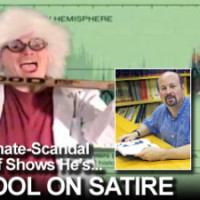
This video documents Chicken Little’s journey to Washington DC to see the king. Unlike the traditional children’s story, Chicken Little decided to make his trip once he discovered that the sky wasn’t falling after all and that claims of man-made global warming were untrue. Chicken Little went to Washington to stand-up for his friends at Minnesotans for Global Warming (M4GW), including Elmer-Welmer, Ducky Lucky, Henny Penny and other American patriots. His friends had recently come under attack by “warmers” like Michael Mann.
Professor David Hand said that the research – led by US scientist Michael Mann – would have shown less dramatic results if more reliable techniques had been used to analyse the data.
Prof Hand was among a group of experts charged with investigating the “climategate” email scandal that engulfed the University of East Anglia’s Climatic Research Unit (CRU) last year.
Sceptics claimed that the hacked messages showed scientists were manipulating data to support a theory of man-made global warming.
However the review, led by Lord Oxburgh into the research carried out by the centre, found no evidence of ”deliberate scientific malpractice”.
Lord Oxburgh said the scientists at the research unit arrived at their conclusions ”honestly and sensibly”.
But the reviewers found that the scientists could have used better statistical methods in analysing some of their data, although it was unlikely to have made much difference to their results.
That was not the case with some previous climate change reports, where “inappropriate methods” had exaggerated the global warming phenomenon.
Prof Hand singled out a 1998 paper by Prof Mann of Pennsylvania State University, a constant target for climate change sceptics, as an example of this.
Climate scientists play a good game of whack-a-mole.Right from the early days of the global warming controversy, they whacked any scientist who dissented from the view that CO2 was warming the planet in a dangerous way. Up popped other skeptical scientists, and WHACK!! Down they went.
Up popped skeptical journalists and WHACK! Down they went, too. Then more whacks for new scientists who surfaced, or pesky scientists who resurfaced.
Today, decades later, the climate science establishment is still whacking away, faster and more frenetically than ever, as more and more skeptical scientists, journalists and politicians surface. And now there’s a new species of skeptic in need of whacking down Â- the many inquiries that have sprung up in the wake of Climategate, the unauthorized release of some 3,000 documents from the computers of the Climatic Research Unit (CRU) at East Anglia University showing that data had been manipulated and destroyed.
East Anglia University was the first to establish an inquiry into its conduct. Then it started a second inquiry to complement the first. The Met Office, the UK government’s meteorological department, announced its inquiry to redo the data that CRU had destroyed, a process that would take it three years. The UK’s Information Commissioner’s Office began an inquiry, to ascertain whether the country’s Freedom of Information Law had been broken. The local police force, working with Scotland Yard, also began an inquiry.
All these would and will need to be whacked, and more would, too. The IPCC itself announced an inquiry. Across the Atlantic, Penn State University, home to Michael Mann, one of America’s most important doomsayers, launched an investigation.
When a Penn State board of inquiry unilaterally decided that Michael Mann had broken no rules in the climate-data scandal, global-warming alarmists breathed a sigh of relief, thinking the most damaging episode in their effort to save the planet was behind them. They were wrong.
The geology professor’s 1998 climate study, which showed a sharp increase in the world’s temperatures in the past century, Â was seen by many as proof that climate change was rapidly occurring and that humans played a significant role in the change. Despite ongoing criticism, the study formed the backbone of global warming theories — until leaked e-mails cast fresh doubt on Mann’s methodology and integrity, notably “the trick” he used to make his data so compelling.
It was those e-mails, stolen from British university East Anglia’s climate study group, that sparked Penn State’s probe into Mann’s work. On Feb. 3, he was exonerated on three of four charges, and the investigation of the fourth charge will be concluded by June 3.Â
But the final say will be in the hands of a skeptical inspector general at the National Science Foundation, the primary funder of the research into global warming. According to published documents obtained by FoxNews.com, the IG must determine whether Penn State’s investigation was adequate.
We need a more authoritative world. We’ve become a sort of cheeky, egalitarian world where everyone can have their say. It’s all very well, but there are certain circumstances – a war is a typical example – where you can’t do that. You’ve got to have a few people with authority who you trust who are running it. And they should be very accountable too, of course.
But it can’t happen in a modern democracy. This is one of the problems. What’s the alternative to democracy? There isn’t one. But even the best democracies agree that when a major war approaches, democracy must be put on hold for the time being. I have a feeling that climate change may be an issue as severe as a war. It may be necessary to put democracy on hold for a while.
By Leo Hickman
When I recently interviewed James Lovelock for the G2 section of the Guardian, we spoke for nearly two hours about the various events of the past few months – a period in which he’d remained silent because he’d been over-wintering with his wife Sandy in her native Missouri. There was a lot to talk about: the stolen emails from the University of East Anglia, the UN climate summit in Copenhagen, the intense scrutiny placed on the IPCC, and the rather nippy winter experienced across much of the Northern Hemisphere. As is inevitable with an interview appearing in the newspaper, space was at a premium so the quotes used were tightly edited. But, just as I did with my interview with Al Gore last year, I have decided to publish a transcript of his key points here online for anyone interested in hearing in much more detail what Lovelock had to say on some of these controversial and much-discussed topics.Â
Lovelock’s reaction to first reading about the stolen CRU emails [he later clarified that he hadn't read the originals, saying: "Oddly, I felt reluctant to pry"]:Â
I was utterly disgusted. My second thought was that it was inevitable. It was bound to happen. Science, not so very long ago, pre-1960s, was largely vocational. Back when I was young, I didn’t want to do anything else other than be a scientist. They’re not like that nowadays. They don’t give a damn. They go to these massive, mass-produced universities and churn them out. They say: “Science is a good career. You can get a job for life doing government work.” That’s no way to do science.
I have seen this happen before, of course. We should have been warned by the CFC/ozone affair because the corruption of science in that was so bad that something like 80% of the measurements being made during that time were either faked, or incompetently done.
Fudging the data in any way whatsoever is quite literally a sin against the holy ghost of science. I’m not religious, but I put it that way because I feel so strongly. It’s the one thing you do not ever do. You’ve got to have standards.
You can make mistakes; they’re helpful. In the old days, it was perfectly OK to make a mistake and say so. You often learned from it. Nowadays if you’re dependent on a grant – and 99% of them are – you can’t make mistakes as you won’t get another one if you do. It’s an awful moral climate and it was all set up for the best of reasons. I think it was felt there was far too much inequality in science and there was an enormous redress. Looking around the country [at the wider society] this was good on the whole, but in some special professions you want the best, the elite. Elitism is important in science. It is vital.
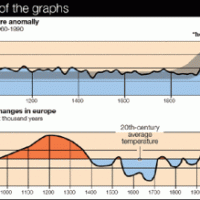
On February 3, 2010, the Pennsylvania State University (PSU) released a report on its internal inquiry of Professor Michael Mann, clearing him of any wrongdoing for his involvement in the “climategate” scandal. Â Mann’s work, including the infamous “hockey stick graph,” concluded: “the 1990s was the hottest decade of the millennium.” Mann’s study has been debunked by the academic community, but has played a key role in aiding the “global warming” propaganda used in the attempt to pass legislation to end such warming effects. Â PSU Young Americans for Freedom (YAF) has launched an online petition urging Penn State to preserve academic integrity and order an independent investigation of Mann and his role in climategate.
PSU YAF Chairman Samuel Settle said, “The university’s supposed independent inquiry report by Professor Mann’s colleagues clearly states they never wanted to do an inquiry and sounds more like a letter of recommendation for their friend Mann than a legitimate investigation of academic integrity. This report does not address the student and community concerns regarding the possible suppression of data by a faculty member. Â This report by Penn State is a whitewash, nothing more.” Â Settle added, “Many students go to college expecting to ‘stick it to the man,’ however, Penn State Young Americans for Freedom (YAF) is now ‘standing up to the Mann’ and his university lackeys calling for a fair, independent investigation of Mann and his involvement in the ‘Climategate’ scandal.”
Jordan Marks, YAF Executive Director, said, “Students are held to a high level of academic integrity on a daily basis and when the academic code of honesty is broken universities go to great lengths to investigate and administer justice.” Â Marks continued, “The cover up of Professor Mann’s suppression of climate data because he is one of the faculty’s own is a disgrace to the academic community and an insult to the students who buy into the system of integrity and honesty. The fact that Mann falsified data to promote his personal agenda should be cause for him to stripped of his PhD and removed from his position as a Professor.”
To sign the PSU YAF online petition urging Penn State preserve academic integrity and order an independent investigation of Professor Mann, please go to http://yaf.com/petition/.
YAF is the nation’s oldest and most recognized conservative/libertarian youth activist organization. Founded on September 11, 1960 in Sharon, Connecticut at the home of William F. Buckley, Jr., YAF is a non-profit organization engaged in advocating public policies and activism consistent with The Sharon Statement. For more information call YAF’s national headquarters at 202-596-7923 or our visit our website at www.yaf.com.
In an unprecedented move Wednesday, the Norwegian Nobel Committee rescinded the Peace Prize it awarded in 2007 to former US vice president Al Gore and the United Nations Intergovernmental Panel on Climate Change, amid overwhelming evidence that global warming is an elaborate hoax cooked up by Mr. Gore.
A press release from the committee quotes a chagrined Rajendra Pachauri, the UN climate panel’s chair, who claims that he was the victim of a “cunning deception spanning decades”:
“I am deeply ashamed for having unwittingly perpetuated such a massive fraud on the governments of the world,” said Mr. Pachauri.
“It turns out that all that data from satellites and radiosondes, surface temperature readings, borehole analysis, measurements of rising sea levels, melting glaciers and permafrost, phenological data, and proxy reconstructions of paleoclimatic conditions were all fabricated out of thin air by my former friend, Al Gore. Now that I think about it, I suppose that we should have instituted some sort of peer-review process before publishing such alarming conclusions. Once again, I’m very sorry.”
After revoking the 2007 prize from Gore and the IPCC, the Nobel committee retroactively awarded it to the more than 31,000 people who signed the Oregon Petition – an appeal challenging the notion that there exists a scientific consensus regarding global warming – “for their efforts to pursue pure, objective science that is free from the influence of any special interest group.”
It’s been a heady few months for climate sceptics – or “deniers” as the opposition loves to call us. Starting with “climategate”, through a progression of “gates” with much else in between – including the apparent collapse at Copenhagen – it seemed as if we had the warmists on the run.Certainly, we’ve scored some hits and, aided and abetted by Mother Nature who has been generous in her deliveries of global warming this winter, we have seen a turnaround in public opinion, with a distinct loss of enthusiasm for the surfeit of alarmism on offer.
The successes have led to a certain amount of triumphalism amongst the sceptics, with a feeling in certain quarters that we are winning the game. But any such sentiment is, to say the very least, premature. In fact, a more realistic appraisal might suggest that we have not even dented the underlying agenda.
Herein lies a certain definitional problem, as we have certainly dented the confidence of many so-called climate “scientists”, worried some of the hangers-on and made serious inroads into the intellectual argument, challenging the science.
But as to the “agenda”, this has nothing to do with science or even climate change. The climate change scare is merely a front used to conceal on the one hand and, on the other, to legitimise a far more sinister movement which has at its root politics, power and money. And its agenda might have suffered a few setbacks and some delays, but it is essentially intact.
NASA can put a man on the moon, but the space agency can’t tell you what the temperature was back then.
By Blake Snow
NASA was able to put a man on the moon, but the space agency can’t tell you what the temperature was when it did. By its own admission, NASA’s temperature records are in even worse shape than the besmirched Climate-gate data.
E-mail messages obtained by a Freedom of Information Act request reveal that NASA concluded that its own climate findings were inferior to those maintained by both the University of East Anglia’s Climatic Research Unit (CRU) — the scandalized source of the leaked Climate-gate e-mails — and the National Oceanic and Atmospheric Administration’s National Climatic Data Center.
The e-mails from 2007 reveal that when a USA Today reporter asked if NASA’s data “was more accurate” than other climate-change data sets, NASA’s Dr. Reto A. Ruedy replied with an unequivocal no. He said “the National Climatic Data Center’s procedure of only using the best stations is more accurate,” admitting that some of his own procedures led to less accurate readings.
It is becoming difficult to keep pace with the speed at which the global warming scam is now unravelling. The latest reversal of scientific “consensus†is on livestock and the meat trade as a major cause of global warming – one-fifth of all greenhouse gas emissions, according to eco-vegetarian cranks. Now a scientific report delivered to the American Chemical Society says it is nonsense. The Washington Times has called it “Cowgateâ€.
The cow-burp hysteria reached a crescendo in 2006 when a United Nations report ominously entitled “Livestock’s Long Shadow†claimed: “The livestock sector is a major player, responsible for 18 per cent of greenhouse gas emissions measured in CO2e (carbon dioxide equivalents). This is a higher share than transport.†This led to demands in America for a “cow tax†and a campaign in Europe at the time of the Copenhagen car crash last December called Less Meat=Less Heat.
Now a report to the American Chemical Society by Frank Mitloehner, an air quality expert at the University of California at Davis, has denounced such scare-mongering as “scientifically inaccurateâ€. He reveals that the UN report lumped together digestive emissions from livestock, gases produced by growing animal feed and meat and milk processing, to get the highest possible result, whereas the traffic comparison only covered fossil fuel emissions from cars. The true ratio, he concludes, is just 3 per cent of greenhouse gas emissions in America are attributable to rearing of cattle and pigs, compared with 26 per cent from transport.
Mitloehner also makes the deadly serious point: “Producing less meat and milk will only mean more hunger in poor countries.†Precisely. The demonising of cows and pigs is just another example of global warmists’ callous indifference to starvation in the developing world, as in the case of the unbelievably immoral and reckless drive for biofuels – pouring Third World resources for subsistence into Western liberals’ fuel tanks – and, notoriously, carbon trading.
Week by week the AGW collapse intensifies. Himalayan glaciers, polar bears, Arctic ice, Amazon rainforests, all discredited. Now it turns out the great cow-burp scare is bovine excrement too. The global warming scam is, to the majority of people, an object of derision. The scientific community has also at last wakened up. They are smelling the coffee in more and more institutions these days.
A new study suggests that the IPCC is losing 10% of it’s credibility mass every month, and could have completely disappeared by Christmas.”It’s shrinking faster that we thought” said Anthony Watts the renowned skeptical blogger, who led a small team of dedicated bloggers, analysing over 10,000 news articles and blogs on the Internet. “Not one of them contained the phrase ‘The IPCC is innocent’”, explained Mr. Watts, “Not even their unofficial web-site RealClimate.org”
Intrepid Spoof reporters sought comments worldwide. Dr. Rajendra K. Pachauri, the eminent Himalayan glacier expert, was interviewed as he emerged from his hairdresser’s salon in downtown Delhi. “It’s a travesty!” he exclaimed, “I have newspaper cuttings and a 1988 photograph to prove it”.
Dr. Pachauri posed for photographs before he continued. “There was just one small error” he explained. “They wrote their reports in English. If they’d used Sanskrit, none of this would have happened”.
Dr. Pachauri spoke briefly to other reporters before posing for more photographs, and was then whisked off in his motorcade to a special meeting of the Railway Engineers Society of India, where he’s to be given a lifetime service award.
AGW skeptic Viscount Monckton of Brenchley commented “It doesn’t surprise me – if you’re striving for a New World Order you can expect a few minor scandals, though they’ve had a lot of major goofs. There’s probably a world lecture tour in this for me – privately, I’m laughing my socks off”.
This reporter sought out climate expert Dr. James Hansen in his office, surrounded by computer screens, charts and bottles of Tipp-ex and Liquid Paper.
“You shouldn’t believe these people” he fumed, waving his arms about. “They don’t use any peer-reviewed sources”.
When asked what he was currently working on, Dr. Hansen outlined his past work on eliminating the Inconvenient Warm Period -
“What did the Vikings know? They couldn’t even write, let alone submit an article to a mainstream journal. I’ve just proved that the last decade was the warmest since NOAA’s flood, and that the Arctic saw record temperatures, using interpolated gridded data based on minimal evidence. I’m currently working on LIAR – that’s Little Ice Age Redaction, and I’ll show you my work in progress” he said, knocking over a bottle of correcting fluid as he reached for a large chart.
Dr. Hansen is currently slated to be nominated for an Albert award this year, the supreme accolade for climate scientists and statisticians. This is awarded by the Gore-Bull Warming Institute, on the first day in the year that the temperature exceeds 85 Fahrenheit, as measured by the sensor located next to the engine-testing area at Dulles International airport. Because of this, nominees have to be prepared to travel at very short notice.
Head of the UK Met Office, John Hirst, said “This is nonsense, though we could have forecast a lesser effect if we’d not abandoned our long-range forecasts last month because of lack of interest”. He continued “We believe in openness and accountability, which is why we’re making available all our temperature data, along with the Sinclair ZX80 Basic program we use to adjust the data whenever we feel like it”.
The Royal Society (Motto: Nullius in VerbaUnless It’s About Global Warming In Which Case We’re Happy To Believe Whatever Unsubstantiated Drivel We’re Fed By Michael Mann, Phil Jones, et al) has announced who’ll be chairing its “independent†inquiry into the science behind the Climategate scandal.
And guess what? The man could scarcely be more parti pris if they’d given the job to Al Gore.
The Science Museum is revising the contents of its new climate science gallery to reflect the wave of scepticism that has engulfed the issue in recent months.
The decision by the 100-year-old London museum reveals how deeply scientific institutions have been shaken by the public’s reaction to revelations of malpractice by climate scientists.
The museum is abandoning its previous practice of trying to persuade visitors of the dangers of global warming. It is instead adopting a neutral position, acknowledging that there are legitimate doubts about the impact of man-made emissions on the climate.
Even the title of the £4 million gallery has been changed to reflect the museum’s more circumspect approach. The museum had intended to call it the Climate Change Gallery, but has decided to change this to Climate Science Gallery to avoid being accused of presuming that emissions would change the temperature.
Last October the museum launched a temporary exhibition called “Prove It! All the evidence you need to believe in climate changeâ€. The museum said at the time that the exhibition had been designed to demonstrate “through scientific evidence that climate change is real and requires an urgent solutionâ€.
Chris Rapley, the museum’s director, told The Times that it was taking a different approach after observing how the climate debate had been affected by leaked e-mails and overstatements of the dangers of global warming. He said: “We have come to realise, given the way this subject has become so polarised over the past three to four months, that we need to be respectful and welcoming of all views on it.â€
In climate-change discussions, two Princeton professors go against the grain
By Mark F. Bernstein
The issue of climate change, or global warming, has become a rallying cry: The Earth’s surface temperatures are Ârising due to increased levels of carbon dioxide and other Âgreenhouse gases in the atmosphere, much of it produced by human activity. Unless action is taken, and soon, global warming could cause crops to fail and sea levels to rise, leading to Âwidespread social disruptions and endangering many species of life on the planet. President Obama, who has renewed the American commitment to combating this problem, declared at the recent United Nations Âclimate-change conference in Copenhagen: “Climate change threatens us all.â€
That’s one thing scientists agree on, right? Well, not everyone.
In some quarters, climate change has become almost a civic religion. Like any religion it has its priests — Al  Gore, perhaps — and its holy books — think Gore’s An Inconvenient Truth or his more provocatively titled best-seller, Earth in the Balance. It also has its heretics — doubters — and not all of them are outside the scientific community. Even among scientists, there are a few who dispute the certainty that global warming is a looming catastrophe. Two of the most vocal dissenters are professors in the Princeton physics department: William Happer *64 and Robert Austin. Â
One person’s skeptic is another person’s crackpot, of course, and so climate dissenters have come in for much public abuse. Happer, the Cyrus Fogg Bracket Professor of Physics, got into a contretemps with Sen. Barbara Boxer, a California Democrat, while testifying last year before the Senate Environment and Public Works Committee. Boxer derided Happer’s testimony as “the most extraordinary argument I have ever heard†and warned, “I will fight you.†The exchange, which ended up on YouTube, was seized upon by bloggers on both sides of the debate, many of whom added their own, decidedly ad hominem, comments.
Temperatures indeed have risen, so to speak — at least in the world of physics. Happer says he’s been attacked verbally over the issue both inside and outside academia, including at Princeton. He claims that climate-change orthodoxy has had a chilling effect that has made some junior faculty around the country reluctant to voice support for his position out of fear of hurting their chances for tenure. Austin, however, says that in his experience, the Princeton physics department “has been great†and very tolerant of climate skeptics.
In an interview last year with The Daily Princetonian, Happer characterized hostility toward climate skeptics in harsh terms. “This is George Orwell,†he said. “This is ‘the Germans are the master race. The Jews are the scum of the earth.’ It’s that kind of propaganda.†In an e-mail following an interview for this article, he warns against “the capture of U.S. society†by a “scientific-technological elite.â€
Although Happer credits some of his willingness to brave personal and professional criticism as an expression of his Huguenot ancestry, he adds that he has spent much of his career studying the interaction of visible and infrared radiation with gases, one of the driving forces of the greenhouse effect, which posits that CO2 in the atmosphere absorbs and redirects infrared radiation, causing temperatures to rise. Happer joined the Princeton faculty in 1980, leaving in 1991 to become director of energy research at the U.S. DepartÂment of Energy, where one of his responsibilities was to supervise the department’s work on climate change. In 1993, however, shortly after President Clinton took office, Happer testified at a House hearing that he believed that “there has been some exaggeration†concerning the dangers of ozone and climate change, an act of apostasy that he says led to his being replaced.
Since returning to the faculty, Happer has gained distinction for his work in other fields. He helped patent an invention that provides high-resolution images of the human lung. From 1995 to 2005, he led the University Research Board, which advises the University president on all research conducted at Princeton. He currently runs a lab in atomic physics and is chairman of the board of directors of the George C. Marshall Institute, an Arlington, Va.-based think tank founded by Frederick Seitz *34, himself a climate-change dissenter before his death in 2008.
Austin, a biophysicist, says that he had always “bought the party line†on climate change until he began talking to Happer. “I’ve always known Will Happer as a guy who usually has creative and insightful things to say that are not part of the mainstream,†Austin explains. Happer explained his disagreements with the climate-change consensus and brought Austin around to his position. Austin has since visited the Greenland glaciers with physicist Freeman Dyson of the Institute for Advanced Study — another Âclimate-change skeptic — and says that while some glaciers may be shrinking at the edges, evidence suggests that they may be getting thicker in the middle. Â
Much of the climate-change debate centers on a 2007 statement adopted by the American Physics Society (APS), a leading professional association of physicists: “The evidence is incontrovertible: Global warming is occurring. If no mitigating actions are taken, significant disruptions in the Earth’s physical and ecological systems, social systems, security, and human health are likely to occur. We must reduce emissions of greenhouse gases, beginning now.â€
Austin, Happer, and a handful of other scientists urged the APS to rescind this statement in favor of one stating, “While substantial concern has been expressed that emissions may cause significant climate change, measured or reconstructed temperature records indicate that 20th- and 21st-century climate changes are neither exceptional nor persistent, and the historical and geological records show many periods warmer than today.†It goes on to say that other forces, such as ocean cycles and solar variability, also might account for rising temperatures. “Current climate models,†it concludes, “appear insufficiently reliable to properly account for natural and anthropogenic contributions to past climate change, much less project future climate.†More than 160 past and present members of the APS signed their petition, including two other Princeton faculty members: Salvatore Torquato, a professor of chemistry, and Syzmon Suckewer, a professor of mechanical and aerospace engineering.